Last updated: August 18, 2026
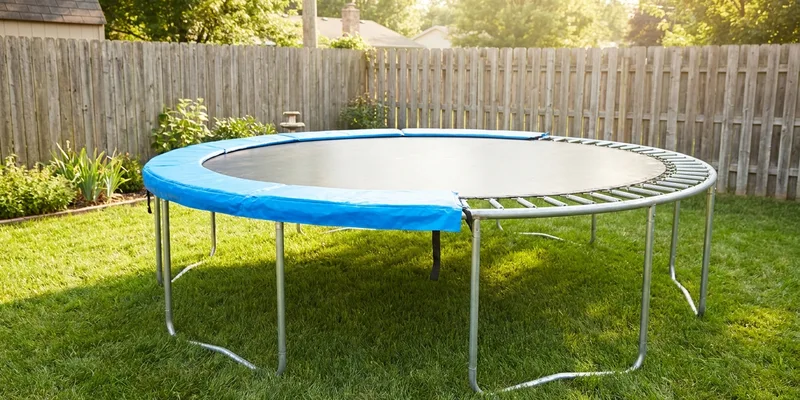
A trampoline safety pad replacement is the repair most owners put off longest and the one safety guidance is clearest about. The CPSC trampoline safety alert tells owners not to use a trampoline without shock absorbing pads that completely cover its springs, hooks and frame, so a pad that has cracked, shrunk or slipped is not a cosmetic problem.
This guide covers the two measurements that decide fit, what separates a pad that survives a few summers from one that flakes apart in a single season, and how to fit and maintain a new one.
This article contains affiliate links. If you buy through them, we may earn a commission at no extra cost to you. Learn more.
Quick Answer
How do you choose a replacement trampoline safety pad?
- Two numbers decide the fit: the frame diameter measured across the outside of the steel, and the pad width, which has to cover the springs from the frame to the edge of the mat.
- Measure the frame rather than trusting the size on the box. Suppliers commonly advise matching to the nearest listed foot size when the frame reads slightly over or under.
- Shape matters as much as size. Round, oval, square and rectangular frames all take different pads, and rectangular pads are sold by two dimensions.
- Look for UV treated PVC or PE covering, closed cell foam rather than open sponge, and enough tie points to stop the pad creeping.
- Fit the pad before anyone jumps. CPSC trampoline safety guidance says not to use a trampoline without pads that completely cover the springs, hooks and frame.
What the Frame Pad Is There For
The frame pad covers the hardest parts of the trampoline: the steel rim, the hooks and the ring of springs between them. It is the one component whose whole purpose is the moment a jumper lands short of the mat, which is why guidance treats a missing pad as a reason not to use the trampoline at all.
That also explains why pads wear out faster than anything else on the trampoline. They sit in full sun all day, they take the direct hit of every mistimed landing, and they are the part that holds water when it rains. A pad reaching the end of its life is usually still recognisable as a pad, which is exactly why it gets left in place too long.
Measuring for a Replacement Pad
Two measurements decide whether the pad you order will fit, and both take a couple of minutes with a tape measure. Take them from the trampoline itself rather than from a manual or a box, because frames are often a few inches off the round number they were sold under.
| What to measure | Why it matters | How to check it |
|---|---|---|
| Frame diameter | The headline size every pad is sold by | Measure across the outside of the steel frame, straight through the center, and take a second reading at right angles |
| Pad width | Decides whether the springs are fully covered or left exposed at one end | Measure your old pad from its inner edge to its outer edge, or measure from the frame to the edge of the mat |
| Frame shape | Round, oval, square and rectangular pads are not interchangeable | Rectangular and square frames are sold by two dimensions, not by a diameter |
| Spring length | Cross checks the pad width, since the pad has to span the spring gap | Unhook one spring and measure it relaxed, hook to hook |
| Tie points | Too few and the pad creeps out of position within a week | Count the straps or elastics on your old pad, and compare with the listing |
If the springs themselves are stretched or rusting, do both jobs in one afternoon while the pad is off. Our guide to trampoline springs replacement covers measuring and fitting them.
What Separates a Pad That Lasts
Pads fail in two ways. The outer cover splits and lets water in, or the foam inside compresses and stops absorbing anything. UV treated PVC or PE covering resists the first, and closed cell foam rather than an open sponge filling resists the second, since open foam soaks up rain and stays wet for days.
Thickness is worth reading on the listing, though it is not the whole story: a thick pad of soft open foam bottoms out faster than a thinner closed cell one. What you can check from the listing is the covering material, the foam type, whether the seams are welded or stitched, and how the pad attaches.
Attachment Is Half the Job
A pad that slides is a pad that leaves springs bare exactly where somebody is about to land. Elastic loops with hooks are the common design and they work, but they perish in sun sooner than the pad does. Sets that include separate underside straps running to the frame hold position noticeably better through a windy season.
Our Top Picks at a Glance
How we chose: we compared widely available replacement pads on whether the listing states frame diameter, pad width, foam type and covering material, on the number of tie points supplied, and on the fading, splitting and slipping complaints that recur in owner reviews. Selections lean on manufacturer specifications and review patterns rather than any hands-on trial of our own.
🏆 Best Overall
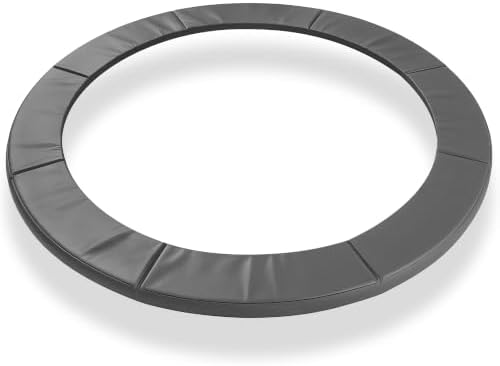
A UV treated round pad in the 14 foot size, the most common family frame diameter, with straps rather than elastics alone holding it to the frame.
📏 Best for Smaller Frames
A 12 foot round pad, the second most common size and the one where a slightly too wide pad starts to overhang the mat and catch feet.

▭ Best for Rectangular Frames
A rectangular spring cover sold by two dimensions, since a round pad cannot be made to follow the corners of a rectangular frame.

Picks by Situation: Fixings and Protection
Two smaller purchases decide whether the new pad stays where you put it. Both are worth ordering at the same time, because the old fixings have had the same years of sun as the pad you are throwing away.
🪝 Best Fixing Set
Replacement pad straps, hooks and bungee ties, so the new pad is held by fresh elastic rather than by whatever survived on the old one.

☂️ Best Weather Protection
A weather cover sized to the same frame, which keeps standing water and winter sun off the pad and is the cheapest way to make it last.

Fitting and Maintaining the New Pad
Fit the pad on a warm day and lay it out in the sun first, since a pad that has been rolled in a box holds its curl and fights you at every tie point. Position the whole ring loosely before tightening anything, then work around the frame taking up slack in a second pass, the same way you would tension a net.
After that, the maintenance is simple. Brush leaves and standing water off rather than letting them sit, check the ties at the start of each season, and cover or remove the pad when the trampoline sits unused for weeks. Our guide to the trampoline cover covers what covering does and does not protect.
Common Mistakes to Avoid
- Ordering by the size on the box. Frames often measure a little over or under their nominal size, and pad width varies between brands at the same diameter.
- Forgetting the width. A pad that is too narrow leaves springs exposed at the mat edge, which is the part guidance specifically says should be covered.
- Buying a round pad for a rectangular frame. It will not follow the corners, and no amount of tension will make it.
- Reusing perished elastics. Old ties give way in the first windy week and the pad ends up folded back over the springs.
- Leaving a split pad in place for one more season. Once water gets into the foam it compresses permanently, and a soaked pad absorbs very little.
- Jumping with the pad off during the repair. CPSC trampoline safety guidance says not to use a trampoline without pads that completely cover the springs, hooks and frame.
Frequently Asked Questions
How do I know what size trampoline safety pad to buy? Measure across the outside of the steel frame through the center for the diameter, and measure your existing pad from its inner to its outer edge for the width. Suppliers commonly advise matching to the nearest listed foot size when the frame reads slightly over or under a round number.
Are trampoline safety pads universal? Only within a shape and size. Many pads are listed as universal across several diameters, but a round pad will not fit a rectangular or square frame, and pad width still has to cover the spring gap on your particular trampoline.
Can you use a trampoline without the safety pad? The CPSC trampoline safety alert advises against it, stating that a trampoline should not be used without shock absorbing pads that completely cover the springs, hooks and frame. Treat a missing or badly split pad as a reason to keep everyone off until it is replaced.
How often should a trampoline safety pad be replaced? When the covering has split, the foam has gone hard or soggy, or the pad no longer sits over the full spring gap. There is no fixed interval, since sun exposure and whether the trampoline is covered in winter make most of the difference.
What are trampoline safety pads made of? Typically a closed cell foam core inside a UV treated PVC or PE cover. Closed cell foam matters because open sponge absorbs rain, stays wet and loses its cushioning much faster.
Why does my trampoline pad keep sliding? Usually too few working tie points. Elastics perish in sun before the pad does, and pads held only by loops at the top move under load. Sets with underside straps that run to the frame hold position better.
Does a safety pad replace the need for an enclosure net? No, they do different jobs. The pad covers the springs, hooks and frame, while the net is there to keep jumpers from going over the edge. Both are separate items on the standard safety checklist.
The Bottom Line
Measure the frame across the outside of the steel and measure the width of the pad you are replacing, then match the shape as well as the size. Look for UV treated covering, closed cell foam and enough tie points to hold position, and order fresh straps at the same time. A pad that fully covers the springs, hooks and frame is what safety guidance asks for, so it is not a job to leave until next spring.