Last updated: August 18, 2026
An outdoor toddler swing is the seat that supports a small child on all four sides, and it is the one piece of play equipment that gets used almost every day for two or three years and then never again. That short window is worth keeping in mind, because it changes what is worth paying attention to and what is not.
What matters is the seat type, the harness, and where it hangs. This guide covers each of those, quotes what the CPSC Public Playground Safety Handbook says about full bucket seats, and explains why the seat you choose depends on whether you have a beam, a tree limb or neither.
This article contains affiliate links. If you buy through them, we may earn a commission at no extra cost to you. Learn more.
Quick Answer
Which outdoor toddler swing should you buy?
- For the youngest riders, a full bucket seat is the type the CPSC Public Playground Safety Handbook points to; the handbook describes full bucket seats as recommended for children under 4 years of age.
- Take the minimum age and weight from the seat’s own manual. Manufacturers state their own figures and they differ, so the number on your product is the one that counts.
- Decide where it hangs before you choose the seat. A beam, a tree limb and a standalone toddler frame all need different hanging hardware.
- The handbook recommends that full bucket seats hang from a separate structure, or at least a separate bay, rather than sharing a beam with belt swings.
- A toddler swing is a supervised activity, not a place to leave a child. Plan for an adult standing there the whole time.
What to Check Before You Buy a Toddler Swing
Almost everything worth knowing can be read off the listing or measured at the spot where the swing will hang. The rows below are the ones that decide whether a seat fits your situation, in the order they usually matter.
| What to check | Why it matters | What to look for |
|---|---|---|
| Seat type | Full bucket, half bucket and high back seats suit very different stages | A full bucket seat for the youngest riders, per the CPSC handbook, and a half bucket only once a child sits confidently |
| Harness or T bar | It is what stops a child sliding forward as they lean | A buckled harness or a fixed front bar, with a fastening a toddler cannot release |
| Stated age and weight range | Manufacturer figures vary and they, not the internet, define the fit | A clearly printed range in the manual or listing, matched to your child today |
| Hanging hardware | Beam, tree limb and portable frame each need different attachments | Chains with hangers for a beam, rated straps for a limb, or a seat matched to a frame |
| Chain covering | Bare chain near a small child’s hands is the common minor injury | Plastic coated chain or rope, with no exposed link where hands rest |
If you do not yet have anywhere to hang a seat, buying the seat first is the wrong order. Where it hangs determines what you can use, and that choice is covered further down.
Seat Types and What the Handbook Says
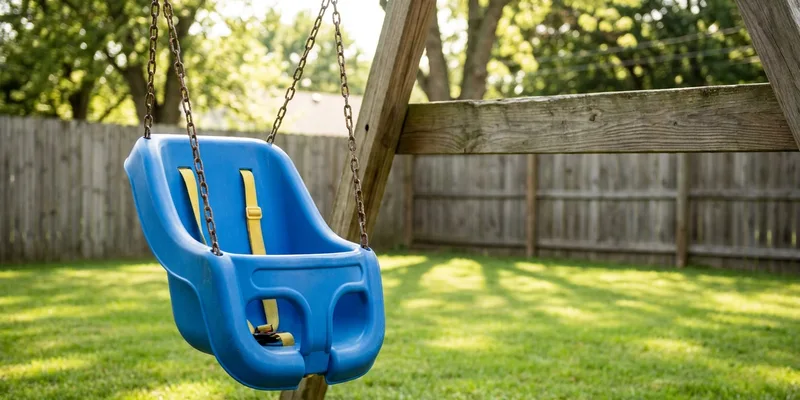
Full bucket seats enclose a child on all four sides with leg holes and a high back. The CPSC Public Playground Safety Handbook describes these as recommended for children under 4 years of age, and treats them separately from belt seats throughout its swing guidance, including how their use zone is measured.
Half bucket seats have a lower back and a front bar rather than full enclosure. High back seats with a removable T bar sit between the two and are marketed as growing with the child. All three are widely sold for backyard use, and all three depend on the harness or bar being fastened every time.
How the handbook separates toddler swings from the rest
Two points from the handbook are worth knowing before you plan a bay. It recommends that full bucket seats be suspended from a structure separate from other swings, or at the very least in a separate bay, because their users are not the ones watching for a belt seat coming the other way. It also sets the pivot point for these swings at more than 47 inches but no more than 96 inches above the protective surfacing. Both points are written for public playgrounds, and residential frames fall under the separate voluntary standard ASTM F1148, but the reasoning applies in any yard.

Where It Hangs: Beam, Tree or Frame
The mounting point is the real decision, and it comes before the seat. An existing swing beam is the simplest case, provided there is a free position at the end. A tree limb is the most common alternative and the one with the most ways to go wrong. A standalone toddler frame suits families with neither.
On a beam, the seat hangs from rated hangers with through bolts, and it should get the end position rather than a middle bay. On a tree, the limb has to be sound, roughly horizontal and thick enough, which is a judgment for an arborist rather than a product listing, and the straps should be a purpose made hanging kit rather than rope over bark.
Standalone toddler frames
A small dedicated frame with one or two bucket seats is the honest answer for a family with no beam and no suitable tree. It is outgrown quickly, but it puts the pivot at a sensible height for a toddler instead of hanging a small child from a beam sized for older children. Our guide to playsets for toddlers covers what else is worth having at that age.
Our Top Picks at a Glance
How we chose: we compared widely available toddler swing seats on seat type, how the harness or front bar fastens, whether hanging hardware is included, and how clearly the manufacturer states an age and weight range. Selections rely on manufacturer specifications and recurring themes in customer reviews rather than any hands-on trial of our own.
🏆 Best Overall
A molded full bucket seat with coated chains and a fastening a toddler cannot open, which is the configuration the handbook’s guidance points toward for the youngest riders.

🌳 Best for a Tree Limb
A bucket seat sold with rated hanging straps rather than bare chain, so the whole assembly goes over a sound limb as one kit.

📈 Best for Growing Into
A high back seat with a removable T bar, which stays useful a season or two longer than a full bucket once a child sits confidently on their own.

Picks by Situation: No Beam and No Tree
Plenty of yards have neither a swing beam nor a limb worth trusting. A small frame built for toddlers is the practical route there, and it puts the seat at a height an adult can lift a child into without stooping.
🧒 Best Standalone Option
A compact toddler swing frame with one or two bucket seats and a low pivot height, sized for the age band rather than scaled down from an older child’s set.

Common Mistakes to Avoid
- Hanging a toddler seat between belt swings. The handbook recommends a separate structure or at least a separate bay, and the reason is the older child arriving at speed.
- Tying rope over a branch. Rope saws into bark and into itself. Use a hanging kit made for the job, over a limb an arborist would sign off on.
- Buying on age alone. The stated weight range and whether the harness holds your child matter more than a number on the box.
- Leaving the harness unfastened for a quick push. Toddlers lean, and an open front bar stops holding anyone.
- Forgetting the surfacing. Grass compacts to something close to bare soil under a swing, and that is what a fall lands on.
Frequently Asked Questions
What age is an outdoor toddler swing for? The CPSC Public Playground Safety Handbook describes full bucket seats as recommended for children under 4 years of age. For the lower end, use the minimum age and weight your seat’s manufacturer states, since those figures vary between products.
What is the difference between a full bucket and a half bucket swing? A full bucket encloses the child on all four sides with leg holes and a high back. A half bucket has a lower back and a front bar, and suits a child who already sits confidently and holds on.
Can I hang a toddler swing from a tree? Yes, if the limb is sound, roughly horizontal and strong enough, which is a question for an arborist rather than for a product page. Use a purpose made hanging kit rather than rope over bark, and check the attachment every season.
How high should a toddler swing hang? Low enough that an adult can lift a child in and out without stooping over the seat. For public equipment, the handbook sets the pivot point of a full bucket seat at more than 47 inches but no more than 96 inches above the protective surfacing.
Can a toddler swing share a beam with regular swings? The handbook recommends against it, advising that full bucket seats hang from a separate structure or at least a separate bay. If the toddler seat has to share a frame, give it the end position and keep the neighboring bay clear.
What goes under a toddler swing? Protective surfacing across the area the swing travels over. Grass wears to bare ground under a swing within a season, so treat the surfacing as part of the installation rather than a later job.
The Bottom Line
Start with where the swing will hang, then pick the seat. A full bucket seat is what the CPSC handbook points to for children under 4, with the manufacturer’s own age and weight range as the binding figure. Give it a separate bay or its own frame, hang it on rated hardware rather than rope, fasten the harness every time, and put protective surfacing underneath.