Last updated: August 18, 2026
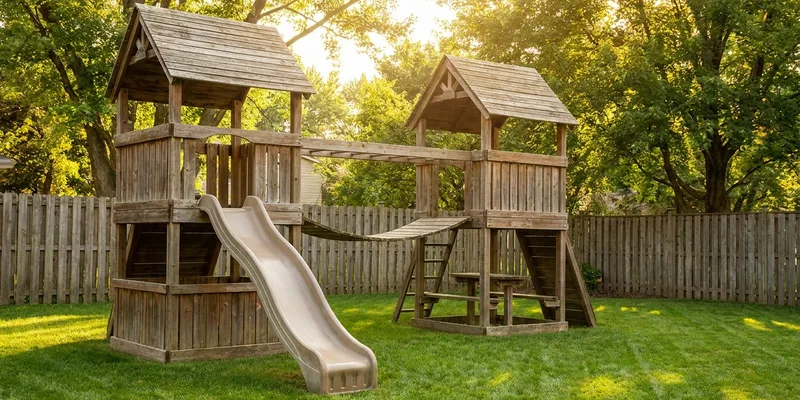
A wooden playset with monkey bars is a different purchase from a swing set that happens to have a bar run bolted to the end of it. A playset is built around a raised deck with a slide, usually a tower with a roof, and the monkey bars are one element of a structure that also has to be leveled, anchored and surfaced as a whole.
Where the bar run sits changes the footprint, the fall height and how long the set stays useful. This guide covers the layouts you will meet, the dimensions the CPSC Public Playground Safety Handbook publishes for horizontal ladders, and where these sets are actually bought.
This article contains affiliate links. If you buy through them, we may earn a commission at no extra cost to you. Learn more.
Quick Answer
What should you look for in a wooden playset with monkey bars?
- Work out the layout first. A bridge run between two towers, a cantilevered arm off one tower and a bar run over the swing beam each take a different shape of yard.
- Check the bar height against your children. The CPSC Public Playground Safety Handbook recommends a maximum grasping height of 60 inches (152 cm) for preschool-age children and 84 inches (213 cm) for school-age children.
- Check rung spacing and grip diameter. The handbook recommends no more than 12 inches (30 cm) between rung centers for preschool-age children and 15 inches (38 cm) for school-age children, and caps grasped components at 1.55 inches (39 mm) in diameter.
- Budget the whole area, not the footprint. The handbook specifies a use zone of at least 6 feet (1.8 m) in all directions around stationary equipment.
- Age matters: the handbook notes that four year olds are generally the youngest children able to use upper body equipment such as horizontal ladders.
Monkey Bar Layouts on a Playset
Manufacturers arrange the bars in one of three ways, and the arrangement decides the footprint more than the deck size does. The table sets out what each layout suits and what it asks of the yard.
| Layout | How it works | What it asks of the yard |
|---|---|---|
| Bridge between two towers | The bar run spans from one deck to another, so children cross rather than drop off the end | The longest footprint of the three, and the highest bars, since the run sits at deck height |
| Cantilevered arm off one tower | A run projects from the deck and ends on a post or in the air | Moderate length. The exit end needs clear, surfaced ground and often sits lower than the deck |
| Bars above the swing beam | Rungs run under or alongside the swing beam | The most compact, but the bars and the swing arc compete for the same space, so check clearances carefully |
Layout also decides how long the set holds a child’s interest. Bars that end at a second deck give a reason to cross, which is a different game from a run that stops in the air.
The Dimensions That Matter
Three published figures cover most of what a listing leaves out. The CPSC Public Playground Safety Handbook recommends a maximum height of 60 inches (152 cm) from the grasping surface to the protective surfacing for preschool-age children, and 84 inches (213 cm) for school-age children. Those are ceilings, not targets.
Rung spacing is the second: no more than 12 inches (30 cm) center to center for preschool-age children and 15 inches (38 cm) for school-age children. The third is grip diameter, capped at 1.55 inches (39 mm) for components intended to be grasped, because a bar a child cannot close a hand around cannot be held.
Public playground figures on a home playset
The handbook is written for parks, schools and childcare centers. Backyard equipment is covered by a separate voluntary standard, ASTM F1148, which residential manufacturers design to and often cite in the manual. A playset that quotes a bar height above the handbook’s figure for your child’s age band is not defective, but the number is still the clearest published reference a parent has. Our guide to monkey bar dimensions works through each figure in detail.
Our Top Picks at a Glance
How we chose: we compared configurations on published bar height and rung spacing, deck height and slide length, the stated timber and hardware, and how completely the manual documents anchoring. Selections rely on manufacturer specifications and recurring themes in customer reviews rather than any hands-on trial of our own.
🏆 Best Overall Configuration
A cedar tower with a slide, a swing beam and a bar run that ends at a second platform, which keeps the exit controlled instead of dropping a child at full stretch.

📐 Best for a Smaller Yard
A compact tower where the bars sit above or alongside the swing beam, trading run length for a footprint that leaves room for the use zone around it.
🛠️ Best Upgrade Route
A monkey bar kit added to a tower you already own, which is the cheaper path when the deck and slide are sound and only the climbing element is missing.

Where These Sets Are Actually Bought
Worth saying plainly: large wooden playsets are not primarily an online marketplace product. Most are bought at home improvement warehouses, warehouse clubs and dedicated playset retailers, often with delivery and assembly quoted separately, and the model lineups differ between those channels rather than overlapping.
So comparison shopping happens across retailers rather than within one listing page, and the accessories, hardware and surfacing are the parts you will genuinely order online. Our comparison of playsets at Costco, Walmart and Home Depot covers how the channels differ.
Assembly is a real part of the decision
These sets arrive as a stack of pre cut timber and a long bolt list, and assembly typically runs across a weekend with two adults. Professional assembly is available almost everywhere they are sold, and deciding in advance beats discovering the box count on delivery day.
Anchoring, Surfacing and the Ground Underneath
A playset with monkey bars puts a hanging child at the end of a lever, which is the load that lifts a corner. Ground anchors are not optional here, and the manual specifies what the manufacturer expects, whether stakes, augers or concrete footings.
Underneath, the fall height for a horizontal ladder is the height of the bars themselves, and that number drives the depth of protective surfacing required. Grass does not count, and it compacts close to bare soil within a season under the busiest part of a set.
Level ground first, then anchor
A rigid timber structure on uneven ground goes together under tension, which shows up as bolt holes that will not line up. Leveling comes before assembly, and it needs to cover the whole use zone rather than four pads under the legs.

Common Mistakes to Avoid
- Buying on deck height and ignoring bar height. The bars are the part with published guidance behind them, and they are what a child hangs from.
- Measuring the footprint instead of the use zone. The handbook’s 6 feet (1.8 m) in all directions is what has to fit, not the frame.
- Assuming the bars suit the youngest child. The handbook points to four years as the youngest age children are generally able to use upper body equipment.
- Leaving the anchoring to later. Anchors are far easier to fit during assembly than under a finished frame.
- Treating grass as surfacing. It compacts under the busy areas, and the fall height under a bar run is the height of the bars.
- Forgetting the annual check. Timber moves, bolts loosen, and a run of rungs is a lot of fasteners.
Frequently Asked Questions
What is the difference between a wooden swing set and a wooden playset? A swing set is essentially a beam with seats. A playset adds a raised deck with a slide, usually a tower and a roof, and often climbing elements such as monkey bars, so it takes more ground and more assembly.
How high should the monkey bars be on a playset? The CPSC Public Playground Safety Handbook recommends a maximum of 60 inches (152 cm) from the grasping surface to the protective surfacing for preschool-age children and 84 inches (213 cm) for school-age children. Those are ceilings, and a lower run suits a smaller child better.
What age are playset monkey bars for? The handbook notes that four year olds are generally the youngest children able to use upper body equipment such as horizontal ladders. Within that, readiness comes down to whether a child can hang unsupported and lower themselves under control.
How much space does a wooden playset with monkey bars need? More than the frame. The handbook specifies a use zone of at least 6 feet (1.8 m) in all directions from the perimeter of stationary equipment, and a larger zone in front of and behind swings, which is often the dimension that decides whether a set fits.
Do wooden playsets need to be anchored? Yes, and the manual specifies the method for that model. A child hanging at the end of a bar run is the load that lifts a corner, so anchoring matters more on a set with monkey bars than on a plain tower.
Can I add monkey bars to a playset I already own? Often yes, using a kit or extension from the manufacturer, provided the tower and posts are sound and the resulting bar height suits your children. Check the manual before drilling anything, since adding a lever arm changes the loads on the frame.
The Bottom Line
Pick the layout that fits the yard, then check the bar height, rung spacing and grip diameter against the figures in the CPSC handbook rather than against the marketing copy. Level the whole use area before assembly, anchor the frame the way the manual specifies, and put proper surfacing under the run. If the deck and slide you own are still sound, a bar kit is usually the better value than a whole new set.