Last updated: August 18, 2026
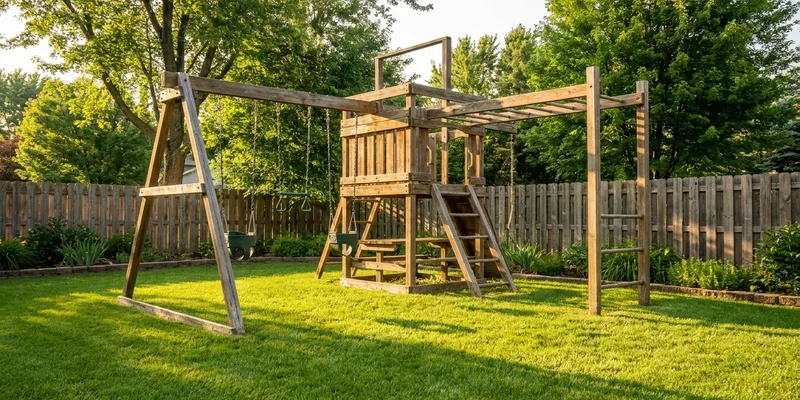
A wooden swing set with monkey bars asks more of the timber than a plain swing beam does. Swings load the top beam straight down, while an overhead ladder puts a swinging, shifting load across a span that is often unsupported in the middle, and that difference shows up in how the wood is graded, how the posts are braced and how the hardware is bolted through.
This guide covers what species and grade of lumber to look for, how the monkey bar section is normally attached, and where a build your own bracket kit beats a boxed set. If you are open to a metal frame or a set that combines a slide with the bars, our guide to a swing set with a slide and monkey bars takes that route.
This article contains affiliate links. If you buy through them, we may earn a commission at no extra cost to you. Learn more.
Quick Answer
What makes a good wooden swing set with monkey bars?
- Look at the lumber first. Naturally rot resistant cedar or a properly treated softwood, in a beam thick enough for the span, is what keeps an overhead ladder rigid over the years.
- Check how the bar section is fixed. Through bolts with washers hold up under a swinging load, while screws into end grain do not.
- Match the bars to the age group. The CPSC Public Playground Safety Handbook treats upper body equipment as unsuitable for the youngest children and gives height guidance by age, so check it against your set.
- Large wooden sets mostly sell through home centers and warehouse clubs. Bracket kits, monkey bar hardware and sealer are the parts you can readily order online.
Lumber and Hardware Compared
The differences between wooden sets come down to a handful of material choices, and every one of them is visible on the listing or the spec sheet. This table sums up what each choice means for a set that carries monkey bars.
| Element | What you will see | What to look for |
|---|---|---|
| Wood species | Cedar, redwood, or treated pine and fir | Cedar and redwood resist rot naturally; treated softwood needs the treatment stated, not implied |
| Beam size | Nominal dimensions such as 4×4 or 4×6 posts | A deeper beam for a longer unsupported monkey bar span |
| Bar material | Powder coated steel tube or hardwood rungs | Coated steel resists weathering; check the coating is not simply painted on |
| Bar attachment | Through bolts, lag screws, or bracket plates | Bolts through the beam with washers on both faces, not screws into end grain |
| Finish | Pre-stained, raw, or factory sealed | A stated finish and a reseal interval, since raw wood weathers faster than owners expect |
| Ground contact | Post bases, anchors or direct burial | Anchors rated for the set, since posts sitting in wet soil are the usual failure point |
Once the wood and hardware are settled, anchoring is the remaining structural question, and our swing set anchor kit guide covers the options for grass, slope and concrete.
Why Monkey Bars Change the Wood You Need
Monkey bars load the structure differently from swings. A child hanging and moving hand over hand applies a shifting load along the span, with a pull that tries to twist the beam rather than simply press it down. That is why an overhead ladder section usually needs a deeper beam, more bracing at the posts, or a shorter unsupported run than a swing beam of the same length.
In practice this shows up as sag. A set that looked straight on assembly day can develop a visible dip in the middle of the ladder run after a season, and that dip is the beam telling you it was undersized for the span or that the wood has taken on moisture and lost stiffness.
Cedar, Redwood and Treated Softwood
Cedar and redwood resist rot and insects without chemical treatment, which is why they dominate the wooden playset market. Treated southern yellow pine and fir are structurally strong and are common on value sets, but the treatment is doing the work rather than the species, so it matters that the listing actually states what treatment was applied.
Age Range and Safety Guidance for Overhead Bars
Upper body equipment is not for every age. The CPSC Public Playground Safety Handbook treats overhead ladders and similar upper body equipment as unsuitable for the youngest age group and sets out height guidance by age group, so check your set against the handbook rather than against the marketing age range on the box.
The same handbook flags openings that can trap a head: any opening between 3.5 inches (8.9 cm) and 9 inches (22.9 cm) is a concern, which matters where a monkey bar section meets a deck, a ladder or an infill rail. Look at the assembled photos for gaps in that range rather than trusting the drawing.
Fall Zone Under the Bars
The ground under an overhead ladder takes every dismount, planned and unplanned. CPSC guidance for home playgrounds calls for protective surfacing extending at least 6 feet (1.8 m) in all directions from stationary play equipment, and a monkey bar run needs that clear along its whole length, not just at the ends.
Our Top Picks for a Wooden Set With Bars
How we chose: we compared widely available wooden playset hardware and monkey bar components on stated load ratings, coating quality, fastener type and how consistently owners report a rigid span after a season outdoors. Selections lean on manufacturer specifications and recurring themes in customer reviews rather than any hands-on trial of our own. Complete wooden sets are largely a home center purchase, so these picks focus on the parts you can actually order.
🏆 Best Overall
A monkey bar kit with powder coated steel rungs and through bolt hardware, sized to add an overhead ladder run to a wooden beam.

🧰 Best for Building Your Own
An A-frame bracket kit for 4×4 lumber, which lets you set the beam depth and span your monkey bar run actually needs.

🔩 Best Hardware Upgrade
Heavy duty swing hangers with sealed bearings, the part that decides whether the beam wears or the hanger does.

Picks by Situation: Keeping the Wood Alive
Two jobs decide how long a wooden set with monkey bars lasts: keeping water out of the timber, and keeping the posts from moving in the ground.
🪵 Best for Sealing
An exterior wood stain and sealer suitable for playsets, applied on the schedule the manufacturer states rather than when the wood already looks tired.

⚓ Best for Stability
A ground anchor kit rated for wooden play structures, installed below ground level so nothing sits proud of the surfacing.

Assembly and Yearly Maintenance
Wooden sets with an overhead ladder need a genuinely level base, because a twisted frame puts the ladder run out of parallel and the bars start loading unevenly. Level the ground before assembly rather than shimming afterward, and our guide on leveling ground for a playset covers doing that without excavating the yard.
After that, the yearly routine is short. Retighten every bolt at the start of the season, since wood shrinks and swells and hardware works loose. Check the rungs turn in their fixings, look for splitting around bolt holes, and reseal the timber on the interval the manufacturer gives.
Common Mistakes to Avoid
- Judging a set by post thickness alone. The monkey bar span and how it is braced matter more than the nominal size of the uprights.
- Fixing bars with screws into end grain. Overhead bars want through bolts with washers, since a swinging load pulls fasteners out of end grain over time.
- Letting the wood go unsealed for years. Raw timber that children grip constantly checks and splinters, and resealing later does not undo it.
- Leaving the ground bare under the ladder run. That whole strip takes dismounts, not just the two ends.
Frequently Asked Questions
What wood is best for a swing set with monkey bars? Cedar and redwood resist rot and insects naturally, which is why they dominate the category. Treated pine and fir are structurally sound alternatives when the listing states the treatment applied.
At what age can children use monkey bars? The CPSC Public Playground Safety Handbook treats upper body equipment such as overhead ladders as unsuitable for the youngest age group and provides height guidance by age. Check your set against the handbook rather than the age range printed on the box.
How far apart should monkey bars be? Rung spacing is set by the manufacturer for the age range the set is built for, and the CPSC handbook covers spacing and entrapment concerns. Follow the manufacturer’s layout rather than modifying the spacing yourself.
Can you add monkey bars to an existing wooden swing set? Often yes, using a monkey bar kit bolted through the beam, provided the beam is deep enough for the added span and the posts are braced for the extra load. Check the manufacturer’s guidance before drilling into a structural beam.
How often should a wooden swing set be sealed? On the interval the manufacturer states for the finish used, which is typically once a season or every other season in most climates. Wood that has already grayed and split needs sanding before sealing does much good.
Do wooden swing sets need to be anchored? Yes. The CPSC Outdoor Home Playground Safety Handbook advises anchoring equipment securely with anchoring devices installed below ground level, and a heavy wooden set still shifts under an overhead ladder load.
The Bottom Line
A wooden swing set with monkey bars stands or falls on the beam depth over the ladder span, through bolted bar hardware, and rot resistant timber that gets resealed on schedule. Check the set against CPSC age guidance for upper body equipment, keep the whole ladder run clear underneath, and anchor the posts below ground level.