Last updated: August 18, 2026
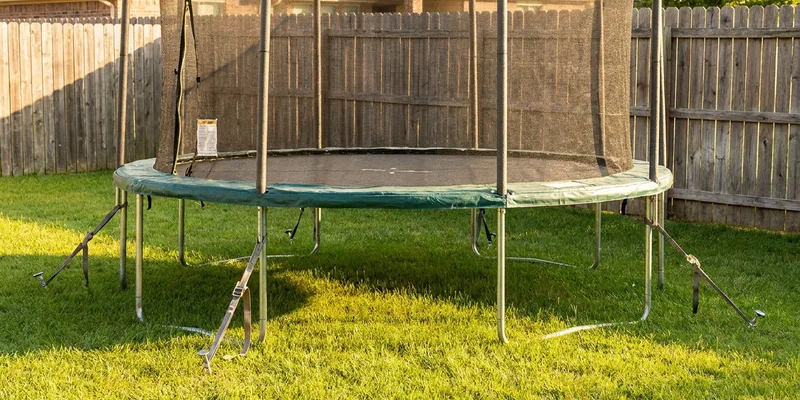
Trampoline ground anchors exist because a trampoline is, in engineering terms, a very large kite. The mat and enclosure catch wind, the frame is light for its footprint, and a single gust can lift an unanchored trampoline over a fence and into a neighbor’s car.
This guide covers the anchor types on the market, what to check on the listing, which style suits which soil, and how to install a kit so it holds instead of pulling straight back out.
This article contains affiliate links. If you buy through them, we may earn a commission at no extra cost to you. Learn more.
Quick Answer
Which trampoline ground anchor kit should you buy?
- For most lawns, a corkscrew auger anchor kit with straps over the frame gives the best grip for the effort, because the helix pulls against a column of soil rather than a point.
- In loose, sandy, or freshly graded soil, longer augers or a wind stake kit with more anchor points spread the load better than four short stakes.
- In hard clay or stony ground where an auger will not turn, U-shaped steel stakes driven over the legs are the practical option.
- Anchors reduce the chance of a trampoline moving in wind, but manufacturers still advise taking the enclosure down and moving or dismantling the trampoline when severe weather is forecast.
What to Check Before You Buy an Anchor Kit
Every row below is visible on the product listing before you order. Anchor kits are simple hardware, and the differences that matter are few, but getting them wrong means a kit that pulls out of the ground in the first real storm.
| What to check | Why it matters | What to look for |
|---|---|---|
| Anchor style | Determines how the anchor resists being pulled upward | Corkscrew auger for turf and normal soil, U-shaped stake for hard or stony ground, screw plus strap for a combination |
| Number of anchor points | More points spread the uplift across the frame instead of loading one leg | A kit with one anchor per leg where possible, rather than four anchors on a six or eight leg frame |
| Anchor length | Short anchors in soft ground lift out with the sod still attached | Longer augers for sandy or recently disturbed soil, with the length stated on the listing |
| Corrosion protection | These sit in wet soil for years | Galvanized or powder coated steel, and stainless hardware where the listing states it |
If you are anchoring more than the trampoline, the same logic applies to swing frames and climbing units, and our guide to ground anchors for play equipment covers the wider set of hardware.
Anchor Types and What Each One Is Good At
There are three common designs, and they are not interchangeable. Choosing by soil type rather than by the picture on the box is what separates a kit that holds from one that comes up with a firm tug.
Corkscrew Augers
An auger is a steel rod with a helix at the bottom that you turn into the ground with a bar through the eye. Because the helix bites a column of soil above it, an auger resists uplift far better than anything hammered in. This is the default for a normal lawn and the style most kits are built around.
U-Shaped Wind Stakes
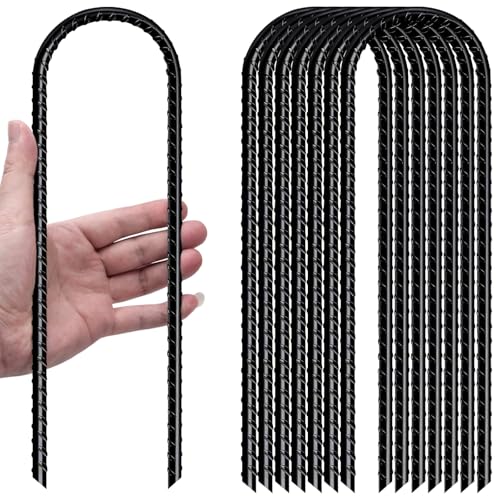
These are heavy steel staples driven over the frame’s legs. They install fast, need no strap, and work where an auger cannot turn, which in practice means compacted clay, stony ground, or thin soil over rock. Their weakness is uplift resistance in soft ground, so more of them is better.
Auger Plus Strap Kits
Here the auger goes into the ground clear of the frame and a webbing strap runs over the frame tube and down to an anchor on the other side. Tightening the strap preloads the frame downward, which stops the small lifting and settling that gradually works other anchors loose. This is the most secure of the three on ordinary soil.
Our Top Picks at a Glance
How we chose: we compared widely available anchor kits on anchor style, the number of anchor points included, stated anchor length and material, and how the kit attaches to the frame. Selections lean on manufacturer specifications and recurring themes in owner reviews rather than any hands on trial of our own.
🏆 Best Overall
A corkscrew auger kit with webbing straps that pass over the frame tube, giving both a deep bite in the soil and a preload that keeps the frame from working itself loose.

🌱 Best for Soft or Sandy Soil
A longer auger set, where the extra depth reaches past the loose upper layer that short anchors simply lift out of along with the sod.

💪 Best for Hard or Stony Ground
Heavy gauge U-shaped steel wind stakes that drive over the frame legs where an auger will not turn, with enough stakes in the set to cover every leg.
Picks by Situation: Exposed Yards and Bigger Frames
Two situations call for more than a basic four point kit: an open, exposed yard with no windbreak, and a larger frame where four anchors leave several legs doing nothing.
🌬️ Best for Exposed, Windy Yards
An over the frame strap kit with ratchet tensioners, which holds the frame down along its whole span rather than pinning individual legs, and can be retensioned after the ground settles.

🔗 Best for Larger Frames
A multi point anchor set with enough anchors to cover every leg on a bigger round or rectangular trampoline, so the uplift is shared instead of concentrated on four corners.

Installing Anchors So They Actually Hold
Set the trampoline where it will stay before you anchor anything, and check the frame is level with the legs sitting evenly, since an anchor pulling a frame down onto an uneven spot puts a permanent twist in it.
Turn augers in with a bar through the eye rather than hammering them, keeping them close to vertical, until the eye sits at or just below the surface so nothing protrudes where someone could catch a foot. With strap kits, tighten until the strap is firm and the frame does not lift when you pull up on it, but not so hard that you bow the frame tube. Then recheck: soil settles and straps relax, so pull up on each leg after the first couple of weeks and after every storm, retensioning and turning augers down further if the ground has given.
Anchors Are Not a Storm Plan
Anchoring reduces the chance of a trampoline shifting in ordinary wind. It does not make one storm proof, and manufacturers are explicit in their manuals that the trampoline should be moved to a sheltered spot or taken apart when severe weather is forecast. Removing the enclosure net first makes the biggest difference, since the net is the largest sail on the structure.
Placement helps too. A trampoline in the lee of a fence, hedge, or house takes far less wind loading than one standing alone on an open lawn. Our guide to picking a trampoline for a small backyard covers placement and clearance alongside sizing.
Common Mistakes to Avoid
- Hammering an auger instead of turning it. The helix is what grips. Driving it in like a stake destroys the thread and most of the holding power.
- Using four anchors on a frame with six or eight legs. The unanchored legs lift first, and the frame racks instead of staying put.
- Anchoring in freshly graded or backfilled soil. Disturbed ground has little holding strength until it consolidates, so use longer anchors and recheck them often.
- Leaving the anchor eye standing above the grass. It becomes a trip hazard exactly where children run around the trampoline.
- Setting it and forgetting it. Straps relax and soil settles. An anchor kit that was never rechecked is often no better than none.
Frequently Asked Questions
Do you really need to anchor a trampoline? Yes. A trampoline has a large surface area and a light frame relative to that area, and manufacturers routinely instruct owners to secure it against wind. Anchoring is the standard precaution, and it is far easier than dealing with a trampoline that has moved across a yard.
What kind of trampoline anchor works best in sandy soil? Longer corkscrew augers, and more of them. Short anchors in loose soil tend to lift out with a plug of sand still attached, so the anchor needs to reach into denser material below the surface layer.
Can you anchor a trampoline on concrete or pavers? Not with ground anchors, which need soil to bite into. Concrete calls for a different approach using masonry fixings and frame straps, and the trampoline manufacturer’s manual should be your first stop, since some models are not intended for hard surfaces at all.
How many anchors does a trampoline need? As a working rule, one anchor point per frame leg, so a frame with more legs needs a larger kit. Four anchors on an eight leg frame leaves half the frame free to lift.
Will anchors keep a trampoline safe in a storm? No. Anchors help in ordinary wind, but manufacturer guidance is to remove the enclosure net and move or dismantle the trampoline when severe weather is forecast rather than relying on the anchors.
Can I use tent pegs or rebar instead of a proper kit? It is a poor substitute. Straight pegs have very little resistance to being pulled upward, which is the exact load a trampoline puts on them, and cut rebar leaves sharp ends at ground level near where children play.
The Bottom Line
For an ordinary lawn, a corkscrew auger kit with straps over the frame is the anchor worth buying, with longer augers in sandy soil and U-shaped steel stakes where the ground is too hard to turn an auger into. Match the number of anchors to the number of frame legs, set the eyes flush with the grass, and recheck tension after the first weeks and after every storm. Then still take the net off and move the trampoline when serious weather is on the way.