Last updated: August 18, 2026
Ground anchors for play equipment do a job that is easy to skip and hard to undo: they keep a swing set, climber, or trampoline from tipping or walking across the yard while children are on it. The CPSC puts it plainly in its home playground guidance, noting that play equipment may need to be restrained with anchors to keep it from tipping over while in use.
This guide covers the four anchor types sold for backyard equipment, how to match one to your soil and your frame, and the installation detail that matters more than the anchor itself: getting the hardware below the surface so it does not become a trip hazard.
This article contains affiliate links. If you buy through them, we may earn a commission at no extra cost to you. Learn more.
Quick Answer
Which ground anchors should you use for play equipment?
- Start with the manufacturer’s own kit. The CPSC advises following the manufacturer’s instructions for anchoring, and says the anchoring process should be completed in strict accordance with their specifications.
- Screw in auger anchors are the practical default for firm soil, since they go in without concrete and can be removed if the set moves.
- Concrete set anchors are the durable answer for tall wooden play sets, and drive in arrowhead anchors hold better than augers in loose or sandy ground.
- Whatever you pick, bury it. The CPSC warns that exposed anchors, hooks, and bolts can create tripping hazards, and its maintenance checklist lists exposed anchoring devices as something that does not belong in a use zone.
The Four Anchor Types Compared
Anchors differ mostly in how they grip and how permanent they are. The table below covers the four you will actually find sold for backyard play equipment, and the situations each one suits.
| Anchor type | How it installs | Suits | Watch out for |
|---|---|---|---|
| Screw in auger | Twisted into the soil by hand or with a bar through the eye, then strapped or bolted to the leg | Firm loam and clay soil, metal frames, sets you may relocate | Loses grip badly in sand or freshly disturbed soil |
| Concrete set J hook or rod | Set into a poured footing at the base of each leg, then bolted or strapped to the post | Tall wooden play sets and anything permanent | Not removable, and the footing has to sit below the surfacing |
| Drive in arrowhead or duckbill | Driven straight down with a rod, then tensioned so the head toggles sideways in the soil | Loose, sandy, or gravelly ground where augers spin free | Needs a cable and tensioning step, so it is fussier to install |
| Spiral or corkscrew stake | Wound into the ground by hand, hooked over a frame tube or strap | Trampolines and lighter frames, wind resistance rather than tipping | Pulls out under sustained load; usually a wind measure, not a structural one |
Most backyards end up with a mix. Auger or arrowhead anchors on the swing legs, spiral stakes on the trampoline, and concrete only where the manufacturer calls for it.
What to Check on the Listing
Check first whether your equipment manufacturer sells or specifies an anchor kit for your model, because the CPSC guidance is to follow the manufacturer’s instructions and complete anchoring in strict accordance with their specifications. Where they do, that kit is the answer.
Buying generically, three specifications decide whether the kit fits: the length and diameter of the anchor, the attachment method at the top, and the corrosion protection. A strap and bracket suits a wooden post, a U bolt or clamp suits a round metal tube, and neither works well on the other.
Corrosion and treated wood
Galvanized or otherwise coated steel is worth insisting on for anything that lives underground. There is a specific reason to care with wooden play sets: the CPSC notes that when using wood treated with modern preservatives such as ACQ, CBA, or CA-B, the associated hardware needs to be compatible with the treatment chemicals, because those chemicals are known to corrode certain materials faster than others. A cheap uncoated bracket bolted to treated wood is a short lived joint.
Our Top Picks at a Glance
How we chose: we compared widely available anchor kits on holding method, the attachment hardware included, corrosion protection, and how consistently owners report the anchors staying tight through a freeze and thaw season. Selections lean on manufacturer specifications and recurring themes in customer reviews rather than any hands-on trial of our own.
🏆 Best Overall
A heavy duty swing set anchor kit sold as a set of four with brackets and fixings included, so every leg gets the same anchor and you are not improvising the connection at the top.

🔩 Best for Firm Soil
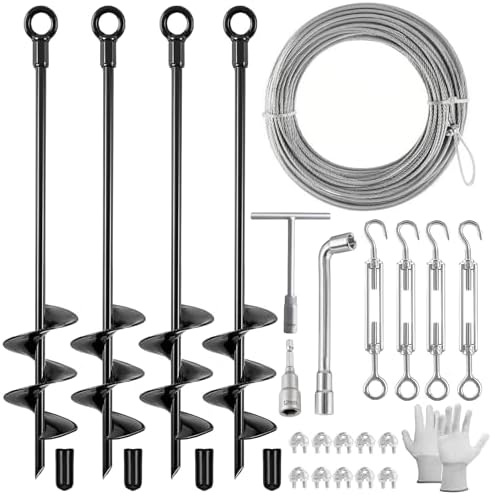
A screw in auger anchor with a wide helix and a galvanized finish, which goes in with a bar and comes back out if you move the set to a different corner of the yard.
🏗️ Best for Permanent Wooden Sets
A concrete set anchor with a J hook or plate that ties the post into a poured footing, the option manufacturers of tall wooden towers most often specify.

Picks by Situation: Loose Soil and Trampolines
Two situations defeat a standard auger. Sandy or gravelly ground gives it nothing to bite, and a trampoline is a wind problem rather than a tipping problem, so it needs a different kind of restraint at more points around the frame.
🏖️ Best for Sandy or Loose Ground
A drive in arrowhead anchor on a cable, which is hammered down rather than screwed and then toggles sideways under tension, giving it holding power where a screw thread simply spins.

🌀 Best for Trampolines
A set of corkscrew wind stakes with straps that go over the frame, sized so all the legs are tied down rather than just two. Our trampoline ground anchor guide goes into the wind and strap details.

Installing Anchors Without Creating a Hazard
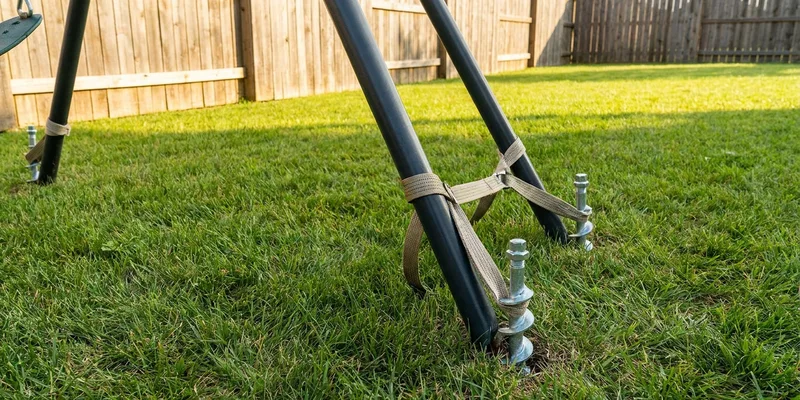
The CPSC gives one instruction about anchor placement that overrides everything else: be sure anchors are buried or otherwise covered with protective surfacing, because exposed anchors, hooks, and bolts can create tripping hazards or lead to other injuries. Its maintenance checklist repeats the point, listing exposed footings and anchoring devices among the trip hazards that should not exist in a use zone.
In practice that means digging a shallow recess for the anchor head and the bracket, setting the top of the hardware below grade, and raking surfacing back over it. Where a concrete footing is used, the top of the footing sits below the surfacing rather than flush with it. Anything that ends up standing proud of the ground is a snag point in the exact area where children run and land.
Getting the connection to stay tight
The CPSC recommends lock washers, self locking nuts, or other locking means for all nuts and bolts to protect them from detachment, and says fasteners and connectors should not loosen or be removable without the use of tools. Cover exposed bolt ends with the caps the manufacturer supplies. Then check the anchors as part of a routine walk around, because ground that freezes and thaws lifts anchors over a winter, and the first sign is usually a leg that rocks slightly under load.
How Many Anchors, and Where
Follow the manufacturer’s count first, since anchor placement is part of how the frame was designed to resist tipping. Where no count is given, the working rule of thumb is one anchor per ground contact point, so a four leg A frame takes four. Anchoring two legs and leaving the others free simply moves the pivot rather than removing it.
Install on level ground, which the CPSC home handbook recommends because it reduces the likelihood of the play set tipping and stops loose fill washing away in heavy rain. If your site slopes, regrading comes before anchoring, not instead of it. Our swing set safety zone guide covers marking out the area first.
Common Mistakes to Avoid
- Leaving the anchor head above the surface. The CPSC is explicit that anchors should be buried or covered with protective surfacing, because exposed hardware is a trip hazard.
- Using auger anchors in sand. A screw thread needs dense soil to bite; in loose ground a drive in arrowhead anchor holds far better.
- Anchoring only the two legs that seem to move. Partial anchoring changes where the frame pivots rather than stopping it.
- Mixing uncoated hardware with treated wood. Modern wood preservatives corrode certain metals faster, and the CPSC advises using hardware compatible with the treatment chemicals.
- Fitting the anchors once and never checking them. A freeze and thaw cycle lifts anchors, and a loose anchor is close to no anchor.
Frequently Asked Questions
Do I really need to anchor a backyard swing set? The CPSC states that play equipment may need to be restrained with anchors to keep it from tipping over while in use, and advises following the manufacturer’s instructions for anchoring. Treat the manufacturer’s requirement as the answer for your specific set.
What kind of ground anchor is best? Screw in augers for firm soil, drive in arrowhead anchors for loose or sandy ground, and concrete set anchors for tall permanent wooden sets. The manufacturer’s own kit takes priority over all three.
Do ground anchors need concrete? Not always. Auger and arrowhead anchors are designed to hold without it, while many wooden tower sets specify a concrete footing. Follow the manufacturer’s specification rather than upgrading or downgrading on your own.
How deep should a ground anchor go? Deep enough that the head and any bracket sit below the surface, since the CPSC advises anchors be buried or covered with protective surfacing. The holding depth itself is set by the anchor manufacturer.
How many anchors does a swing set need? Use the count in the manufacturer’s instructions. Without one, the sensible default is an anchor at every ground contact point rather than at a selected few.
How often should I check the anchors? As part of your routine inspection of the equipment. Ground movement through a freeze and thaw cycle loosens anchors, and the CPSC maintenance checklist calls for confirming that all equipment is securely anchored.
The Bottom Line
Use the manufacturer’s anchor kit if there is one, and otherwise match the anchor to your soil: augers in firm ground, drive in arrowhead anchors in sand, concrete footings under tall wooden towers, and corkscrew stakes for trampolines. Anchor every leg, use locking nuts and coated hardware compatible with treated wood, and bury the heads so nothing sticks up inside the use zone.