Last updated: August 18, 2026
Learning how to move a trampoline is mostly about knowing which of three methods your move actually calls for. Shuffling one a few feet to let the grass recover is a short job. Getting one around a corner of the house needs a different approach. Taking one to a new address without bending the frame means taking it apart, in the right order.
This guide walks through all three in steps, with the mistakes that turn an easy afternoon into a kinked frame and a bag of springs nobody can match back up.
This article contains affiliate links. If you buy through them, we may earn a commission at no extra cost to you. Learn more.
Quick Answer
What is the easiest way to move a trampoline?
- Short distance on flat, open lawn: take the net and poles off, then walk it with one person per leg, lifting rather than dragging.
- Past a corner, a gate, or a slope: stand it on its side and roll it, with one person on each side and a third steadying it.
- To a new address, or anywhere it cannot be walked or rolled: take it apart, bagging and labeling the hardware as you go.
- Whatever the method, remove the enclosure first and never move a trampoline in wind. A frame on its side is a sail.
Which Method Fits Your Move
Pick the method by the obstacles between the trampoline and its new spot, not by how far it has to go. A trampoline can be walked a long way across open lawn far more easily than it can be walked six feet through a side gate.
| Your situation | Method | People needed |
|---|---|---|
| A few feet to a new patch of grass, flat ground | Walk it flat | One per leg, usually four to six |
| Around a corner, through a wide gate, or up a gentle slope | Roll it on its side | Three, two rolling and one steadying |
| Through a standard gate, over a fence, or to a new address | Disassemble and bag the hardware | Two, plus time |
| You are on your own | Disassemble, whatever the distance | One, in stages |
If the move is happening because the trampoline is in the wrong spot rather than because you are leaving, sort placement properly this time. Our guide to choosing a trampoline for a small backyard covers clearance and where a frame actually fits.
Before You Start: Clear the Deck
Take the enclosure net and its poles off first, every time, for every method. The net is the largest wind catching surface on the trampoline and the part most easily torn when the frame goes onto its side. Remove the safety pad as well and set it flat somewhere it will not blow away.
Then release any ground anchors, walk the route for tree roots, sprinkler heads, and low branches, and pick the new spot before you lift anything. Check the weather too, because a calm forecast is not optional here.
What Helps to Have on Hand
- A spring pull tool, one per person doing springs, if you are taking it apart.
- Work gloves, since spring hooks and frame ends reliably catch a hand.
- Labeled zip bags for bolts, a bucket for springs, and a marker for the frame pieces.
- Your model’s manual, found online before you start rather than halfway through reassembly.

Method 1: Walking It Flat Across Open Lawn
This is the fastest method and only works on level, open ground with nothing to squeeze past. The aim is to lift the frame clear of the ground and step it across, never to drag it, because dragging bends legs and tears turf.
- Remove the enclosure net, poles, safety pad, and any ground anchors.
- Station one person at each leg, spaced evenly around the frame, and agree on a direction and a count.
- Lift only enough to clear the grass, then walk in short steps, pausing whenever anyone needs to reset their grip.
- Set it down together on the count, with legs landing flat rather than one corner first.
- Check the frame sits level, then reinstall the pad, the enclosure, and the anchors.
Method 2: Rolling It on Its Side
Rolling gets a trampoline past corners, along narrow strips of lawn, and up or down gentle slopes. It is also the method that most often goes wrong, because a frame on edge is heavy, top heavy, and catches wind, so it needs three people and a slow pace.
- Strip the net, poles, and pad, and release the anchors.
- Lift one side until the trampoline stands on edge, with people spread along the rim rather than bunched at one point.
- Keep one person on each side holding the rim and a third at the trailing edge to stop it running away.
- Roll in short segments, stopping the moment anyone loses footing or the ground changes.
- On a slope, brace the downhill side and roll across the slope rather than straight down it.
- Lower it flat with everyone lifting, never by letting it fall the last part of the way.
Stop if the wind picks up. A frame standing on edge behaves like a sail on a mast, and there is no good way to hold one once it starts to move.
Method 3: Taking It Apart for a Longer Move
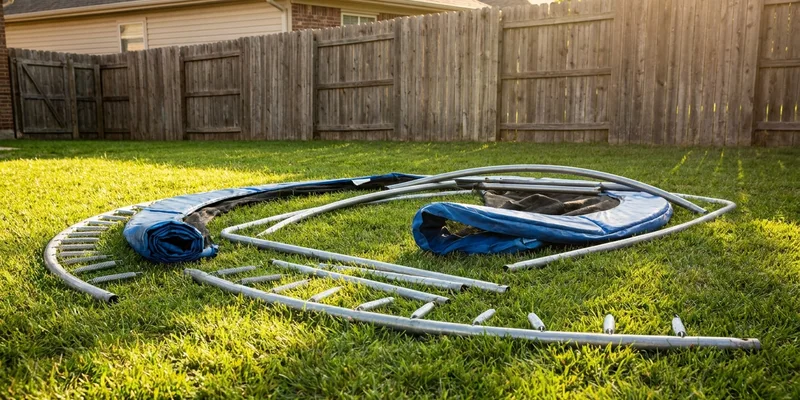
Disassembly is the only realistic option for a new address, a narrow gate, or a one person job. Work in reverse of assembly order and label as you go. The frustrating part of reassembly is never the frame; it is working out which of four similar looking bolts belongs where.
- Remove the enclosure net, then the poles, keeping pole caps and foam sleeves with their poles.
- Take off the safety pad and roll it rather than folding it, since folds become permanent creases.
- Remove the springs with a spring pull tool, working around the circle in opposite pairs to keep tension even, counting them into a bucket.
- Lift the mat off, fold it loosely, and keep it dry and out of direct sun.
- Take the frame apart, marking mating pieces with tape and a marker as you separate them.
- Bag every bolt, pin, and clip by the part it belongs to, and put the manual in with the bags.
- Load long pieces flat and supported along their length, since resting a tube on two points is where a permanent bend comes from.
While the trampoline is apart you get the best look at it you will have all year. Check the mat’s stitching, V-rings, and edge webbing before it goes back together. Our guide to trampoline mat repair covers what is patchable and what is not.
Setting It Back Up in the New Spot
Choose ground that is level and firm and clear of overhead branches, fences, and other play equipment. The Consumer Product Safety Commission’s trampoline safety alert advises placing a trampoline away from structures and other play areas and keeping the springs, hooks, and frame covered by a shock absorbing pad.
Reassemble in reverse order, fit springs in opposite pairs so the mat sits square, and put the pad and enclosure back before anyone uses it. Then anchor it again, which our guide to trampoline ground anchors covers by soil type.
Common Mistakes to Avoid
- Moving it with the enclosure still on. The net catches wind, snags on everything, and tears at the pole sleeves first.
- Dragging instead of lifting. Dragging bends legs, scores the frame, and tears the lawn you are trying to protect.
- Trying it in wind. It takes very little breeze to matter once the frame is on edge.
- Too few people for the method. Walking a frame flat needs a person per leg. Rolling needs three. Anything less turns into a controlled drop.
- Skipping the anchors at the new spot. The trampoline is no more secure in its new position than it was in the old one.
Frequently Asked Questions
Can you move a trampoline without taking it apart? Yes, across open, level ground. Take the enclosure and pad off, put one person at each leg, and lift and walk it in short steps. If anything has to be squeezed past or lifted over, take it apart instead.
How many people does it take to move a trampoline? One per frame leg to walk it flat, so usually four to six, and at least three to roll it on its side. Someone working alone should disassemble rather than move an assembled frame.
Is it safe to roll a trampoline on its side? It is workable with three people, on firm ground, in calm weather, with the net and pad removed. It stops being safe as soon as wind picks up or the ground gets uneven.
How do I keep track of the parts when I take a trampoline apart? Bag bolts and clips by the part they belong to, tape and mark mating frame pieces before separating them, count the springs into a bucket, and keep the manual with the hardware.
Where should the trampoline go in the new spot? On level, firm ground with clearance from fences, walls, trees, and other play equipment. CPSC guidance includes placing home trampolines away from structures and other play areas and keeping the frame and springs covered by a pad.
The Bottom Line
Match the method to the obstacles: walk it flat across open lawn with a person per leg, roll it on its side around corners with three people, and take it apart for anything narrower, steeper, or further. Strip the net and pad first, never work in wind, bag and label every bolt, and anchor it again in its new spot.
See which method fits your move