Last updated: August 18, 2026
Choosing a trampoline for a small backyard is less about finding the smallest frame on the market and more about being honest with a tape measure. The number that decides everything is not the trampoline’s diameter, it is the diameter plus the clear space that has to stay open around and above it. That is where most small yard plans quietly fall apart.
This guide covers how much room a trampoline really needs, which shapes suit a narrow or awkward yard, and what to check on a listing before you order.
This article contains affiliate links. If you buy through them, we may earn a commission at no extra cost to you. Learn more.
Quick Answer
Which trampoline works in a small backyard?
- For most compact yards, a small round trampoline with a full enclosure net is the sensible default, since round frames use a corner poorly but a middle very well.
- For a long, narrow strip of lawn, a rectangular frame fits where a round one cannot, because its usable jumping area follows the shape of the space.
- If the yard is small because it is overlooked or on a slope, an in ground kit lowers the profile and removes the climb, at the cost of a real excavation job.
- Measure the clear space around and above the frame before you choose a size, using the clearance figures in the manufacturer’s manual for the exact model.
What to Check Before You Buy
Every row here is on the listing or in the manual before you order. In a small yard the fit questions matter more than they would on an acre, because there is no spare ground to absorb a mistake.
| What to check | Why it matters | What to look for |
|---|---|---|
| Overall footprint, not mat size | The frame is wider than the jumping surface, and enclosure poles add more | The stated overall diameter or outer dimensions, which is the number your yard has to accommodate |
| Required clearance | Clear space around and above the trampoline is part of the installation, not a nicety | The clearance the manufacturer specifies in the manual for that model, before you commit to a spot |
| Frame shape | Round, oval, and rectangular frames use a small yard very differently | Round for open middles, rectangular for narrow strips, oval as a compromise |
| Stated weight limit | Smaller frames are often rated for lighter loads | The manufacturer’s stated limit on the listing, checked against who will actually use it |
| Safety standard named | Shows what the product was built and labeled against | A listing naming the standard it meets, commonly ASTM F381 for consumer trampolines and ASTM F2225 for enclosures |
If you are weighing sizes against each other rather than shapes, our breakdown of trampoline sizes compared covers how the common frame sizes measure up in practice.
How Much Room a Trampoline Actually Needs
A trampoline needs clear ground all the way around it and clear air above it, and the required distances come from the manufacturer’s manual for the specific model rather than from a general rule of thumb. Check that figure before you shortlist sizes, because it frequently rules out the size people had in mind. The Consumer Product Safety Commission’s trampoline safety alert also advises placing a home trampoline away from structures and other play areas.
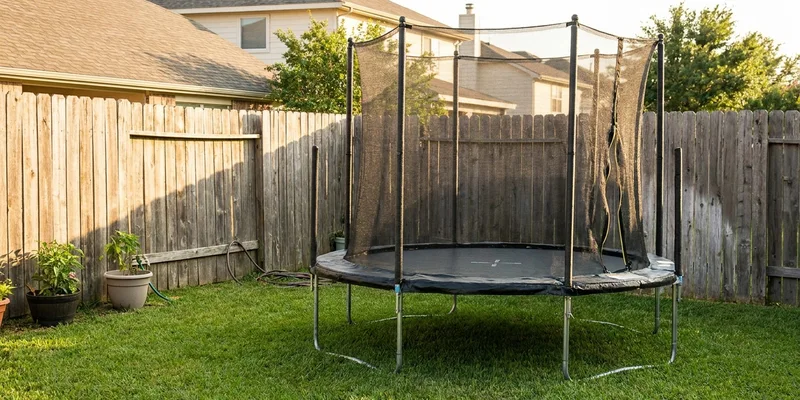
In practice the constraints in a small yard are the fence line, the house wall, a shed, and an overhanging tree. Branches are the one people forget: an enclosure net is tall and a jumper’s head goes higher still, so the clear space overhead has to account for both.
Measure the Space Before You Shop
Mark the intended footprint on the grass with a hose, then walk around it and look up. If you cannot walk the full circle without stepping into a flowerbed or ducking under a branch, the frame is too big for that spot, and the fix is a smaller frame or a different spot rather than a smaller clearance.
Our Top Picks at a Glance
How we chose: we compared widely available trampolines on overall footprint against usable jumping area, enclosure design, frame shape, and the clarity of the manufacturer’s stated weight limit and safety standard. Selections lean on manufacturer specifications and recurring themes in owner reviews rather than any hands on trial of our own.
🏆 Best Overall for a Compact Yard
A small round trampoline with a full height enclosure attached inside the frame, which keeps the net clear of the springs and gets the most jumping area out of the smallest circle.

📏 Best for a Narrow Strip of Lawn
A rectangular frame, which follows the shape of a long thin yard and keeps the usable surface where a round frame would only give you corners of dead grass.

🌿 Best Low Profile Option
An in ground kit, which drops the jumping surface close to grade so the trampoline does not dominate a small yard visually and there is no ladder to climb.

Picks by Situation: Young Children and Tight Corners
Two cases sit outside the standard small yard choice: a yard used mainly by young children, and a yard with no spot big enough for any full size frame at all.
🧒 Best for Younger Children
A smaller kids’ trampoline with a net and a low frame height, sized for a modest lawn and for jumpers who are not yet ready for a full size surface.

🏠 Best When Nothing Full Size Fits
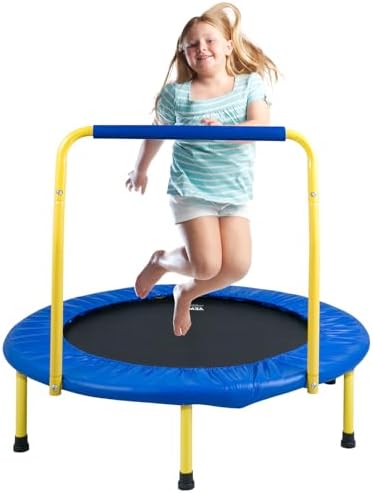
A mini trampoline with a support handle, which asks very little floor space and can move indoors in bad weather, though it gives a bounce closer to exercise than to backyard play.
Round, Rectangular, or In Ground
Round frames push a jumper back toward the middle, which is why they are the standard for family use and why they suit an open patch of lawn. Rectangular frames give a more even bounce and fit a long narrow yard far better, but they take up their full footprint in both directions with no forgiving corners.
In ground kits solve a different problem. They lower the frame close to grade, which suits an overlooked yard or a household that would rather not have a ladder. They also involve digging a hole, dealing with the spoil, and providing drainage and airflow under the mat, so treat one as a landscaping project rather than a purchase. Our guide to the in ground trampoline kit covers what the job involves.
Placing It in a Small Yard
Put the trampoline where the ground is level and firm and where the required clearance genuinely exists, rather than where it looks tidiest. Sinking one corner into a slope to make it fit is the reliable way to end up with a frame that racks and a mat that never sits square.
Keep it away from fences, walls, sheds, washing lines, and other play equipment, and anchor it, since a smaller frame moves in wind more readily than a large one. Our guide to trampoline ground anchors covers which kit suits which soil. On setback from a property line or anything an association or county might require, check locally, since those rules vary by jurisdiction.
Common Mistakes to Avoid
- Shopping by mat size instead of overall footprint. The frame and the enclosure poles sit outside the jumping surface, and that is what has to fit.
- Treating clearance as optional. The clear space around and above the trampoline is part of the installation. If it is not there, the size is wrong.
- Forgetting to look up. Branches, gutters, and washing lines all sit exactly where a jumper’s head goes.
- Buying the biggest frame that physically fits. A frame wedged against a fence has nowhere for a jumper to come off safely and nowhere for you to walk around it.
- Choosing an enclosure with poles outside the springs. That design leaves the net where a jumper can land against the springs rather than into a net.
Frequently Asked Questions
What size trampoline fits a small backyard? That depends on the clear space available around and above the frame, not on the lawn’s total area. Mark the intended footprint on the grass, check the clearance the manufacturer specifies for that model, and pick the largest size that leaves that space genuinely open.
Is a rectangular trampoline better for a narrow yard? Usually yes, because its usable jumping surface follows the shape of the space instead of leaving unusable corners. The trade off is that rectangular frames tend to cost more for a given jumping area and need their full footprint in both directions.
How much clearance does a trampoline need around it? Use the figure the manufacturer states in the manual for your specific model, since it varies by frame size and enclosure design. CPSC guidance for home trampolines also advises placing them away from structures and other play areas.
Can you put a trampoline right against a fence? No. That leaves no clear space on that side, puts the fence within reach of a jumper, and makes the trampoline difficult to walk around and maintain. Move the frame or choose a smaller one.
Are in ground trampolines a good choice for a small yard? They can be, since a lower profile suits an overlooked yard and removes the ladder. Bear in mind that installation means excavating, moving the spoil, and providing drainage and airflow beneath the mat, so it is a landscaping job rather than an afternoon of assembly.
Does a smaller trampoline still need anchoring? Yes, and arguably more, because a lighter frame moves in wind more easily. Anchor it and take the enclosure net off when severe weather is forecast, as manufacturers instruct.
The Bottom Line
Size a trampoline for a small backyard by the clear space around and above it, using the manufacturer’s stated clearance, rather than by the size of the lawn. A small round frame with the net inside the poles suits most compact yards, a rectangular frame suits a long narrow one, and an in ground kit suits a yard where profile matters more than installation effort. Then anchor it and check the stated weight limit before you order.