Last updated: August 18, 2026
A trampoline for toddlers with a net is a different product from the trampoline in your neighbor’s yard, and the difference is not just scale. The Consumer Product Safety Commission’s trampoline safety alert advises that children under six should not use a full size trampoline, which is why toddler models exist as their own category: low frames, small jumping surfaces, an enclosure the child cannot fall out of, and often a handle to hold.
This guide covers what that guidance means in practice, how toddler trampolines differ from full size frames, and what to check on a listing before ordering.
This article contains affiliate links. If you buy through them, we may earn a commission at no extra cost to you. Learn more.
Quick Answer
Which trampoline with a net suits a toddler?
- CPSC guidance is that children under six should not use a full size trampoline, so the choice for this age group is a purpose built toddler model, not a scaled down family frame.
- The features that matter are a low frame, a fully enclosed net with a zip or overlap closure, padded springs or a springless design, and a handle for balance.
- Age and weight limits vary by model. Use the manufacturer’s stated limits on the listing rather than any general figure, and treat them as the maximum, not a target.
- One child at a time, always supervised, no somersaults, and no ladder left in place. Those are the CPSC precautions, and they matter more than the model you choose.
What to Check Before You Buy
Every row below can be checked on the listing or in the manual before you order. With toddler equipment, the enclosure details and the stated limits are where the real differences sit, not in the marketing copy.
| What to check | Why it matters | What to look for |
|---|---|---|
| Stated age range | Toddler models are designed and labeled for a specific age band | The manufacturer’s stated age range on the listing, which is the figure that applies to that product |
| Stated weight limit | Small frames carry lower limits, and the limit assumes one user | A clearly stated maximum in pounds, and a note on whether it allows one jumper only |
| Net closure | An unzipped or gapping net is the most common way a small child gets out | A full height net with a zip plus a clip, or a generous overlap, and no gap between net and mat |
| Spring coverage | Springs, hooks, and the frame are the parts that cause injury on contact | A springless design, or a padded cover over springs, hooks, and frame as CPSC advises for home trampolines |
| Frame height and entry | Getting on and off is where small children fall | A low frame the child can step onto, and a zipped door rather than a ladder |
| Standard named | Shows what the product was built and labeled against | A listing naming the standard, commonly ASTM F381 for consumer trampolines and ASTM F2225 for enclosures |
What the CPSC Says About Young Children and Trampolines
The CPSC’s trampoline safety alert sets out a short list of precautions for home trampolines: one person on the trampoline at a time, no somersaults, a shock absorbing pad covering the springs, hooks, and frame, placement away from structures and other play areas, supervised use, and no ladder left in place, because a ladder gives unsupervised access to young children. It also advises that children under six should not use a full size trampoline.
That last point shapes this whole category. It is not a reason to skip trampolines entirely; it is the reason toddler specific models with low frames, small surfaces, and full enclosures are sold separately. Pediatric bodies including the American Academy of Pediatrics have also long discouraged recreational home trampoline use for young children, and their guidance is worth reading directly.
Where the Numbers Come From
You will find plenty of confident age and weight figures online. Ours come from two sources only: the CPSC guidance above, and the manufacturer’s stated limits for the specific product. For anything to do with your own child’s readiness, ask your pediatrician rather than take a figure off a product page.
Our Top Picks at a Glance
How we chose: we compared widely available toddler trampolines on enclosure design and closure, spring coverage or springless construction, handle placement, frame height, and how clearly the manufacturer states age and weight limits. Selections lean on manufacturer specifications and recurring themes in owner reviews rather than any hands on trial of our own.
🏆 Best Overall
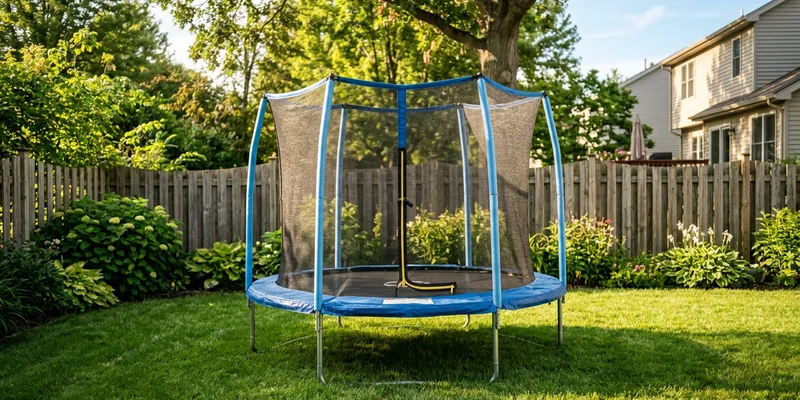
A toddler trampoline with a full height enclosure that zips closed, a padded handle inside the net, and covered springs, which is the combination that keeps a small child on the mat and away from the hardware.

🛡️ Best Springless Option
A springless toddler trampoline using elastic bands or bungees instead of steel springs, which removes the pinch points at the mat edge entirely.

🏡 Best Small Indoor and Outdoor Option
A compact kids’ trampoline with a net and a support bar, light enough to move under cover in bad weather and small enough for a patio or a modest lawn.

Picks by Situation: Siblings and All Weather Use
Two situations come up constantly with this age group: a toddler with an older sibling who also wants a turn, and a family with nowhere sheltered to put a trampoline.
👧 Best When an Older Sibling Is Around
A larger kids’ trampoline with a full net and a higher stated weight limit, which keeps an older child off the toddler’s frame instead of both trying to share one, since CPSC guidance is one jumper at a time.

☔ Best for Year Round Use
A folding toddler trampoline with a net that packs down, so it can come inside through a wet season instead of sitting out and degrading in the sun and rain.

Toddler Trampolines Compared With Full Size Frames
The obvious difference is size, but the meaningful ones are frame height, enclosure, and bounce. A toddler model sits low, so getting on and off is a step rather than a climb, and its smaller, tighter mat gives a modest bounce a small child can control. A full size frame does the opposite on all three counts.
The enclosure differs too. On toddler models the net usually attaches at the mat edge and closes with a zip and a clip, leaving no gap for a child to slip through. Many full size enclosures are built to be climbed into by someone who can manage a ladder, which is exactly the access CPSC advises against leaving available to young children. Planning ahead to a full size frame later, our guide to choosing a trampoline for a small backyard covers what the yard has to accommodate.
Rules That Actually Keep It Safe
One child on the trampoline at a time is the rule that prevents the most injuries, and the one families abandon first. Collisions and double bounces between a heavier child and a lighter one are exactly what the CPSC single jumper guidance is aimed at, and a toddler is always the lighter one.
Beyond that: supervise every session rather than watching from a window, no somersaults, no shoes and no hard toys on the mat, and check the net closure, the spring pad, and the frame before each use. Bring the trampoline in when severe weather is forecast, and anchor an outdoor frame, which our guide to trampoline ground anchors covers.
Common Mistakes to Avoid
- Putting a toddler on a full size trampoline. CPSC guidance is that children under six should not use one, and a net does not change that.
- Letting two children on at once. One at a time is the core precaution, and the size mismatch between a toddler and a sibling is what makes double bouncing dangerous.
- Leaving the ladder up. CPSC advises against it precisely because it lets a small child climb on unsupervised.
- Treating a stated weight limit as a target. It is a maximum for a single user, and it assumes the trampoline is in good condition.
- Leaving the net unzipped for convenience. The closure is the whole point of the enclosure, and an unzipped door is a gap at exactly toddler height.
Frequently Asked Questions
What age can a toddler use a trampoline with a net? The CPSC advises that children under six should not use a full size trampoline. Toddler specific models carry their own manufacturer stated age range on the listing, and that stated range is the figure to follow for a given product.
What weight limit do toddler trampolines have? It varies by model, so use the manufacturer’s stated limit rather than a general number. Treat it as a maximum for one jumper at a time and check it against your child rather than assuming a small frame implies a small limit.
Is a net enough to make a trampoline safe for a toddler? No. An enclosure reduces falls off the mat, but the CPSC precautions still apply: one jumper at a time, adult supervision, no somersaults, springs and frame covered by a pad, and no ladder left in place.
Can two toddlers jump together if they are both small? No. CPSC guidance is one person on the trampoline at a time regardless of size, and collisions between two jumpers are a common injury cause on small frames as well as large ones.
When can a child move up to a full size trampoline? Follow the CPSC guidance on age six for full size trampolines and the manufacturer’s stated age and weight ranges for the specific model, and talk to your pediatrician about your own child’s readiness rather than relying on a general rule.
The Bottom Line
For children under six, CPSC guidance points away from full size trampolines and toward purpose built toddler models: a low frame, a zipped full height net with no gap at the mat, covered springs or a springless design, and a padded handle. Take age and weight limits from the manufacturer’s listing rather than a general figure, keep it to one jumper at a time with an adult watching, and leave no ladder in place.