Last updated: August 19, 2026
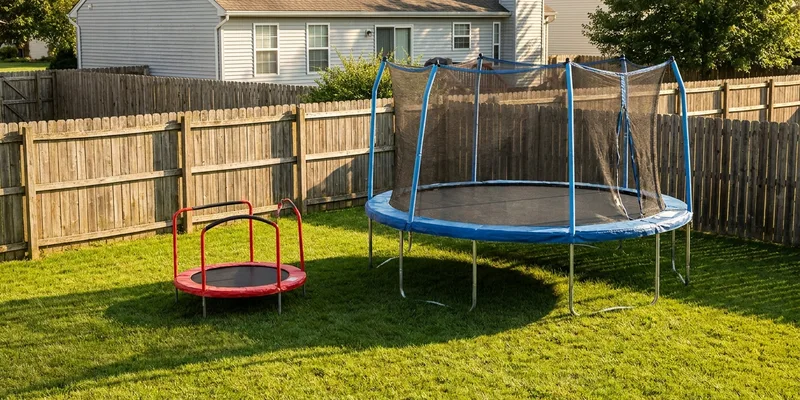
Trampoline sizes are quoted as the outside frame diameter, not the jumping surface, which is the first thing that trips people up when they measure their yard against a listing. A 14 foot trampoline needs meaningfully more than 14 feet of clear space, and the usable mat is smaller than the number on the box.
This guide compares the common diameters from 8 through 15 feet, explains what each one realistically suits, and covers the clearance, shape and weight limit questions that decide whether a size works in your yard.
This article contains affiliate links. If you buy through them, we may earn a commission at no extra cost to you. Learn more.
Quick Answer
Which trampoline size should you choose?
- Twelve and fourteen foot round trampolines are the mainstream choice for a family yard, and 14 foot is the most common size sold with a basketball hoop.
- Eight and ten foot models suit a single younger jumper or a small yard, but they get cramped fast as children grow.
- Fifteen foot and rectangular models are for larger yards and more athletic jumping; they need more clearance in every direction.
- The quoted size is the frame diameter, not the mat. Measure your clear space, not just the footprint, and keep the trampoline away from structures, trees and other play areas as CPSC trampoline safety guidance advises.
Trampoline Sizes at a Glance
The quickest way to narrow the choice is to match the diameter to the yard and to who is jumping. Sizes below are frame diameter for round models, which is how manufacturers list them. Weight limits are set per model, so always read the specification for the exact unit rather than assuming from the size.
| Size | Typically suits | Yard reality | Watch out for |
|---|---|---|---|
| 8 ft | One younger child, or a very tight yard | Fits most small lawns and some large patios with clearance to spare | Outgrown quickly; the usable mat is noticeably smaller than the frame |
| 10 ft | One child, or two taking turns | Workable in a modest suburban back yard | Feels small to an older child; limited room to land off center |
| 12 ft | The common family size for mixed ages | Needs a genuinely open stretch of lawn, not a corner | Check the enclosure pole count, since taut netting matters more at this size |
| 14 ft | Older children and the usual hoop size | Dominates a small yard; suits medium to large lawns | More surface for wind to catch, so anchoring becomes important |
| 15 ft | Larger yards and taller jumpers | Wants clear space in every direction, including overhead | Harder to relocate, and replacement parts are less commonly stocked |
| Rectangular | More athletic, repetitive jumping | Footprint measured in two dimensions; often longer than any round model | Bounce is more even across the mat, which suits confident jumpers rather than beginners |
If a hoop is part of the plan, size interacts with that choice directly. Our guide to the trampoline with basketball hoop covers why 12 and 14 foot models dominate that category.
How Much Space Each Size Really Needs
You need the frame diameter plus clearance on every side, plus clear space overhead. CPSC trampoline safety guidance advises placing the trampoline away from structures, trees and other play areas, without setting a single distance, so the practical approach is to walk the site and look for what a jumper could reach: fence tops, low branches, a shed corner, a washing line, a downspout.
Overhead clearance is the one people forget. A jumper on a mat gains real height, and branches directly above the trampoline are a hazard even when the trunk is well clear of the frame. Look up before you decide, in leaf and out of leaf, because a bare winter canopy hides how low the summer growth will hang.
Frame Diameter Is Not Mat Diameter
The number on the box is the outside of the frame. Springs and the frame pad occupy a band around the perimeter, so the actual jumping surface is smaller. This is why a 10 foot trampoline can feel tight for a nine year old even though the footprint looks generous on paper, and it is worth checking the stated mat dimension separately when a manufacturer publishes it.
Round, Oval and Rectangular
Shape changes the bounce more than the size does. Round trampolines pull a jumper back toward the center, which is forgiving for younger children and the main reason they dominate backyard sales. Rectangular trampolines give a more consistent bounce across the whole mat, which is what gymnastics oriented jumpers want and what makes them less self correcting for a beginner.
Oval models sit between the two and suit long narrow yards where a big circle will not fit but a stretched footprint will. For most families buying a first trampoline, round is the sensible default, and the choice then comes down purely to diameter.
Weight Limits and What They Actually Mean
A stated weight limit is a manufacturer specification for that model, not a general rule tied to diameter, and it is not a licence to put several people on the mat at once. CPSC trampoline safety guidance is explicit that only one person should be on a trampoline at a time, so the limit describes the single heaviest jumper the frame and springs are rated for rather than a combined total.
Two trampolines of the same diameter can carry very different ratings depending on frame gauge, spring count and mat construction. Read the specification for the exact unit, and treat a listing that does not state a limit at all as missing information worth asking about.
Matching Size to Age
Size and age are separate questions, and the age one has a firmer answer. CPSC trampoline safety guidance states that no child under six years of age should use a full size trampoline. That applies regardless of whether the model is 8 foot or 15 foot, so a small diameter does not make a full size trampoline suitable for a toddler; equipment designed specifically for very young children is a different product category.
For school age children, buy for the age they will be in three years rather than the age they are now. The most common regret owners describe is a trampoline that felt right for a six year old and cramped for a nine year old, and swapping diameters later means selling or storing a large steel frame.
Choosing a Small Trampoline for Kids
A small trampoline for kids usually means an 8 or 10 foot round model with a full enclosure net. That size gives one school age child a real bounce while fitting yards where a 12 foot frame would crowd the clearance zone, and the lower jump height it produces is part of the appeal for parents.
Two cautions keep the choice honest. First, small does not mean toddler safe: CPSC guidance keeps children under six off full size trampolines at every diameter, and equipment for that age group is a separate category we cover in our guide to trampolines for toddlers. Second, an 8 foot mat is outgrown faster than any other size, so weigh the space savings against a shorter useful life.

Common Mistakes to Avoid
- Measuring the footprint but not the clearance. The trampoline needs open space around and above it, not just a patch of lawn the size of the frame.
- Confusing frame diameter with jumping surface. Springs and the frame pad take up a band around the edge, so the usable mat is smaller than the quoted size.
- Buying for this year’s height. Children grow into a bigger mat quickly, and a size swap later means disposing of a large steel frame.
- Reading a weight limit as a combined total. It describes a single jumper, and CPSC guidance is one person on the trampoline at a time regardless.
- Ignoring wind at larger diameters. More surface area means more lift, so anchoring matters more as the size goes up.
- Assuming a small trampoline is a toddler trampoline. CPSC guidance keeps children under six off full size trampolines whatever the diameter.

Frequently Asked Questions
What is the most common trampoline size? Twelve and fourteen foot round models are the mainstream backyard sizes in the United States, with 14 foot being the usual diameter for versions sold with a basketball hoop.
Is a 12 ft trampoline big enough for two kids? It is large enough physically, but CPSC trampoline safety guidance calls for only one person on the trampoline at a time, so plan on taking turns rather than sizing up to fit two jumpers at once.
How much space do you need around a trampoline? Enough that a jumper cannot reach a fence, wall, tree branch or another play structure. CPSC trampoline safety guidance advises placing the trampoline away from structures, trees and other play areas without setting one distance, so assess your own site including the space overhead.
Is the trampoline size the mat or the frame? The frame. Manufacturers quote the outside diameter of the frame, and the springs plus the frame pad reduce the actual jumping surface, so the usable mat is always smaller than the advertised size.
What size trampoline is best for a small backyard? Eight or ten foot round models fit tighter spaces while leaving clearance, though they are outgrown faster. Measure the clear space including overhead before choosing, since clearance rather than the lawn area is usually the limiting factor.
Are rectangular trampolines better than round ones? Better for a different purpose. Rectangular mats give a more even bounce across the surface, which suits athletic jumping, while round mats pull a jumper back toward the center and are more forgiving for younger children.
What age can a child use a full size trampoline? CPSC trampoline safety guidance states that no child under six years of age should use a full size trampoline, and that applies to every diameter.
What is a good small trampoline for a child? An 8 or 10 foot round model with a full enclosure net is the usual answer for one school age jumper in a compact yard. It is not a toddler product though: CPSC guidance keeps children under six off full size trampolines regardless of diameter.
The Bottom Line
For most families the choice is 12 or 14 foot round, and the deciding factor is clearance rather than lawn area: measure what a jumper could reach on every side and overhead before you settle on a diameter. Remember the quoted number is the frame, not the mat, buy for the age your children will be in a few years, and treat the weight limit as a single jumper figure because CPSC guidance keeps it to one person on the mat at a time.