Last updated: August 18, 2026
A slackline for kids is a wide webbing strap tensioned between two anchor points at roughly knee height, and one of the few pieces of backyard play equipment that genuinely improves balance rather than just burning energy. Almost all the difference between a line children use daily and one that gets rolled up after a week comes down to width, height and whether a second training line is included.
This guide covers what to check on a listing, why beginners need an overhead line to hold, which figures belong to the manufacturer rather than to any article, and what should be underneath.
This article contains affiliate links. If you buy through them, we may earn a commission at no extra cost to you. Learn more.
Quick Answer
Which slackline should you buy for kids?
- Choose a two inch wide line rather than a one inch line. The wider webbing is more stable underfoot and far more forgiving for a child who is still learning to stand on it.
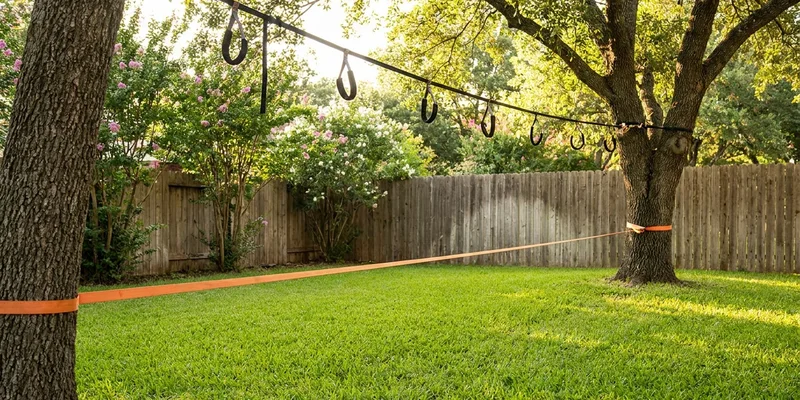
- Buy a kit that includes a training line, the second strap that runs overhead for beginners to hold. Children who can hold something stay on the line long enough to improve; children who cannot give up.
- Take height, tension and weight limits from the kit’s own instructions. Those figures are set by the webbing, the ratchet and the span, and they are not transferable between kits.
What to Check Before You Buy a Kids Slackline
A slackline kit is webbing, a ratchet and some straps, so little goes wrong in manufacture. The disappointment nearly always comes from a mismatch between the kit and the child, and every row below can be checked on the listing before you order.
| What to check | Why it matters | What to look for |
|---|---|---|
| Webbing width | Sets how stable the line feels underfoot for a beginner | Two inch webbing for children, rather than the one inch line experienced users prefer |
| Training line included | Decides whether a child can stay upright long enough to learn | A second overhead strap with its own ratchet, not an accessory sold separately |
| Total length | Has to span your anchor points with slack left for the ratchet | A stated length clearly longer than the distance you measured between trunks |
| Stated weight limit | Adults and older siblings will use it too | A weight rating on the listing, checked against the heaviest likely user |
| Ratchet and cover | The ratchet is the only real pinch point on the whole kit | A metal ratchet with a smooth release and a padded cover over the mechanism |
| Tree protection | Webbing under tension cuts into bark | Wide padded sleeves supplied for both anchor points, not just one end |
If what your children actually want is to hang and swing rather than to balance, the ninja line for kids is the related product, and the wider climbing and active play section covers the rest.
Two Inch Webbing, Not One Inch
Width is the first decision and the easiest to get wrong, because the one inch line looks more serious. One inch webbing rolls under the foot and demands ankle strength a young child does not have yet. Two inch webbing sits flatter, twists less and gives a beginner a surface they can actually stand on.
The trade off is that a wide line feels less lively to an experienced user, which is why adults eventually move to one inch. That is a problem for later.
Webbing material and stretch
Polyester webbing stretches less than nylon and holds tension better through a long afternoon, so the line does not need retightening every hour. Nylon has more spring, which is fun for bouncing and harder to balance on. For a children’s line, less stretch is the more useful property.

Length, Height, and Tension
Measure the gap between your two anchor points at the height you plan to set the line, then buy a kit noticeably longer than that number, because the ratchet consumes webbing as you tension it. Kits come in a short backyard length, a mid length and a long version, and the mid length suits most suburban yards.
Height and tension are different. Both are stated by the kit manufacturer for that specific webbing, ratchet and span, and both change how the line behaves under a rider’s weight. Take them from the instructions supplied with your kit rather than from a figure quoted anywhere else, including here.
Shorter is easier
A long line sags deeply in the middle and swings more, which is harder for a beginner even when set correctly. If your anchor points are far apart, most kits let you rig over part of the span and manage the excess webbing at the anchor.
Our Top Picks at a Glance
How we chose: we compared widely available slackline kits on webbing width and material, whether a training line and ratchet come in the box, stated weight limits, and whether tree protection is supplied for both ends. These picks lean on manufacturer specifications and recurring themes in customer reviews rather than any hands-on trial of our own.
🏆 Best Overall
A two inch polyester kit supplied with a full length training line, two ratchets and padded tree protection at both ends, which is the combination that keeps children on the line long enough to get good at it.
🌳 Best for Longer Spans
A longer two inch line with a higher stated weight limit, for yards where the trees are well apart and older children or adults will use it as well.

💚 Best Starter Kit
A short line with a simple ratchet and protectors, enough to find out whether balancing appeals before committing to a longer setup.

Why the Training Line Matters
The training line is a second strap tensioned above the main line, at roughly shoulder or head height, that a beginner holds while learning to stand. It is the single feature that separates a kit children keep using from one they abandon, because balancing without something to hold takes longer than most children will persist for.
Some kits sell the training line as an add-on. That works, but it needs its own ratchet and tree protection, so bundled is usually simpler. Set it high enough that a child stands upright to hold it, and drop it out of the way once they stop reaching for it.
Anchors, Trees, and the Ground Below
Both ends of a slackline are under real tension, and webbing against bare bark scars a trunk over a season and can girdle a young tree. Wrap both anchor points with the padded protectors before the webbing goes on. Whether a particular tree can take the load at all is a question for a certified arborist, since species, trunk diameter, lean and root condition all matter and none of them is visible from the lawn. Fence posts, deck railings and gazebo uprights are not anchor points.
Children fall off a slackline constantly, which is fine at knee height over a forgiving surface and less fine over anything else. Keep the ground beneath the whole span clear of roots, rocks and edging. The CPSC Public Playground Safety Handbook ties protective surfacing to the fall height, meaning the distance from the highest point a child stands down to the surface below, and specifies a use zone extending a minimum of 6 feet (1.8 m) in all directions from the perimeter of stationary equipment. Our guide to playground surfacing depth covers what it recommends.
Common Mistakes to Avoid
- Buying a one inch line for a beginner. It rolls underfoot and demands ankle strength most children have not developed. Two inch webbing is the children’s answer.
- Skipping the training line. It is the difference between a week of use and a summer of it.
- Guessing at tension. The kit instructions give the tension for that webbing and ratchet. Over tightening puts more force into the trees and does not improve the line.
- Anchoring to a fence post or deck rail. Neither is designed for a sustained sideways pull, and both fail in ways you do not see coming.
Frequently Asked Questions
What age can a child start slacklining? Children who can walk confidently and follow a simple instruction can start on a low line with a training strap to hold, and many kits are marketed from preschool age upward. The useful test is whether the child can be trusted to step off rather than jump when they lose balance.
How wide should a kids slackline be? Two inches. The narrower one inch webbing that experienced users prefer twists under the foot and is much harder for a beginner to stand on.
How high should a slackline be set? At the height the kit manufacturer specifies, which depends on the webbing, the ratchet and the span. Lower is easier and safer to learn on, and the line sags under weight, so the height with a child on it is not the height you set.
What is a training line for? It is a second strap tensioned overhead for a beginner to hold while learning to balance. It is the feature that keeps children on the line long enough to improve, and it needs its own ratchet and tree protection.
Does a slackline damage trees? It can, if the webbing sits against bare bark under tension. Padded protectors on both anchor points prevent most of it, and a certified arborist is the right person to say whether a given tree should be used at all.
The Bottom Line
Buy two inch webbing with a training line included, measure the span before choosing a length, and set the line short and low to begin with. Take the height, tension and weight figures from the kit instructions, protect both trunks with padded sleeves, and keep the ground under the whole span clear. A slackline a child can stand on in the first week stays up all summer.