Last updated: August 18, 2026
Playground surfacing depth is not a single number, and that is the first thing worth clearing up. It depends on the material and on how far a child can fall onto it, and the CPSC publishes a table that pairs the two. Nine inches of one material protects a 4 foot fall. Nine inches of another protects 10 feet.
This guide sets out those figures exactly as the CPSC gives them, explains how to measure the fall height of your own equipment, and covers the part most people miss: the depth you install is not the depth you end up with.
Quick Answer
How deep does playground surfacing need to be?
- The CPSC Public Playground Safety Handbook advises never using less than 9 inches of loose fill material, with shredded or recycled rubber the one exception at a recommended 6 inches.
- Those are compressed depths. The same handbook notes loose fill compresses at least 25 percent over time, and gives the example that a playground needing 9 inches of wood chips should be filled to 12 inches initially.
- What 9 inches protects depends on the material: 10 feet of fall height for wood chips, 7 feet for wood mulch that is not CCA treated, 5 feet for pea gravel, and 4 feet for sand.
- For home play equipment under 4 feet high, the CPSC Outdoor Home Playground Safety Handbook allows a minimum of 6 inches, noting that below 6 inches the material is too easily displaced or compacted.
The CPSC Depth Table
Table 2 of the CPSC Public Playground Safety Handbook lists minimum compressed loose fill surfacing depths against the fall height each one is expected to protect. The right hand column below is the initial fill depth you order, allowing for the compression the handbook describes.
| Material | Compressed depth | Protects to fall height | Initial fill depth |
|---|---|---|---|
| Shredded or recycled rubber | 6 inches | 10 feet | 6 inches, since it does not compress the same way |
| Wood chips | 9 inches | 10 feet | 12 inches |
| Wood mulch, not CCA treated | 9 inches | 7 feet | 12 inches |
| Pea gravel | 9 inches | 5 feet | 12 inches |
| Sand | 9 inches | 4 feet | 12 inches |
The handbook adds a footnote to the rubber row: shredded and recycled rubber loose fill does not compress in the same manner as other loose fill materials, but care should still be taken to maintain a constant depth because displacement still occurs.
How to Measure Your Fall Height
Fall height is the number you look up the table with, and the CPSC defines it as the distance between the highest designated play surface on a piece of equipment and the protective surface beneath it. A designated play surface is somewhere a child is intended to stand, sit, or climb on, so it is the deck of the tower or the top rung of the climber, not the peak of the roof above it.
Swings are measured differently. The CPSC states that the fall height for swings is the vertical distance between the pivot point and the protective surfacing beneath it, which is the top bar the swing hangs from rather than the seat. That usually makes the swing the tallest fall height on a backyard play set, and therefore the number that decides your surfacing.
Match the rating to the tallest piece
Where a critical height rating is published for a tested surface, the CPSC advises that it should be greater than or equal to the fall height of the highest piece of equipment on the playground. In a backyard with one composite play set, that means you size the surfacing to the highest deck or the swing beam, not to an average.
Why You Fill Deeper Than the Finished Depth
Every depth in the CPSC table is a compressed depth, measured after the material has settled from use and weathering. The handbook is explicit that loose fill materials compress at least 25 percent over time, and it walks through the arithmetic itself: if the playground will require 9 inches of wood chips, the initial fill level should be 12 inches.
The CPSC Outdoor Home Playground Safety Handbook repeats the point for backyards, noting that an initial fill level of 12 inches will compress to about a 9 inch depth over time, and that the surfacing will also compact, displace, and settle and should be periodically refilled to maintain at least a 9 inch depth. In practice that means the day you finish spreading it is the only day the depth is generous.
Depth Rules for Lower Backyard Equipment
Not every backyard has a tall tower, and the home handbook accounts for that. It advises maintaining a minimum depth of 9 inches of loose fill such as wood mulch, wood chips, engineered wood fiber, or shredded and recycled rubber mulch for equipment up to 8 feet high, and 9 inches of sand or pea gravel for equipment up to 5 feet high.
Below 4 feet of equipment height the same handbook allows a minimum of 6 inches of protective surfacing, and says that if maintained properly this should be adequate. It also explains the floor: at depths less than 6 inches, the protective material is too easily displaced or compacted. That is the reason a token scattering of mulch is not a shallow version of protection, it is no protection.
The toddler exception
The CPSC advises that loose fill be avoided for playgrounds intended for toddlers, which points toward a unitary surface tested to ASTM F1292 instead. Ground level equipment such as sandboxes, playhouses, and activity walls needs no protective surfacing at all, since there is nothing to fall from.
Where the Depth Has to Extend To
Depth without area does not help. The CPSC Outdoor Home Playground Safety Handbook advises extending surfacing at least 6 feet from the equipment in all directions, and further to the front and rear of swings: a distance equal to twice the height of the top bar from which the swing is suspended. For tire swings it recommends a circle whose radius equals the height of the suspending chain or rope plus 6 feet in all directions.
Those distances define the surfaced area you have to keep at full depth, not just the patch immediately under the deck. Our swing set safety zone guide covers how to lay those measurements out in a real yard before you order material.
Keeping the Depth Once It Is Installed
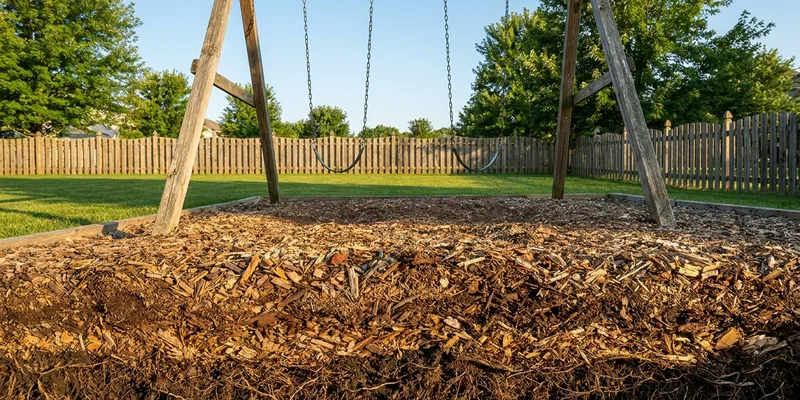
The CPSC calls for frequent maintenance of loose fill surfacing so that levels never drop below the minimum depth, and singles out the areas under swings and at slide exits as more susceptible to displacement. Its maintenance checklist treats raking and fluffing compacted surfacing as a task distinct from topping up.
Two habits from the handbook are worth copying. Mark the minimum fill level on the equipment support posts, so checking the depth is a glance rather than a measurement. And take drainage seriously, since standing water reduces effectiveness and leads to compaction and decomposition. The handbook also notes that critical height may be reduced during winter where the ground freezes.
Never Over Concrete or Asphalt
The CPSC Outdoor Home Playground Safety Handbook is unambiguous for backyards: do not install home playground equipment over concrete, asphalt, or any other hard surface, and do not install loose fill surfacing over hard surfaces such as concrete or asphalt. Grass and dirt do not count as protective surfacing either, because wear and environmental factors reduce their shock absorbing effectiveness.
The public playground handbook does describe a layered build for existing sites where a hard surface cannot be removed, using a drainage layer of loose fill, geotextile cloth, the surfacing itself, and impact mats under high traffic areas. That is not a backyard shortcut: CPSC staff strongly recommend against installing over hard surfaces in the first place.
Frequently Asked Questions
How deep should playground mulch be? The CPSC Public Playground Safety Handbook advises never using less than 9 inches of loose fill material, except shredded or recycled rubber at a recommended 6 inches. Fill to 12 inches so it settles to 9.
Is 6 inches of mulch enough? Only for shredded or recycled rubber, or for home equipment less than 4 feet high, where the CPSC home handbook allows a 6 inch minimum. Below 6 inches, material is too easily displaced or compacted.
How deep does pea gravel need to be under a swing set? Nine inches compressed, according to the CPSC surfacing table, and that depth is rated to protect a fall height of 5 feet.
What fall height does 9 inches of wood chips protect? Ten feet, per the CPSC table. Wood mulch that is not CCA treated at the same depth protects 7 feet.
How do I measure the fall height of my play set? Measure from the highest surface a child stands or sits on down to the surfacing. For swings, measure from the pivot point at the top bar instead.
Does frozen ground change anything? Yes. The CPSC notes that critical height may be reduced during winter in areas where the ground freezes, so surfacing performs less well in hard frost.
The Bottom Line
Look up your tallest fall height, then match it to a material and a depth from the CPSC table rather than picking a depth first. Nine inches is the floor for every loose fill material except shredded rubber at 6 inches, fill 12 inches deep so it settles to 9, extend it at least 6 feet in all directions and further behind swings, and rake it back into the hollows before the depth quietly drops below the minimum.