Last updated: August 18, 2026
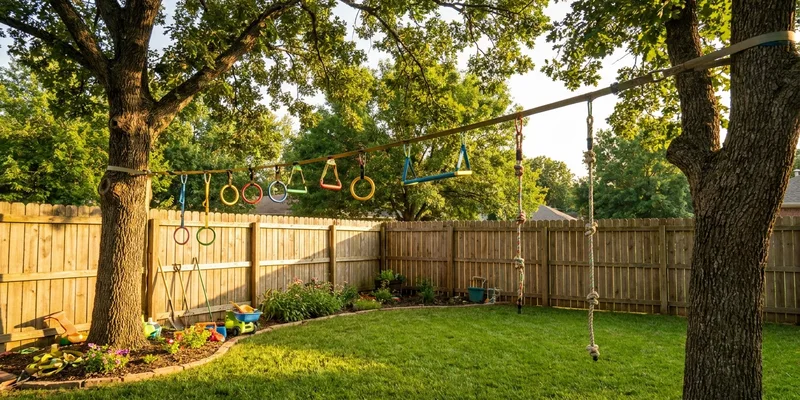
A ninja line for kids is the cheapest way to turn two trees into an obstacle course, and it is also the play equipment parents most often buy in the wrong length. The line itself is a heavy webbing strap with a ratchet on one end. Everything that makes it fun, the hanging rings, the rope ladder, the monkey bars and the trapeze, clips on separately.
This guide covers how to size the line to your yard, which obstacles are worth hanging and which ones sit unused, and what to check on the listing before you buy a kit.
This article contains affiliate links. If you buy through them, we may earn a commission at no extra cost to you. Learn more.
Quick Answer
Which ninja line should you buy for your kids?
- Measure the gap between your two anchor points first, then buy a line comfortably longer than that gap. A line stretched to its limit sags badly once a child hangs from it.
- For most yards a mid length kit with six to eight obstacles gives enough variety without crowding the line, and leaves room to add pieces later.
- Hang it low. The line should sit high enough that feet clear the grass and low enough that a slip is a short drop onto soft ground.
What to Check Before You Buy a Ninja Line
Every row below is something you can confirm on the product listing before ordering. Ninja lines are simple products, so almost all of the disappointment comes from a mismatch between the kit and the yard rather than from build quality.
| What to check | Why it matters | What to look for |
|---|---|---|
| Total line length | The line has to span your anchor points and still leave slack for the ratchet | A stated length that clearly exceeds the distance you measured between the two trees |
| Stated weight limit | Adults and teenagers use these too, not just the child it was bought for | A weight rating printed on the listing, checked against the heaviest person likely to try it |
| Number and type of obstacles | Determines how long the novelty lasts and how much of the line gets used | A mix of grip types: rings, a rope ladder, a bar and at least one that spins or swings |
| Tree protectors included | A bare ratchet strap under tension cuts into bark | Wide padded sleeves for both anchor points, not just the ratchet end |
| Ratchet quality and cover | The ratchet is the only part under real load and the only pinch point | A metal ratchet with a smooth release and, ideally, a padded cover |
A ninja line and a set of fixed bars solve different problems. If your kids mostly want to hang and swing hand over hand, our guide to monkey bars for the backyard covers the rigid option, and both sit in our wider climbing and active play section.
How Long Should a Ninja Line Be?
Start with a tape measure, not a product page. Measure the distance between the two trunks at the height you plan to hang the line, then buy a kit noticeably longer than that number. The ratchet consumes webbing as you tension it, and a line that only just reaches will end up either too tight to enjoy or too slack to walk under.
Kits are commonly sold in a short backyard length, a standard mid length and a long version aimed at bigger properties. The mid length suits the majority of suburban yards with two mature trees. Longer is not automatically better, because a long line with only a few obstacles leaves large empty stretches that nobody uses.
What if you only have one tree?
The second anchor has to be something that will not move under a sideways pull, which rules out fence posts, deck railings and most gazebo uprights. A purpose built post set in concrete works, and some kits state that a swing set frame is acceptable. If the manufacturer does not say a frame is suitable, do not assume it is.
Which Obstacles Are Worth Hanging
The obstacles that get used are the ones a child can reach and hold. Gymnastic rings, a short rope ladder and a straight bar cover most of what kids actually do on a ninja line, and every kit includes some version of those three. The pieces that sit unused tend to be the ones sized for adult grip strength or hung too high to reach from the ground.
Variety matters more than quantity. A line with six well spaced obstacles of different grip types gets more play than a line crowded with a dozen near identical plastic holds, because each different grip forces a different movement.
Spacing them out
Leave enough gap between obstacles that a child swinging on one cannot collide with the next. Sliding buckles make this easy to adjust after the first session, and you should expect to move everything at least once in the first week.

Our Top Picks at a Glance
How we chose: we compared widely available ninja line kits on stated length and weight limits, the mix of obstacles included, and whether tree protectors come in the box. These picks lean on manufacturer specifications and recurring themes in customer reviews rather than any hands-on trial of our own.
🏆 Best Overall
A mid length kit with a metal ratchet, padded tree protectors on both ends and a mixed set of rings, a bar and a rope ladder, which is the combination that suits an average suburban yard with two mature trees.

🌳 Upgrade Pick
A longer heavy duty line with a higher stated weight limit and more obstacles, worth it if teenagers or adults will use it as well and you have the span between trees to justify the length.

💚 Best Value
A short starter line with a handful of obstacles, enough to find out whether your kids take to it before committing to a full course.

Setting It Up Without Damaging Your Trees
Wrap both trunks with the supplied protectors before the webbing goes on. A tensioned strap on bare bark scars the tree over a season and can girdle a young trunk, and the protectors also stop the webbing itself from abrading against rough bark. Choose living, healthy trunks with no visible rot, and avoid anything you would hesitate to hang a rope swing from.
Tension the ratchet until the line stops touching the ground under load, then stop. Over tightening does not make the course better, it just puts more force into the trees and the hardware. Release the tension at the end of the season rather than leaving the line loaded through the winter.

Height, Landing Surface, and Supervision
Hang the line so that a hanging child’s feet stay just clear of the ground. That single decision does more for safety than any other setting, because the whole point of a ninja line is that kids let go, and a short controlled drop is a non event while a high one is not. Loose grass over compacted soil is the most common landing surface and it is not especially forgiving.
The CPSC Public Playground Safety Handbook ties the amount of protective surfacing needed to the fall height, meaning the distance from the highest point a child grips down to the surface below. That handbook is written for public playgrounds rather than a strap between two trees, but the principle transfers, and our guide to playground surfacing depth covers what it specifies.
Common Mistakes to Avoid
- Buying a line that only just spans the gap. The ratchet eats webbing. Measure first, then buy longer than you measured.
- Skipping the tree protectors. They are in the box for a reason, and bark damage from a tensioned strap does not grow back quickly.
- Hanging it high because it looks more impressive. Height adds nothing to the play value and adds everything to the fall.
- Anchoring to a fence post or deck rail. Neither is built for a sustained sideways pull, and both fail in ways that are hard to see coming.
Frequently Asked Questions
What age is a ninja line suitable for? Most kits are marketed at school-age children, and the practical limit is whether a child can reach and grip the first obstacle without being lifted. Younger children need the line hung low and obstacles chosen for small hands rather than adult sized rings.
How far apart do the trees need to be? Far enough that the kit length exceeds the span with room left over for the ratchet. Measure the actual distance between the trunks at hanging height before choosing a length, since kit lengths are stated for the whole line, not the usable span.
Can I attach a ninja line to a swing set? Only if the manufacturer of both the line and the swing set says so. A frame designed for vertical swing loads is not automatically rated for the sideways pull of a tensioned line, so check both sets of instructions rather than assuming.
How high should a ninja line be hung? Low enough that a hanging child’s feet nearly touch the ground. Kids will let go, and the height you hang it at determines whether that is a step down or a fall.
Do ninja lines damage trees? They can, if the webbing sits directly against bark under tension. Padded tree protectors on both anchor points prevent most of it, and releasing the tension out of season prevents the rest.
The Bottom Line
Buy the ninja line to fit your yard rather than the other way around: measure the span between anchor points, choose a kit comfortably longer, and hang it low enough that letting go is uneventful. A mid length line with six to eight varied obstacles covers most families, and adding a spare set of rings later costs far less than replacing a line that never fit.