Last updated: August 18, 2026
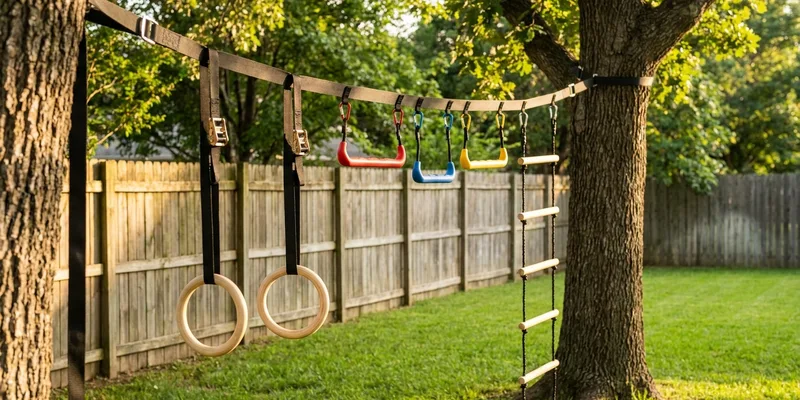
A ninja warrior obstacle course for kids is sold in two very different forms, and buying the wrong one is the main reason these kits end up in a garage. One is a tensioned line strung between two anchor points with obstacles clipped along it. The other is a freestanding steel rig that stands on its own legs and needs no trees at all.
This guide covers which format suits which yard, which obstacles get used, what the CPSC recommends for the height children hang at, and what goes underneath.
This article contains affiliate links. If you buy through them, we may earn a commission at no extra cost to you. Learn more.
Quick Answer
Which ninja warrior course should you buy for your kids?
- Two mature trees the right distance apart means a hanging line kit, which gives the most course for the money. No trees means a freestanding rig, and there is no sensible workaround in between.
- Buy for grip variety rather than obstacle count. Rings, a bar, a rope and one piece that spins cover almost everything children actually do; a dozen near identical plastic holds do not.
- Hang everything low enough that letting go is a step down. Height adds nothing to the play and everything to the fall.
The Four Ways to Build a Course
Every kit is one of four things, and the choice is made by your yard rather than your budget. Work out which row you are in before comparing products, because the specifications that matter differ in each case.
| Format | What it needs | Strengths | Limits |
|---|---|---|---|
| Hanging line kit | Two solid anchor points, usually mature trees | The longest course for the least money, easy to reconfigure | Useless without anchors, and the line sags as children grow heavier |
| Freestanding rig | A level patch of ground and anchors or footings | Works in any yard, fixed height, no tree damage | Shorter runs, heavier to move, more to store over winter |
| Add-on obstacle set | An existing line or rig with spare span | Cheap way to refresh a course kids have solved | Clip and buckle types have to match what you already own |
| Playset mounted | Written approval from the set’s manufacturer | Uses a structure that is already anchored and braced | Most swing beams are not rated for sideways obstacle loads |
If a simple tensioned line is what you are after rather than a full course, our guide to the ninja line for kids covers lengths and setup in detail, and the wider climbing and active play section has the rest.
Hanging Line or Freestanding Rig?
Trees decide it. A hanging kit needs two healthy trunks far enough apart that the line spans them with slack to spare, and both have to be sound rather than merely large. If you have that, a line kit buys far more course length than a rig. If you do not, a freestanding rig is the honest answer.
Rigs are sold by frame length and by height, and the useful ones adjust. A fixed height rig sized for a nine year old is a wall for a five year old, while an adjustable frame follows the children for several seasons. Look for stated adjustment steps rather than a single overall height figure.
What a rig gives up
A rig will always be shorter than a line between two trees, so the course is less about distance and more about difficulty. That suits some children better, since a short run they can finish beats a long one they fall off halfway.

Which Obstacles Earn Their Place
The pieces that get used are the ones a child can reach from the ground and hold with one hand. Gymnastic rings, a straight bar, a knotted rope and a rope ladder cover most real play on any course. The ones that hang untouched are sized for adult grip strength or mounted too high to start from standing.
Variety of grip beats quantity of obstacles. Six well spaced pieces that each demand a different hand position produce more play than a dozen similar plastic holds crowded together, because each new grip forces a new movement rather than a repeat of the last one.
Spacing and swing room
Leave enough gap that a child swinging on one obstacle cannot reach the next, and expect to move everything at least once after the first session. Sliding buckles make that quick on a line kit; on a rig the mounting points are usually fixed.

Our Top Picks at a Glance
How we chose: we compared widely available ninja course kits on the obstacle mix supplied, stated weight limits, whether height is adjustable, and whether anchoring hardware or tree protection is in the box. These picks lean on manufacturer specifications and recurring themes in customer reviews rather than any hands-on trial of our own.
🏆 Best Overall
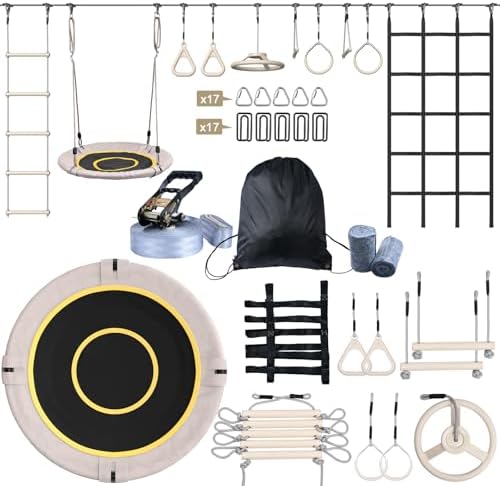
A hanging kit with a mid length line, padded protectors for both anchor points and a mixed set of rings, a bar, a rope and a rope ladder, which is the combination that suits a suburban yard with two mature trees.

🏗️ Best Without Trees
An adjustable freestanding steel rig that stands on its own legs, so the course does not depend on anchor points you do not have and the height moves up as the children grow.
🧒 Best for Younger Children
A short course with low mounted rings and a rope ladder rather than adult sized holds, for children who need to start from standing rather than from a jump.
Age, Reach, and Hanging Height
Hanging is upper body work, and the CPSC Public Playground Safety Handbook is clear that it is not for the youngest children. The handbook notes that four year olds are generally the youngest able to use upper body equipment such as horizontal ladders, and gives its recommendations in two age bands.
For height, the handbook recommends a maximum measured from the grasping surface down to the protective surface below of 60 inches (152 cm) for preschool-age children and 84 inches (213 cm) for school-age children. Those are ceilings, not targets. On a course where children deliberately let go, hanging lower is better play as well as a shorter fall.
Grip size matters more than it sounds
The handbook caps the grasping diameter of a rung at 1.55 inches (39 mm), because a hand that cannot close around a bar loses its grip before the arms give out. Rings and rope are self adjusting, but any fixed bar or hold on a kit is worth measuring against that figure if young children will use it.
Underneath the Course, and Holding It Down
Children fall off ninja courses constantly, which is the point of them, so the ground is part of the purchase. The CPSC Public Playground Safety Handbook advises never using less than 9 inches of loose fill material, with shredded or recycled rubber the one exception at a recommended 6 inches, and specifies a use zone extending a minimum of 6 feet (1.8 m) in all directions from the perimeter of stationary equipment. Grass over compacted soil does not count as protective surfacing. Our guide to playground surfacing depth has the full CPSC table.
A freestanding rig also has to be held down, because children swinging along a frame put a rocking load into it that lifts one end. Follow the kit’s own anchoring instructions rather than reaching for a generic stake. A hanging kit puts that load into the trees instead, so wrap both trunks with the supplied protectors and release the tension out of season. Whether a given tree is a suitable anchor at all is a question for a certified arborist.
Common Mistakes to Avoid
- Buying a line kit without usable anchor points. Fence posts, deck rails and most gazebo uprights are not built for a sustained sideways pull.
- Choosing on obstacle count. Twelve similar holds give less play than six that each demand a different grip.
- Hanging everything high because it looks impressive. The course is designed around children letting go, so the height you set is the height they drop from.
- Leaving the lawn as the landing surface. Turf over compacted soil absorbs very little, and the CPSC surfacing recommendations exist for exactly this reason.
Frequently Asked Questions
What age is a ninja warrior course suitable for? The CPSC Public Playground Safety Handbook notes that four year olds are generally the youngest children able to use upper body equipment such as horizontal ladders. Beyond that, readiness is whether a child can hang unsupported and let go under control rather than a birthday.
Do you need trees for a ninja course? Only for a hanging line kit, which needs two sound trunks the right distance apart. A freestanding rig works in a yard with no trees at all, at the cost of a shorter run.
How high should the obstacles hang? Low enough that a hanging child’s feet nearly touch the ground. The CPSC handbook caps grasping height at 60 inches (152 cm) for preschool-age children and 84 inches (213 cm) for school-age children, and those are maximums rather than aims.
What should go under a ninja course? Protective surfacing rather than lawn. The CPSC handbook advises never less than 9 inches of loose fill, with shredded or recycled rubber the exception at a recommended 6 inches, extending at least 6 feet in all directions from the equipment.
Can you attach a ninja course to a swing set? Only where the swing set’s manufacturer states that the frame accepts that load. A beam engineered for the vertical pull of a swing is not automatically rated for children swinging sideways along obstacles.
The Bottom Line
Let the yard pick the format: two sound trees means a hanging line kit and the longest course for the money, no trees means an adjustable freestanding rig. Then buy for grip variety rather than obstacle count, hang everything low enough that letting go is uneventful, and put real surfacing underneath before the first run.