Last updated: August 18, 2026
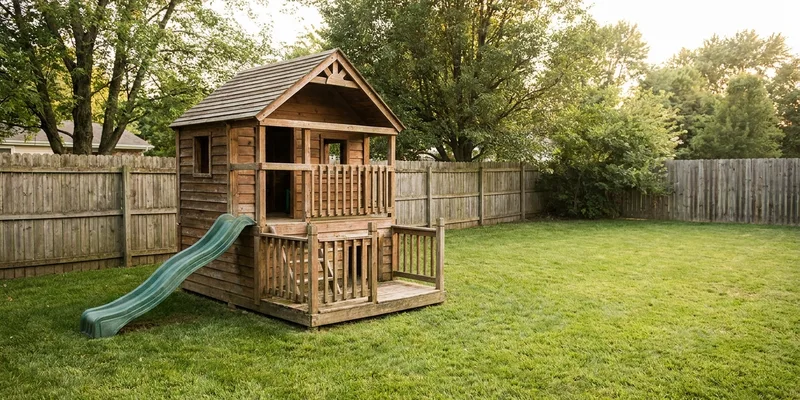
An outdoor playhouse with slide is a different purchase from a plain playhouse, because adding a slide adds a raised platform, and a raised platform brings fall height, a use zone and a surfacing question that a ground level cottage never raises. That is the part most buyers discover after the box is open.
This guide covers how the slide changes what you should look for, how to match platform height to the age using it, what the CPSC handbook says about the space around the slide exit, and which configurations suit small yards and toddlers.
This article contains affiliate links. If you buy through them, we may earn a commission at no extra cost to you. Learn more.
Quick Answer
What should you look for in an outdoor playhouse with a slide?
- Match the platform height to the age of the child, not to the size of the yard. A toddler needs a low deck with an enclosed entry to the slide, not a tall one with a ladder.
- Plan the clear space at the slide exit before you plan the footprint, since the CPSC use zone extends beyond the slide itself and that is where children land and run.
- Molded plastic units suit toddlers and preschoolers and assemble quickly; wooden units with a deck suit school age children and last longer.
- The slide is the part that fails first from sun exposure, so check whether a replacement slide is sold separately for the model you pick.
What Changes When a Slide Is Attached
A slide turns a playhouse into play equipment with a fall height, and that changes four practical requirements at once. Each row below can be checked on the listing, in the assembly manual, or by measuring your yard before you order anything.
| What changes | Why it matters | What to check |
|---|---|---|
| Platform height | Sets the fall height and decides which age band the unit suits | A stated deck height, not just the overall roof height of the house |
| Space at the slide exit | Children land and keep moving, so the run out area is part of the footprint | Clear ground beyond the exit, free of fencing, patio edges and planters |
| Surfacing underneath | Fall height determines whether loose fill or a mat is warranted | CPSC handbook surfacing guidance for the deck height of your model |
| Entry to the slide | The transition from deck to slide is where younger children slip | An enclosed or hooded entry, side rails, and a handhold at the top |
| Slide material and orientation | Plastic slides fade, warp and get hot in direct sun | UV stabilized plastic, and a placement that avoids all day southern exposure |
If a slide is not actually a requirement, a ground level house is a simpler and cheaper structure to own, and our guide to choosing a playhouse for backyard use covers that comparison in full.
Matching Deck Height to the Child’s Age
Deck height is the single most useful number on the listing, and it is often buried below the overall dimensions. It determines the fall height, which drives the surfacing question, and it also determines whether the child can get up and down without help, which drives whether the thing gets used at all.
The CPSC Public Playground Safety Handbook separates play equipment by age group, with distinct guidance for children aged 6 to 23 months, 2 to 5 years, and 5 to 12 years. The handbook also sets lower thresholds for guardrails and protective barriers on preschool age equipment than on school age equipment, which is worth reading directly if your model has a tall deck.
Practical Guidance for Toddlers
For a two or three year old, a low deck reached by two or three wide steps beats a taller platform with a ladder every time. The bottleneck is not bravery but grip strength and the ability to turn around at the top, and a hooded or enclosed slide entry gives them something to hold while they sit down.
The Space Around the Slide, Not Just Under It
Plan the clear area at the slide exit before you fix the footprint in your head. Children do not stop at the end of a slide; they land and keep going, which is why the CPSC handbook describes a use zone that extends outward from equipment rather than just the ground directly beneath it.
The handbook’s guidance for stationary equipment is that the use zone extends at least 6 feet (1.8 m) in all directions from the perimeter, with specific additional guidance for the area at a slide exit. Rather than guessing, take the deck height of your model to the handbook’s slide section and lay out the exit clearance from there.
In practice this is what disqualifies otherwise appealing placements: a slide aimed at a fence, a patio step, a raised bed, or downhill on a slope. Turning the unit so the slide runs into open lawn usually solves it, and if it cannot be turned, the yard wants a smaller model.
Surfacing Under a Playhouse Slide
Grass is not a protective surface, and neither is bare soil once a season of landings has compacted it. What the right material and depth are depends on the fall height of your specific deck, which is exactly why the CPSC handbook publishes surfacing depth by material and by fall height rather than a single number.
Loose fill options such as engineered wood fiber, play sand and pea gravel all appear in the handbook, as do bonded and unitary surfaces such as rubber mats. Our guide to playground surfacing depth works through the handbook’s tables so you can match a depth to your deck height instead of estimating.
Our Top Picks at a Glance
How we chose: we compared widely available playhouse and slide combinations on stated deck height, slide entry design, material and UV resistance, anchoring provisions, and whether replacement parts are offered. Selections lean on manufacturer specifications and recurring themes in owner reviews rather than any hands-on trial of our own.
🏆 Best Overall
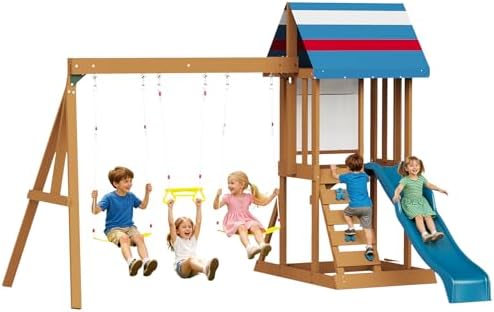
A wooden playhouse with an integrated deck and a molded slide, sized for preschool through school age, with guardrails on the platform and a manual that states the deck height clearly.
🧒 Best for Toddlers
A molded plastic cottage with a short attached slide, a low deck reached by wide steps, and a hooded slide entry that gives small hands something to hold on the way down.

📐 Best for a Small Yard
A compact unit with a slide that folds or attaches on the short side, so the exit clearance can face open lawn without the house itself eating the whole yard.

Picks by Situation: Climbing Add Ons and Repairs
Two situations call for something other than the standard pick: a child who has outgrown a plain slide and wants a climbing element, and an existing playhouse whose slide has faded, cracked or warped while the rest of the structure is still sound.
🧗 Best With a Climbing Element
A playhouse and slide combination that adds a climbing wall or rock panel on the opposite face, which extends the useful life of the unit into the school age years without a second structure.
🔧 Best Fix for a Tired Slide
A replacement slide section sized to your existing deck height, which is usually the cheapest way to get several more seasons out of a structure that is otherwise fine.

Placement, Anchoring and Sun
Level the ground first, anchor second, and think about sun third. A unit assembled on a slope puts uneven load on the deck supports and eventually leaves a slide that no longer sits flush at the top. Anchoring matters most for plastic models, which are light enough to shift in wind.
Sun exposure is the quiet factor. A plastic slide facing full afternoon sun fades, gets hot in summer and turns brittle sooner. If your yard offers a choice, put the slide on the shadier face.
Common Mistakes to Avoid
- Planning the footprint without the slide exit clearance. The use zone extends past the equipment, and the exit area is where it matters most.
- Aiming the slide at a fence, patio edge or planter. Children run out at the bottom rather than stopping there.
- Reading overall height instead of deck height. Only the deck height tells you the fall height and the age fit.
- Buying a tall deck for a toddler. A low platform they can manage alone gets used daily; a tall one gets used only with an adult standing there.
Frequently Asked Questions
What age is an outdoor playhouse with a slide for? It depends on the deck height and the slide entry rather than the house itself. Low deck plastic models generally suit toddlers and preschoolers, while wooden units with a taller platform suit preschool through school age. The CPSC handbook groups play equipment by age band, which is the clearest frame for the decision.
How much space do you need around a playhouse slide? More than the footprint of the structure. The CPSC Public Playground Safety Handbook describes a use zone extending at least 6 feet (1.8 m) in all directions from stationary equipment, with additional guidance for the area at a slide exit based on the height of the platform.
Do you need special surfacing under a playhouse slide? If the platform creates a fall height, yes. The CPSC handbook publishes surfacing material and depth guidance keyed to fall height, so match your model’s deck height to the handbook rather than assuming grass is sufficient.
Can you replace just the slide? Often yes, if the manufacturer sells a matching section for that model and deck height. Confirm this before buying, since it is the difference between a repair and replacing the whole unit when the slide finally fails.
Does a playhouse with a slide need to be anchored? Yes. Plastic models are light enough to move in wind, and anchoring also keeps the deck from settling unevenly, which is what leaves a slide sitting proud at the top after a season or two.
The Bottom Line
Buy on deck height and exit clearance, not on how the house looks in the product photo. Match the platform to the age using it, lay the slide run out over open lawn, take the surfacing depth from the CPSC handbook, and check that a replacement slide exists before you commit.