Last updated: August 18, 2026
Buying monkey bars for backyard use is a different decision from picking any other piece of play equipment, because the whole appeal rests on a child being able to hang at full stretch and swing forward without touching the ground. Get the height wrong and the bars are either unusable or unsafe, and no amount of powder coating fixes that.
This guide covers the three ways people add monkey bars at home, what to check on a listing before you commit, how age and reach determine the height you need, and what has to go underneath the bars once they are up.
This article contains affiliate links. If you buy through them, we may earn a commission at no extra cost to you. Learn more.
Quick Answer
Which monkey bars should you buy for a backyard?
- For most families, a freestanding steel monkey bar frame with adjustable height is the safest buy, because it grows with the child instead of being right for one summer only.
- If you already own a swing set with an open beam or a compatible frame, a monkey bar add-on kit is cheaper and faster than a second structure.
- Whatever you choose, plan the surfacing and the clear space underneath before you order. The CPSC Public Playground Safety Handbook calls for a use zone of at least 6 feet (1.8 m) in all directions around stationary equipment.
What to Check Before You Buy Backyard Monkey Bars
Every row below is visible on a product listing or in the manual before you pay. Monkey bars fail in predictable ways: a frame that racks under a swinging load, rungs spaced for a taller child, or a footprint that does not fit the clear space you actually have.
| What to check | Why it matters | What to look for |
|---|---|---|
| Bar height | A child needs to hang with feet clear of the ground, but a drop from too high is the main injury risk | Adjustable height, or a stated height matched to your child’s reach rather than their age alone |
| Rung spacing and diameter | Small hands cannot grip a thick bar, and a long reach between rungs stops progress cold | Spacing and bar diameter stated in the specs, with a grip size intended for children rather than adults |
| Frame stability | Swinging generates side loads that rock an underbuilt frame | Wide A-frame or braced legs, plus anchor points the manufacturer expects you to use |
| Weight capacity | Siblings and friends climb on at the same time, not one at a time | A per-child capacity and a total capacity, both stated by the manufacturer |
| Materials and finish | Bare steel rusts and gets hot; untreated wood splinters where hands go | Powder coated steel or rated outdoor lumber, with UV and rust resistance mentioned in the listing |
| Footprint and clear space | Bars need clear space on all sides, not just at the ends | Assembled dimensions from the manual, checked against the space you can actually keep clear |
Exact heights and rung spacing by age group are worth reading in one place before you shop, which is why we cover them separately in our guide to monkey bars dimensions.
Freestanding Frames, Add-On Kits, and Full Structures
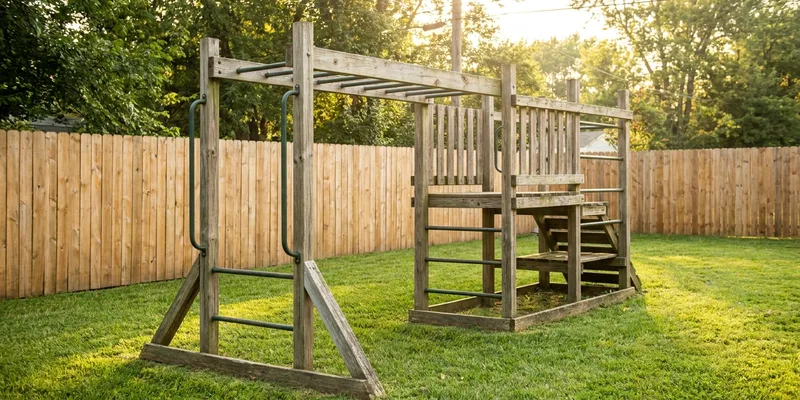
There are three realistic ways to get monkey bars into a backyard, and they suit very different situations. A freestanding frame is a standalone unit. An add-on kit bolts onto an existing swing set. A full structure builds the bars into a larger tower and slide combination.
Freestanding steel frames are the most common purchase because they arrive complete, install in an afternoon, and can be moved if you reseed the lawn or change your mind about placement. Many now offer height adjustment, which is the single feature that keeps a set useful from about the point a child can hang unassisted through the years they can traverse the whole span.
When an add-on kit makes more sense
If you already own a wooden swing set, an add-on monkey bar section can attach to the frame or extend from the tower, and it takes up far less room than a second structure. The catch is compatibility: the kit has to match your beam dimensions and your bracket type, and the manufacturer of your swing set has to allow the modification. Check the manual before assuming an aftermarket section will bolt on cleanly.
Height, Reach, and Age Fit
The right bar height is set by your child’s reach, not their birthday. A child should be able to reach the bars with a small jump or a short step, hang fully extended without their feet dragging, and drop to the surfacing under control. Bars set above that point turn a missed rung into a real fall.
The CPSC Public Playground Safety Handbook organizes playground equipment by age group, with separate recommendations for children aged 6 to 23 months, 2 to 5 years, and 5 to 12 years, and overhead climbing events sit at the older end of that scale. Rather than guessing, check the age range the manufacturer states for the specific model and read the handbook’s guidance for the age group you are buying for.
Our Top Picks at a Glance
How we chose: we compared widely available backyard monkey bar sets on adjustability, frame bracing, stated weight capacity, and how consistently owners report a stable frame after a season outdoors. Selections lean on manufacturer specifications and recurring themes in customer reviews rather than any hands-on trial of our own.
🏆 Best Overall
A freestanding steel monkey bar frame with adjustable height, braced legs, and anchor points, which covers the widest span of ages without needing to be replaced as a child grows.

🔩 Best Add-On
A monkey bar section built to attach to an existing swing set beam or tower, for families who already have a structure and just want the overhead climbing event.

🌱 Best for Younger Kids
A low, lightweight frame sized for early climbers, with closely spaced rungs and a small grip diameter that suits hands still learning to hold their own weight.

Picks by Situation: Small Yards and Heavier Use
Two situations push the decision away from a standard frame: a yard where the clear space around the bars is tight, and a household where several older children use the set hard at the same time.
📐 Best for Tight Spaces
A narrow-span steel frame with a compact footprint, which fits a smaller yard while still leaving room for the clear use zone the CPSC handbook calls for around stationary equipment.

🛠️ Best for Anchoring
A heavy duty anchor kit, since almost every frame manufacturer expects the legs to be secured and almost every set ships without adequate stakes.

What Goes Underneath the Bars
Surfacing is not optional on an overhead climbing event, because falls from monkey bars come from the highest point a child reaches. CPSC guidance is direct that playground equipment should not be installed over concrete, asphalt, or packed earth, and that grass by itself does not count as protective surfacing.
The handbook includes a surfacing table that matches material and installed depth to the fall height it protects against, so look up your equipment height there rather than estimating. Loose fill migrates away from the busiest landing spots, so raking it back level is ordinary maintenance. Our guide to playground surfacing depth works through that table in detail.
Common Mistakes to Avoid
- Buying for the age on the box instead of the child’s reach. A set your child cannot hang from is unusable, and one set too high turns every missed rung into a fall.
- Skipping the anchors. Swinging loads rock an unanchored frame sideways. Most manufacturers require anchoring, and most sets do not include stakes that are up to the job.
- Installing over grass or bare soil. CPSC guidance does not treat either as protective surfacing, and packed earth under a well used set gets harder each season.
- Assuming an add-on kit fits your swing set. Beam dimensions and bracket types vary between brands, and modifying a structure outside the manual voids warranties.
- Never rechecking the hardware. Bolts, adjustment pins, and locking collars work loose under repeated swinging. One tightening pass each spring catches most of it.
Frequently Asked Questions
What age are backyard monkey bars suitable for? Overhead climbing events suit children who can already hang and support their own weight, which the CPSC Public Playground Safety Handbook places in its older equipment age groups rather than with toddler equipment. Follow the age range the manufacturer states for the specific model you are buying.
How high should monkey bars be? High enough for a child to hang with feet clear of the ground and no higher. Because that depends on reach rather than age, an adjustable frame is the practical answer for most families, and the handbook’s guidance on fall height should set your ceiling.
Do monkey bars need to be anchored? Nearly always. Swinging produces side loads that rock a freestanding frame, so check the manual for the anchoring method the manufacturer requires and buy anchors rated for your soil if the included stakes look light.
What should go under monkey bars? Protective surfacing, at a depth taken from the surfacing table in the CPSC handbook for your equipment height. Concrete, asphalt, packed earth, and plain grass are all ruled out by CPSC guidance.
Can you add monkey bars to an existing swing set? Sometimes. An add-on kit needs to match your beam dimensions and bracket type, and your swing set manufacturer needs to permit the modification. Check the manual before ordering an aftermarket section.
The Bottom Line
The best monkey bars for a backyard are an adjustable steel frame with braced legs and proper anchors, sized so your child can hang with feet clear of the ground. Add-on kits are the cheaper route if you already own a compatible swing set. Whichever you pick, plan the surfacing and the clear use zone first, using the CPSC Public Playground Safety Handbook rather than estimating.