Last updated: August 18, 2026
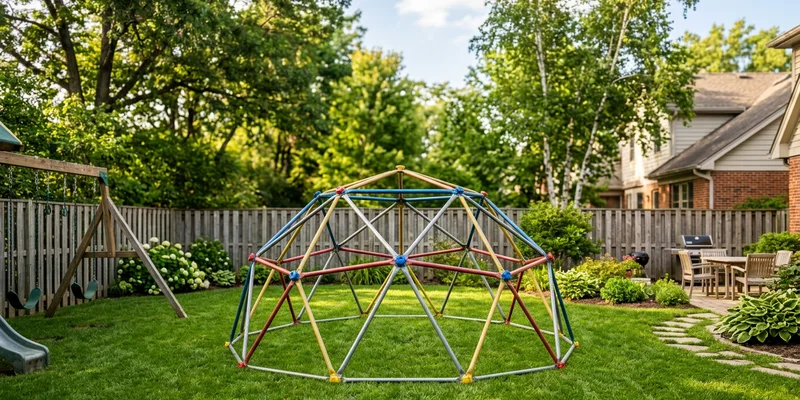
Choosing a climbing dome for kids comes down to one question that nobody asks until the box arrives: 6ft or 10ft. Diameter drives everything else, including the height a child can fall from, how many children can use it at once, how much of your yard disappears, and how long the dome stays interesting before it gets ignored.
This guide compares the common dome sizes side by side, explains which one suits which age spread, and covers the build quality, anchoring, and surfacing details that decide whether a dome lasts one summer or ten.
This article contains affiliate links. If you buy through them, we may earn a commission at no extra cost to you. Learn more.
Quick Answer
Should you buy a 6ft or a 10ft climbing dome?
- A 6ft dome suits preschool age children, a small yard, and one or two users at a time. It is easier to place and lower to fall from.
- A 10ft dome suits school age children and mixed age groups, holds several climbers at once, and stays interesting for years, but it takes a serious chunk of yard.
- Whichever size you pick, the CPSC Public Playground Safety Handbook calls for a clear use zone of at least 6 feet (1.8 m) in all directions around stationary equipment, so add that to the dome’s own diameter before you decide it fits.
6ft vs 8ft vs 10ft: The Sizes Compared
Dome climbers are sold by diameter, and the three common sizes behave differently in a real yard. The table below sets out what each size suits, using the manufacturer stated age ranges and the space you need once the use zone is included.
| Dome size | Typical age fit | Space needed | Best suited to |
|---|---|---|---|
| 6ft dome | Preschool age, per the manufacturer’s stated range | Diameter plus a clear use zone on all sides | Small yards, one or two young climbers, a lower fall height |
| 8ft dome | Mixed ages, bridging preschool and school age | Noticeably more than a 6ft, still workable in an average yard | Households with a spread of ages and a normal suburban lot |
| 10ft dome | School age, per the manufacturer’s stated range | The largest footprint, use zone included, and the most height above the surfacing | Several children at once, older climbers, yards with real open space |
| Dome with slide or swing | Widens the usable age range downward | Add the slide run-out or swing arc to the footprint | Families wanting one structure to cover several kinds of play |
If a slide is part of what you want, our guide to the climbing dome with slide covers how the attachment method and run-out change the decision.
Which Size Actually Fits Your Kids
Match the dome to the oldest child who will use it regularly, not the youngest. Younger siblings climb the lower rungs of a large dome easily, but an older child who tops out on a small dome in a week has nothing left to work toward, and that is the dome nobody touches by August.
The exception is a wide age gap with a very small youngest child. A 10ft dome puts the top well above a toddler’s comfort zone, and while children generally self-limit on a dome, the fall height is real. A mid-size dome is usually the calmer answer there.
What the CPSC handbook says about age groups
The CPSC Public Playground Safety Handbook divides playground equipment into age groups, with separate recommendations for children aged 6 to 23 months, 2 to 5 years, and 5 to 12 years, and it treats climbing events as equipment that belongs to specific groups rather than all of them. Use the age range the manufacturer states for the model you are buying, and check it against the handbook’s guidance for that group instead of assuming a dome suits everyone.
Build Quality: Where Domes Differ
Domes look identical in listing photos and are not. What predicts how a dome ages is tubing gauge, connector material, fastener quality, and whether the finish is a real powder coat or a thin painted layer that chips at every bolt hole and rusts there.
Connectors deserve the most attention. Metal connectors at the load points hold a frame rigid; plastic ones flex, and once the frame moves a little, every bolt works itself looser over the season. Owner reviews across brands report the same pattern: wobble starts at the joints, not in the tubing.
Hardware and assembly
A dome is a lot of bolts, and the quality of those bolts matters outdoors. Stainless or properly galvanized fasteners survive rain; plated steel ones rust and seize, which becomes a problem the first time you need to take a section apart. Assembly is realistically a two person job for the larger sizes, and a socket set makes it far less painful than the stamped wrench in the box.
Our Top Picks at a Glance
How we chose: we compared widely available dome climbers on tubing and connector quality, fastener material, stated weight capacity, and how consistently owners report a rigid frame and intact finish after a season outdoors. Selections lean on manufacturer specifications and recurring themes in customer reviews rather than any hands-on trial of our own.
🏆 Best Overall
A 10ft steel dome with metal connectors, a stated weight capacity for several children at once, and anchors included, which stays useful through the whole school age range.

🌱 Best for Younger Kids
A 6ft dome sized for preschool age climbers, with a lower top and a footprint that still leaves room for the clear use zone in a small yard.

⚖️ Best Middle Ground
An 8ft dome for households with a spread of ages, offering more climbing than a 6ft without taking the space a 10ft demands.

Picks by Situation: Sun and Extra Play Value
Two additions change how much a dome gets used. A canopy keeps the top bars out of direct sun, which matters on a steel frame in an open yard, and an attachment such as a swing or hammock gives quieter use on days when nobody wants to climb.
☀️ Best Sun Cover
A fitted canopy for a dome climber, which keeps the upper bars and any slide surface from heating up through the afternoon.

🪢 Best Add-On
A swing or hammock attachment made for a dome frame, which broadens what the structure offers without adding a second footprint to the yard.

Anchoring and Surfacing
Anchor the dome to the manufacturer’s instructions, using heavier anchors if the included stakes look light for your soil. A dome is wide and comparatively light, and children swinging out from the frame apply exactly the kind of side load that shifts an unanchored structure across a lawn over a season.
For what goes underneath, CPSC guidance is explicit that equipment should not be installed over concrete, asphalt, or packed earth, and that plain grass is not protective surfacing. The handbook includes a surfacing table matching material and installed depth to fall height, and a taller dome means a higher fall height, so take the depth from that table rather than reusing a figure from a smaller set.
Common Mistakes to Avoid
- Sizing for the youngest child. A dome your oldest tops out on in a week stops being used. Size for the oldest regular user and let the younger ones work the lower rungs.
- Forgetting the use zone in your measurements. The dome diameter is not the space requirement. CPSC guidance calls for clear space in all directions around stationary equipment.
- Ignoring connector material. Plastic connectors at load points are where wobble begins, and the wobble then loosens every bolt in the frame.
- Assembling alone with the supplied wrench. The larger sizes are a two person job, and a socket set saves hours.
- Skipping the seasonal retightening. Domes have dozens of bolted joints. One pass with a socket at the start of each season is what keeps the frame rigid.
Frequently Asked Questions
Is a 6ft or 10ft climbing dome better? A 6ft dome suits preschool age children, small yards, and a lower fall height. A 10ft dome suits school age children, holds several climbers at once, and stays interesting for years, but it needs real open space once the clear use zone is added.
What age is a climbing dome for? Use the age range the manufacturer states for the specific model. The CPSC Public Playground Safety Handbook groups playground equipment by age, with separate recommendations for children aged 6 to 23 months, 2 to 5 years, and 5 to 12 years.
Are climbing domes safe? They are a climbing event with a real fall height, so safety comes down to correct anchoring, protective surfacing at the depth the CPSC handbook specifies for that height, a clear use zone, and supervision appropriate to the age of the children using it.
How much space does a climbing dome need? The assembled diameter plus a clear use zone. CPSC guidance calls for at least 6 feet (1.8 m) in all directions around stationary equipment, and any slide or swing attachment extends the footprint further.
How many kids can use a climbing dome at once? Whatever total weight capacity the manufacturer states, which is the number to work from rather than a headcount. Larger domes generally state higher capacities, which is one practical reason bigger domes suit households with several children.
Do climbing domes rust? Powder coated steel resists it well, but chips at bolt holes and scratches are where rust starts. Touching up damaged spots and retightening hardware each season is the maintenance that keeps a dome sound.
The Bottom Line
Pick the dome size from the oldest child who will use it regularly, then check that the diameter plus a clear use zone actually fits your yard. A 6ft dome is the small yard and preschool answer, a 10ft the choice for school age climbers and several children at once. Metal connectors and decent fasteners predict how the frame ages, and the CPSC handbook is the source for use zone and surfacing depth.