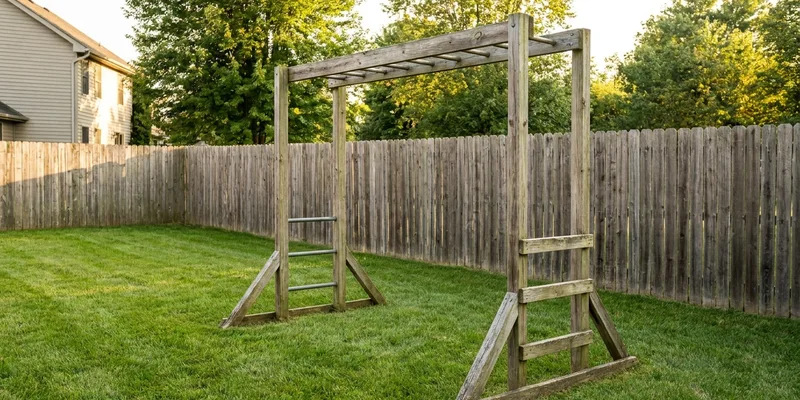
Last updated: August 18, 2026
Monkey bars dimensions are one of the few backyard play measurements with a published reference behind them. The Consumer Product Safety Commission sets out recommended heights, rung spacing and clearances for horizontal ladders in its Public Playground Safety Handbook, and those numbers are the ones equipment manufacturers design against.
This guide covers what the handbook says about height, rung spacing, grip diameter and age, and how the public playground rules relate to a set bought for a home yard.
This article contains affiliate links. If you buy through them, we may earn a commission at no extra cost to you. Learn more.
Quick Answer
What are the standard monkey bars dimensions?
- The CPSC Public Playground Safety Handbook recommends a maximum height, measured from the grasping surface down to the protective surface below, of 60 inches (152 cm) for preschool-age children and 84 inches (213 cm) for school-age children.
- Rung spacing, measured center to center, is recommended at no more than 12 inches (30 cm) for preschool-age children and no more than 15 inches (38 cm) for school-age children.
- The handbook notes that four year olds are generally the youngest children able to use upper body equipment such as horizontal ladders.
Monkey Bar Dimensions at a Glance
The table below collects the figures from the CPSC Public Playground Safety Handbook that apply to horizontal ladders, which is what the handbook calls monkey bars. The two age bands are the ones the handbook itself uses.
| Dimension | Preschool-age (4 and 5) | School-age (5 to 12) | Where it comes from |
|---|---|---|---|
| Maximum height of the grasping surface | 60 in (152 cm) | 84 in (213 cm) | CPSC Public Playground Safety Handbook, horizontal ladders |
| Rung spacing, center to center | No more than 12 in (30 cm) | No more than 15 in (38 cm) | CPSC Public Playground Safety Handbook, horizontal ladders |
| Youngest suitable age | Four years, per the handbook | Four years, per the handbook | CPSC handbook, upper body equipment |
| Openings to avoid | Anything between 3.5 in (89 mm) and 9 in (229 mm) between opposing surfaces | CPSC handbook, head entrapment | |
| Use zone around the structure | At least 6 ft (1.8 m) in all directions from the perimeter | CPSC handbook, use zones for stationary equipment | |
The handbook is free to download from the CPSC, and it is worth having open when you compare kits, since most listings quote only overall height and total length.
How High Should Monkey Bars Be?
Height is the dimension with the clearest guidance behind it. The CPSC Public Playground Safety Handbook recommends that the height of a horizontal ladder, measured from the center of the grasping device down to the protective surfacing below, be no more than 60 inches (152 cm) where preschool-age children will use it and no more than 84 inches (213 cm) for school-age children.
What the figure does not tell you is how high the bars should be for your particular child. A ladder a child cannot reach without being lifted is one they cannot get off safely either, and the handbook’s numbers are ceilings rather than targets. Adjustable height frames exist for exactly this reason.
Measuring the height correctly
Measure from the top of the finished surface, not the top of the soil. Loose fill raises the ground and lowers the effective height, and compaction over a season does the reverse, which is why the handbook treats surfacing and equipment height as one question rather than two.

Rung Spacing and Grip Diameter
Rung spacing is measured center to center along the ladder. The CPSC Public Playground Safety Handbook recommends no more than 12 inches (30 cm) between rung centers for preschool-age children and no more than 15 inches (38 cm) for school-age children. Wider spacing asks for a reach most children in the age band do not have.
Grip diameter matters just as much and gets far less attention. The handbook caps the diameter of components intended to be grasped at 1.55 inches (39 mm), because a bar thicker than a child’s hand can close around cannot be held reliably. Steel tube that feels reassuringly solid to an adult can sit above that limit, so check the stated diameter.
Clearance, Use Zone, and Landing Surface
The space around monkey bars is as much a dimension as the bars themselves. The CPSC Public Playground Safety Handbook specifies a use zone extending a minimum of 6 feet (1.8 m) in all directions from the perimeter of stationary playground equipment, clear of fences, tree trunks and anything else a falling child could strike.
Underneath, the handbook ties the required depth of protective surfacing to the fall height, which for a horizontal ladder is the height of the bars themselves. A taller ladder therefore raises the amount of surfacing expected under it, and our guide to playground surfacing depth works through the material by material figures.
Age: When Are Children Ready for Monkey Bars?
The handbook is direct about this. It notes that four year olds are generally the youngest children able to use upper body equipment such as horizontal ladders, and it splits its recommendations into preschool-age and school-age bands rather than giving one set of dimensions for all children. Below that age, the limit is grip strength and shoulder control rather than the equipment.
Readiness is individual within that band. A child who can hang unsupported for a few seconds and lower themselves under control is closer to ready than one who has to be lifted up and caught coming down.
Public Playground Guidance and Home Sets
The CPSC Public Playground Safety Handbook is written for public playgrounds: parks, schools and childcare centers. Home playground equipment is covered by a separate voluntary standard, ASTM F1148, which backyard set manufacturers design to and often reference in their manuals. The handbook’s numbers remain the clearest published reference for a parent, but a home kit is not obliged to meet them.
That distinction matters when a listing quotes a height above the handbook’s figure for your child’s age band. It does not mean the product is defective, and where the manufacturer’s instructions and the handbook differ on installation, follow the instructions for the product you own.
Permits, setbacks and HOA rules
How close a structure may sit to a property line, and whether it needs approval, varies by county and by homeowners association. Check with yours before you dig.

Common Measuring Mistakes
- Measuring height from the soil rather than the finished surface. Loose fill raises the ground and changes the fall height you actually have.
- Measuring rung spacing edge to edge. The recommendation is center to center, and the two differ by the diameter of a bar.
- Forgetting the use zone. A fence or a tree inside those 6 feet undoes the rest of the measuring.
Frequently Asked Questions
How high should monkey bars be? The CPSC Public Playground Safety Handbook recommends a maximum of 60 inches (152 cm) measured from the grasping surface to the protective surface below for preschool-age children, and 84 inches (213 cm) for school-age children. Those are ceilings rather than targets, and a lower bar suits a smaller child better.
How far apart should monkey bar rungs be? Center to center, the handbook recommends no more than 12 inches (30 cm) for preschool-age children and no more than 15 inches (38 cm) for school-age children. Measure between the centers of the bars, not the gap between them.
What age are monkey bars suitable for? The handbook notes that four year olds are generally the youngest children able to use upper body equipment such as horizontal ladders. Within that, readiness comes down to whether a child can hang unsupported and lower themselves under control.
How long should a monkey bar ladder be? The handbook does not specify a length, so this comes from the manufacturer. A run a child can complete is more useful than a longer one they drop off halfway along.
How much clear space is needed around monkey bars? The handbook specifies a use zone of at least 6 feet (1.8 m) in all directions from the perimeter of stationary equipment, kept free of fences, trees and other structures.
What diameter should the bars be? The handbook caps components intended to be grasped at 1.55 inches (39 mm) in diameter, because a bar a child cannot close their hand around cannot be gripped reliably.
The Bottom Line
The numbers worth remembering all come from the CPSC Public Playground Safety Handbook: a maximum grasping height of 60 inches (152 cm) for preschool-age children and 84 inches (213 cm) for school-age children, rung spacing of no more than 12 or 15 inches center to center for those same bands, a grasping diameter cap of 1.55 inches (39 mm), and a use zone of at least 6 feet in all directions.