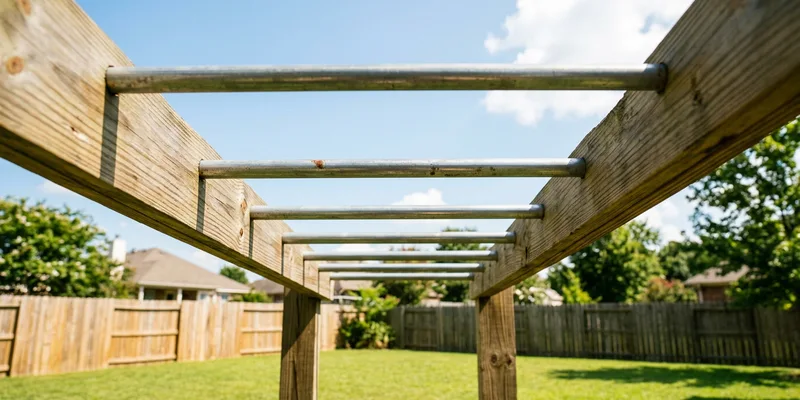
Last updated: August 18, 2026
A monkey bar kit is what you buy when the swing set is already standing and the kids have outgrown it. Instead of a whole new structure, you add an overhead ladder to the end of the existing frame, or bolt a run of rungs between two posts you set yourself. The kits range from a bag of steel brackets to a complete bolt together extension with legs.
This guide covers the kinds of kit on the market, whether one will fit the set you already own, and what the CPSC recommends for height and rung spacing.
This article contains affiliate links. If you buy through them, we may earn a commission at no extra cost to you. Learn more.
Quick Answer
Which monkey bar kit should you buy for an existing set?
- Check with the set’s manufacturer before you attach anything. A frame designed for swing loads is not automatically rated for children hanging and swinging at the end of a cantilevered ladder.
- If the answer is no, or your set is out of production, a standalone kit on its own posts is the safer route. It costs more in lumber and concrete but it does not put an unplanned load into a structure you did not design.
- Buy on hardware, not on rung count. Through bolts with lock nuts, powder coated steel rungs and a stated grip diameter matter more than whether the kit has seven bars or nine.
What Comes in a Monkey Bar Kit
Kits fall into a few groups and they are not interchangeable. One supplies only the connectors and expects you to buy lumber and rungs, one supplies rungs and mounting hardware but no structure, and one is a complete extension with its own legs. Knowing which you are looking at prevents most ordering mistakes.
| Kit type | What is in the box | What you supply | Best when |
|---|---|---|---|
| Bracket kit | Steel corner brackets and fasteners sized for standard timber | All lumber, all rungs, concrete for the footings | You are building the whole thing from scratch and want the joints engineered |
| Rung and hardware kit | Steel or coated rungs, flanges or through bolt hardware, a drilling template | Two beams or an existing frame to span between | Your set already has parallel beams at the right height and spacing |
| Complete extension | Ladder section, legs, all fasteners, model specific instructions | Footings or anchors, and a level patch of ground | The extension is sold by the maker of your set, or it stands on its own legs |
| Add-on attachment | A short bar section that hangs from an existing top beam | Confirmation from the set maker that the beam is rated for it | You want a couple of bars rather than a full run |
If you are still deciding between adding to what you have and buying a structure outright, our guide to monkey bars for the backyard compares freestanding frames against add-on routes, and both sit in the wider climbing and active play section.
Will It Fit the Set You Already Own?
Three measurements decide this: the span between the posts you plan to bridge, the cross section of those posts, and the height of the beam above the ground. Take all three before you look at a single listing, because kits are sold to fixed spans and a ladder that is two inches too long has no useful adjustment.
Most wooden backyard sets use nominal four by four or four by six timber, and bracket kits are cut for one or the other. Packing the gap out with washers is exactly the improvisation that works loose over a winter, so measure the actual timber rather than trusting the description of a set bought years ago.
When the manufacturer says no
Plenty of set makers will not approve an overhead ladder on a frame they sold as a swing beam, and that is a real answer rather than a liability formality. A swing puts a vertical, roughly predictable load through the beam; a monkey bar run adds sideways force at the far end of a lever, hundreds of times a week. If your set is out of production and nobody can tell you, treat it as a no.

Rungs, Grip Diameter, and Spacing
The rungs are the only part a child touches, and the two things that matter are how thick they are and how far apart. The CPSC Public Playground Safety Handbook caps the grasping diameter of a rung at 1.55 inches (39 mm), because beyond that a small hand cannot close around it and the grip fails before the arms tire.
Spacing follows the same logic. The handbook recommends no more than 12 inches (30 cm) between rung centers where preschool-age children will use the ladder, and no more than 15 inches (38 cm) for school-age children. Kits are often sold with the wider spacing because it needs fewer rungs, so read the stated figure rather than counting bars in the photo.
Steel, coated steel, or wood
Powder coated steel is the default, with the caveat that a dark coating on a sunny afternoon gets hot enough that nobody uses the ladder until evening. Wooden dowels feel best in the hand but they are the part that eventually splits, and a split rung is not something you notice until a child is hanging from it.
Our Top Picks at a Glance
How we chose: we compared widely available monkey bar kits on what is included, the timber sizes the hardware fits, stated rung diameter and spacing, and whether the instructions cover footings. These picks lean on manufacturer specifications and recurring themes in customer reviews rather than any hands-on trial of our own.
🏆 Best Overall
A complete extension kit sold for wooden swing sets, with the ladder section, its own support legs and every fastener supplied, so the only thing left to source is the concrete for the footings.
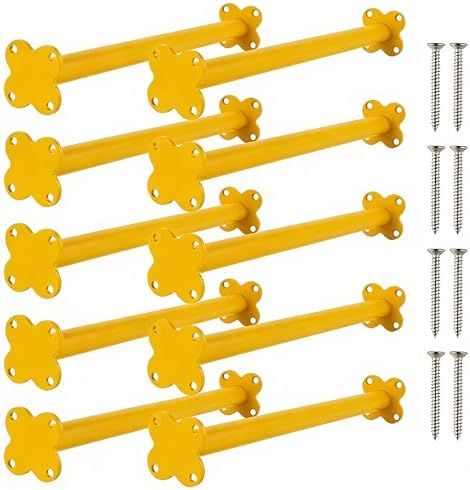
🔩 Best Bracket Kit
A set of heavy gauge steel brackets cut for standard four by four timber, for anyone building the frame from scratch and wanting the joints to be engineered rather than toe nailed.

🧒 Best Short Add-On
A three or four rung section that hangs from an existing top beam, for younger children who want somewhere to hang without a full length ladder run overhead.

Height, Surfacing, and Holding It Down
Height is the figure most kits leave to you, and it is the one that decides how far a child falls. The CPSC Public Playground Safety Handbook recommends a maximum height, measured from the grasping surface down to the protective surface below, of 60 inches (152 cm) for preschool-age children and 84 inches (213 cm) for school-age children. Those are ceilings rather than targets.
The surface underneath is not optional. The handbook advises never using less than 9 inches of loose fill material, with shredded or recycled rubber the one exception at a recommended 6 inches, and it specifies a use zone extending at least 6 feet (1.8 m) in all directions from the perimeter of the equipment. Grass over compacted soil does not count as protective surfacing. Our guide to playground surfacing depth sets out the full depth table.
Bracing and anchors do different jobs
Hand over hand travel pulls the frame sideways on every swing. Diagonal bracing stops it leaning, ground anchors stop it lifting or walking, and a kit that addresses only one of the two is half finished.

Common Mistakes to Avoid
- Attaching to a beam nobody has rated for it. A swing beam carries vertical load. A monkey bar run adds swinging force at the end of a lever, and the set maker is the only source for whether that is acceptable.
- Buying a bracket kit sized for the wrong timber. Four by four and four by six brackets are not interchangeable, and washers do not make up the difference.
- Ignoring rung spacing. Kits with fewer, wider spaced rungs are cheaper to make and harder for a small child to use. The CPSC gives figures by age band.
- Adding bars without adding surfacing. The fall height changes the moment the ladder goes up, and the ground underneath usually does not change with it.
Frequently Asked Questions
Can you add monkey bars to any swing set? No. Whether a frame can carry an overhead ladder depends on beam size, post spacing and bracing, and the set’s manufacturer is the only party who can answer it. Where the set is out of production and nobody can confirm, a standalone kit on its own posts is the sensible alternative.
How high should the bars be? The CPSC Public Playground Safety Handbook recommends a maximum of 60 inches (152 cm) from the grasping surface to the protective surface below for preschool-age children, and 84 inches (213 cm) for school-age children. Lower is fine, and better for a smaller child.
How far apart should the rungs be? The handbook recommends no more than 12 inches (30 cm) between rung centers for preschool-age children and no more than 15 inches (38 cm) for school-age children. Wider spacing needs a reach most children in the younger band do not have.
Do I need concrete footings? For a standalone kit, almost always, and the kit instructions are the source for depth and diameter. For an extension bolted to an existing set, follow whatever the extension’s instructions specify, and add ground anchors if the set did not already have them.
What goes under a monkey bar kit? Protective surfacing, not lawn. The CPSC handbook advises never less than 9 inches of loose fill, with shredded or recycled rubber the exception at a recommended 6 inches, extending at least 6 feet in all directions from the equipment.
The Bottom Line
Start with whoever made your swing set, because that answer decides which kit you are shopping for. If an extension is approved, buy the one sold for your model and follow its footing instructions. If it is not, buy a standalone kit on its own posts. Either way, check rung diameter and spacing against the CPSC figures, and sort the surfacing out before the first child hangs from it.