Last updated: August 18, 2026
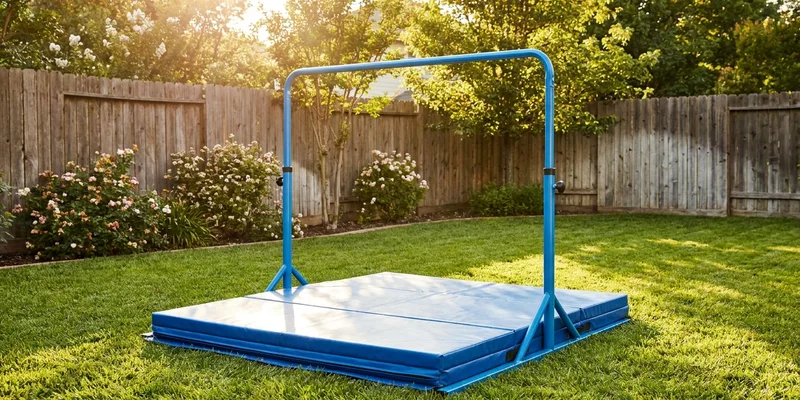
A gymnastics bar for the backyard is a different purchase from a set of monkey bars, even though both involve a child hanging from a rail. A gym bar is built for rotation: pullovers, casts and kips, where the child comes over the top of the bar and lands with momentum. That changes what matters, from the stability of the base to what is on the ground when they come down.
This guide covers the types on the market, what an adjustable height range buys you, how to judge stability before ordering, and how to think about the landing area outdoors, where a folding mat on lawn is not a gym floor.
This article contains affiliate links. If you buy through them, we may earn a commission at no extra cost to you. Learn more.
Quick Answer
Which gymnastics bar should you buy for a backyard?
- Buy an adjustable bar with a range that covers the child now and for the next few years, and check the stated weight limit against the heaviest person likely to use it rather than the child it is bought for.
- Judge it on the base. Rotation puts a rocking load into the frame, and a wide, deep base with a stated anti tip design does more for safety than any other feature.
- Sort the landing area before the bar arrives. A folding mat on lawn is not a gym floor, and outdoors the surface has to suit the height the child is coming down from.
What to Check Before You Buy a Gymnastics Bar
Home gym bars are sold with more marketing than specification, so it is worth knowing which numbers to look for. Every row below appears on a good listing, and one that omits several is telling you something.
| What to check | Why it matters | What to look for |
|---|---|---|
| Height adjustment range | Decides how many years the bar stays useful | A stated minimum and maximum, with the adjustment steps between them |
| Stated weight limit | Rotation loads a bar far more than hanging does | A weight rating given by the manufacturer, checked against the heaviest user |
| Base width and depth | The base is what stops the frame tipping during a pullover | Wide feet, a deep footprint and a described anti tip or wide stance design |
| Rail material | Fiberglass with a wood veneer is the competition standard for a reason | A stated rail material and diameter rather than just a colour |
| Frame tube and finish | Outdoor use means moisture at the joints and at ground level | Powder coated steel, with the outdoor suitability stated by the maker |
| Anchoring provision | On grass a freestanding base can shift under load | Stake points or an anchoring method described in the manual |
If what the children actually want is to hang and travel rather than rotate, our guide to monkey bars for the backyard covers that instead, and both sit in the wider climbing and active play section.
Adjustable, Expandable, or Fixed
Adjustable bars are the default and the right answer for most families. The upright telescopes and pins at set heights, so one bar suits a child learning a pullover at a low setting and the same child working on a kip two years later. The useful figure is the number of steps in the range, not the maximum.
Expandable bars widen as well as heighten, which matters because a taller setting on a narrow base is less stable. Fixed height junior bars work well for young children, with the obvious limitation that they are outgrown rather than adjusted.
Bars that mount to a playset
Some sets sell a gym bar that bolts between two posts of an existing structure. That works only where the set’s manufacturer states the frame accepts the load, because a child rotating around a bar puts a very different force into the posts than one swinging beneath a beam.
Stability Is the Whole Purchase
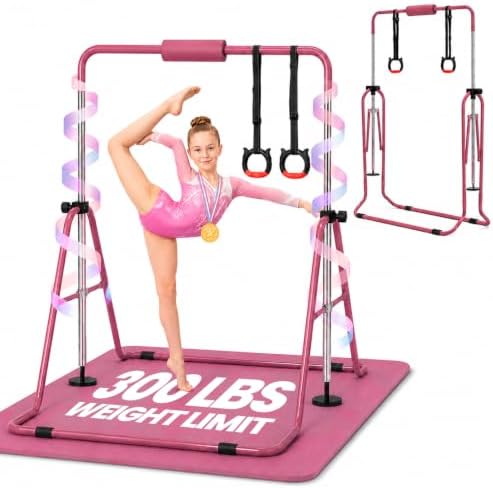
Everything that goes wrong with a home gym bar goes wrong at the base. A pullover loads the frame forward, a cast loads it back, and a bar that rocks even slightly teaches a child to expect a movement that will not always happen. Look for a wide stance, a deep footprint and a stated anti tip design rather than a bar that folds neatly.
Weight limits are the other half of the same question, and they are commonly ignored because the child is small. The limit applies to the whole system under dynamic load rather than to a child standing still, and older siblings are exactly who tests it. Take the number from the manufacturer for that model.
On grass, anchor it
Indoors a mat and a hard floor hold a base still. On lawn the feet sink unevenly, the ground softens after rain, and the frame can shift mid skill. Where the manual describes an anchoring method, use it, and set the bar on the flattest ground you have rather than the most convenient corner.
Our Top Picks at a Glance
How we chose: we compared widely available home gymnastics bars on stated height range and adjustment steps, weight limits, base dimensions and anti tip design, rail material, and whether the maker calls the bar suitable for outdoor use. These picks lean on manufacturer specifications and recurring themes in customer reviews rather than any hands-on trial of our own.
🏆 Best Overall
An adjustable bar with a wide base, several height steps and a clearly stated weight limit, which covers the years between a first pullover and a working kip without needing to be replaced.
📏 Best Expandable
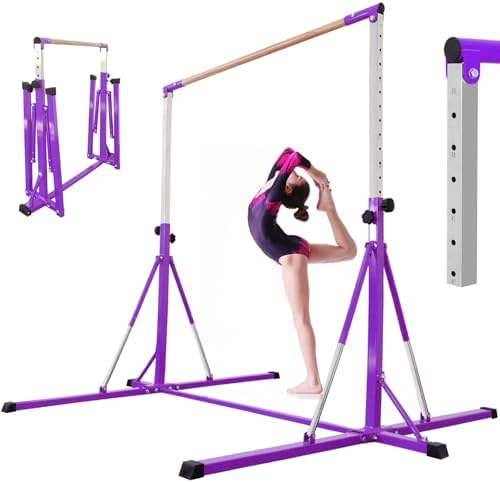
A bar that widens as well as rises, so the base grows with the height rather than leaving a tall setting on a narrow stance.

🧒 Best Junior Bar
A low fixed height bar for young children learning to hang and roll over, where the simplicity is the point and the height range is not yet needed.

The Landing Area Outdoors
This is where a backyard bar differs most from one in a garage. A gym uses a sprung floor and thick matting; a lawn does not absorb a landing, and neither does a thin folding mat laid on it. The surface under and around the bar has to suit the height the child comes down from, which is whatever the top setting is.
The CPSC Public Playground Safety Handbook is written for public playgrounds rather than for gymnastics equipment, but its surfacing principle is the clearest public guidance available: fall height is the distance from the highest point a child is on down to the surface below, and each surfacing material and depth is rated for the fall height it protects. The handbook advises never using less than 9 inches of loose fill material, with shredded or recycled rubber the exception at a recommended 6 inches, and specifies a use zone extending a minimum of 6 feet (1.8 m) in all directions from the perimeter of stationary equipment. Our guide to playground surfacing depth sets out the full table.
Mats have their place
A folding mat is useful for the landing itself, but it is an addition to a suitable surface rather than a substitute, and a mat that slides on wet grass creates its own problem. Most home mats are not made for permanent outdoor exposure, so plan to bring it in.

Common Mistakes to Avoid
- Setting it up on soft or uneven lawn. Feet sink unevenly and the frame can move mid skill. Flat ground and the manufacturer’s anchoring method.
- Treating a folding mat as the surface. It is a landing aid on top of a suitable surface, not a replacement for one.
- Bolting a bar to a swing set. Only where the set maker says the frame takes rotational load, which most do not.
- Leaving it out all year. Rust, seized adjusters and a degraded rail are the result, and few bars are sold for permanent outdoor exposure.
Frequently Asked Questions
Can a gymnastics bar be used outside? Some are described by their manufacturers as suitable for outdoor use and many are not, so check that specifically before ordering. Steel uprights rust where the coating is scratched and telescoping tubes seize with grit and moisture, so plan to set the bar up for the season and store it over winter regardless.
What height should a kids gymnastics bar be set at? Low enough that the child can reach the rail with feet on the ground while learning, and raised in steps as skills develop. The manufacturer states the range and the steps for each model, and there is nothing to gain from starting high.
How do you stop a gymnastics bar from tipping? Buy a wide, deep base to begin with, keep it within the stated weight limit, set it on flat ground, and use whatever anchoring method the manual describes. A bar that rocks at all is a bar that needs one of those four addressed.
What should go under a backyard gymnastics bar? A surface suited to the height the child comes down from. The CPSC Public Playground Safety Handbook ties surfacing to fall height, advises never less than 9 inches of loose fill except shredded or recycled rubber at a recommended 6 inches, and calls for a clear zone of at least 6 feet in all directions.
Can you attach a gymnastics bar to a swing set? Only where the swing set’s manufacturer states that the frame accepts that load. A structure engineered for the vertical pull of a swing is not automatically rated for a child rotating around a bar fixed between its posts.
The Bottom Line
Buy the base, not the bar. A wide, deep, genuinely stable frame with a stated weight limit and several height steps will carry a child from a first pullover to a working kip, and it is the one specification a listing cannot fake with photography. Then plan the landing area with the same care: a suitable surface sized to the height they come down from, a mat on top of it rather than instead of it, and the bar put away when the season ends.