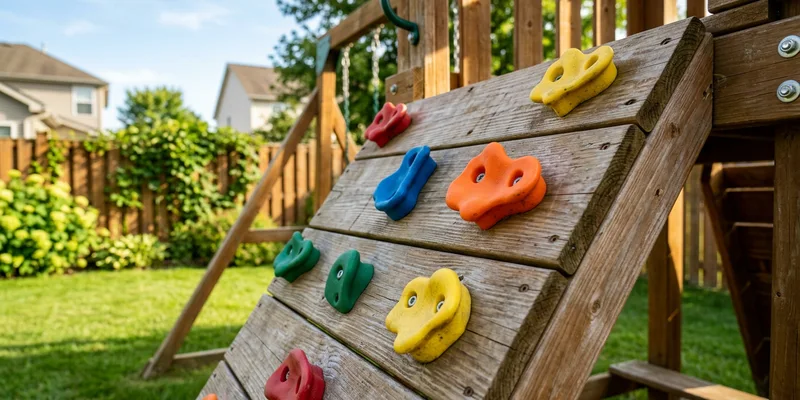
Last updated: August 18, 2026
Climbing rocks for a playset are the cheapest upgrade you can make to a wooden play structure, and the one most often installed badly. The holds are moulded resin or polyurethane and look much the same in a listing. What separates a wall children use from one they ignore is hold size, how they are fixed to the board, and how they are spread out.
This guide covers bolt-on against screw-on mounting, how to size holds to the age of the children using them, how to lay a wall out so it stays interesting, and what the CPSC says about the height they climb to.
This article contains affiliate links. If you buy through them, we may earn a commission at no extra cost to you. Learn more.
Quick Answer
Which climbing rocks should you buy for a playset?
- Buy large holds. Small crimps look like a real climbing wall and are useless to children, whose hands need something they can wrap fingers around and stand on with a whole foot.
- Check how they mount. Screw-on holds go straight into the board and suit most backyard playsets; bolt-on holds need a hole drilled through and a T-nut behind, which means access to the back of the panel.
- Order more holds than the wall looks like it needs. A sparse wall gives one route and gets solved in a week; a crowded one gives a dozen and keeps going.
What to Check Before You Buy Climbing Holds
Holds are simple products sold with very variable information. The rows below determine whether a set works on your playset, and each can be confirmed from the listing or the photos before you order.
| What to check | Why it matters | What to look for |
|---|---|---|
| Mounting type | Decides whether you need access behind the panel | Screw-on for a solid board with no rear access, bolt-on where you can fit T-nuts |
| Hardware included | Sets often ship without the right length screws for thick boards | A stated screw or bolt size, and a note of the board thickness it suits |
| Hold size | Small holds are for adult fingers, not children’s hands | Large jug shaped holds children can grip fully and stand on flat footed |
| Number in the set | Sparse walls give one route and are quickly solved | Enough holds to cover the panel with varied spacing, not a scattering |
| Material and UV rating | Outdoor holds sit in sun and rain all year | Polyurethane or resin described as UV stabilised for outdoor use |
| Texture | Smooth holds get slippery when wet and after a season of wear | A moulded grip texture rather than a glossy finish |
Rock holds are one way to add a climb to a set. A rope net is the other, and our guide to the cargo net for climbing covers that route, along with the rest of the climbing and active play section.
Bolt-On or Screw-On
Screw-on holds attach with two or three wood screws driven straight into the panel, which is the simpler method and the one most backyard playsets need, since the board is usually fixed in place with no way to reach behind it. The trade off is that repositioning a hold leaves screw holes.
Bolt-on holds pass a machine bolt through a drilled hole into a T-nut hammered into the back of the panel. They hold more securely, spin less over time, and can be moved by unbolting them. All of that needs rear access to the board, which usually means fitting them while you build the set rather than as an upgrade later.
Board thickness and screw length
The screws supplied are cut for a typical panel. On thicker stock they may not bite deeply enough, and on a thin panel the wrong screw comes through the other side. Measure the board before ordering and buy fasteners separately if the set does not state a thickness.

Hold Size and Shape by Age
For children, big beats technical every time. A young child climbs with whole hands and flat feet, so the holds that work are large jug shapes with a deep lip and a top wide enough to stand on. Small edges and pinches are designed for adult finger strength and cannot be used by a five year old.
Mixed sets are worth it once children are older, because a wall made entirely of large jugs stops being interesting once it is easy. Big holds low down and slightly smaller ones higher up gives beginners a route and confident climbers something to work toward on the same panel.
Shapes that keep working
Rounded rock shapes are the default. Flat topped holds, sold as footholds or ledges, are worth including for the feet, because a wall with nothing to stand on becomes an arm pulling exercise.
Our Top Picks at a Glance
How we chose: we compared widely available outdoor hold sets on size and shape variety, whether mounting hardware is supplied and for what board thickness, the material and its stated UV resistance, and how many holds come in a set. These picks lean on manufacturer specifications and recurring themes in customer reviews rather than any hands-on trial of our own.
🏆 Best Overall
A screw-on set with large jug shaped holds, a mix of hand and foot shapes and the fasteners included, which covers a standard playset panel without a second order for hardware.
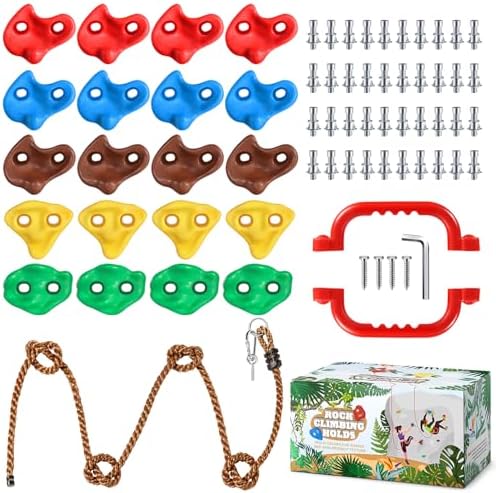
🧗 Best Large Holds
Oversized rock shaped holds for younger children who need to grip with a whole hand and stand with a whole foot rather than an edge.

🪢 Best Combined Kit
A set that pairs holds with a knotted climbing rope, which gives a second way up the same panel and suits children who find a pure rock wall frustrating.

Laying Out the Wall
Start at the bottom and work up, spacing the lowest holds close enough that the smallest child can reach the second from standing on the first, then let the spacing open out toward the top. That single decision turns one wall into a route for a four year old and a route for an eight year old.
Stagger the holds left and right rather than running them straight up the middle. A vertical ladder gets climbed once, while two or three offset lines that cross let children invent their own way up, which is most of the play value. Hold a few back so you can change the wall once you have watched it in use.

Height, Fall Height, and What Goes Underneath
A climbing wall changes the fall height of a playset, because the top of the wall becomes somewhere children stand. The CPSC Public Playground Safety Handbook defines fall height as the distance between the highest designated play surface and the protective surface beneath it, and pairs each material and depth with the fall height it protects.
The handbook advises never using less than 9 inches of loose fill material, with shredded or recycled rubber the one exception at a recommended 6 inches, and specifies a use zone extending a minimum of 6 feet (1.8 m) in all directions from the perimeter of stationary equipment. Our guide to playground surfacing depth sets out the full table.
Keep the base of the wall clear
The area directly below a climbing panel takes more falls than anywhere else on a playset, and it is often the spot where a sandbox, a bench or a planter has been tucked in. Clear it, and rake the surfacing back into the hollow that forms there, since the CPSC calls for loose fill levels never to drop below the minimum depth.
Common Mistakes to Avoid
- Buying small technical holds. They look like a climbing gym and children cannot use them. Large jugs and flat footholds are what get climbed.
- Using the supplied screws without checking the board. Too short and the hold works loose, too long and it comes through the other side.
- Forgetting the fall height changed. Adding a wall raises the height children stand at, and the surfacing underneath has to suit the new number.
- Never retightening. Timber moves through the year and holds spin. It is a two minute job twice a season.
Frequently Asked Questions
How many climbing rocks do you need for a playset panel? More than the panel looks like it needs. A typical board takes a couple of dozen holds before it offers more than a single route, and smaller sets usually end up combined with a second order.
Can you add climbing rocks to an existing playset? Usually yes, using screw-on holds, since most playset panels are fixed in place with no access behind them. Bolt-on holds need a T-nut in the back of the board, which normally means fitting them during assembly.
What size holds are best for young children? Large jug shaped holds with a deep lip to grip and a top wide enough to stand on flat footed. Small edges and pinches are designed for adult finger strength and are unusable for children.
What goes under a climbing wall on a playset? Protective surfacing sized to the fall height. The CPSC Public Playground Safety Handbook advises never less than 9 inches of loose fill, with shredded or recycled rubber the exception at a recommended 6 inches, extending at least 6 feet in all directions from the equipment.
Do outdoor climbing holds fade? Yes, most fade over a few seasons of sun, which is cosmetic. The functional issue is fixings working loose as the timber swells and shrinks, so put a wrench over every hold at the start and end of the season and check the panel for splitting around the fixings.
The Bottom Line
Buy large holds, plenty of them, in a mix of hand and foot shapes, and check the mounting method against your panel before ordering. Set the lowest holds close together for the smallest climber and stagger the lines so there is more than one way up. Then sort the surfacing to match the new fall height, and put a wrench over every hold twice a season.