Last updated: August 18, 2026
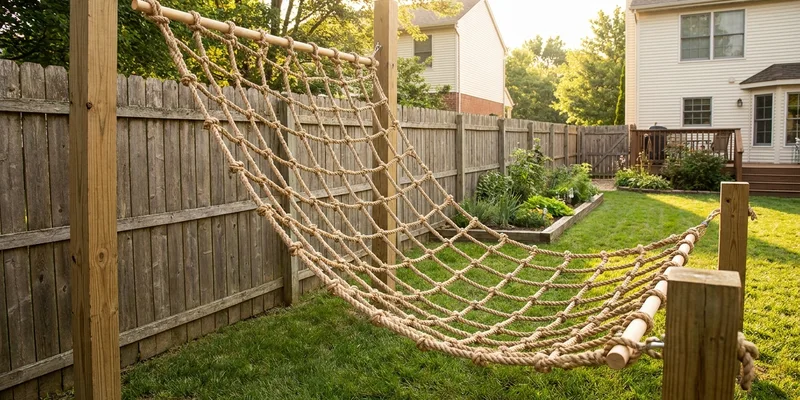
A cargo net for climbing is one of the few pieces of backyard play equipment that takes up almost no ground space, holds several kids at once and packs down for the winter. It is also the piece most often bought without checking the two things that decide whether it works: how the net attaches at the top, and how big the openings in the mesh are.
This guide covers rope materials, mesh sizing, mounting angle and hardware, and what belongs underneath a climbing net once it is up.
This article contains affiliate links. If you buy through them, we may earn a commission at no extra cost to you. Learn more.
Quick Answer
Which climbing cargo net should you buy?
- For an existing swing set or playset tower, buy a net sized to the frame opening and use the manufacturer’s own mounting hardware rather than improvising with rope.
- Polyester and nylon rope with a steel or polypropylene core lasts far longer outdoors than untreated natural fiber rope, which stiffens, frays and holds water.
- Check the mesh opening size against your children’s age and the CPSC guidance on head entrapment before you buy, not after you hang it.
- A net mounted at an angle is easier for younger children than one hanging vertically, and it is the setup most kids will actually use.
What to Check Before You Buy a Climbing Net
Climbing nets are simple, which means the specification sheet tells you almost everything you need. The rows below are all visible on a product listing, and getting them right is the difference between a net that stays taut for years and one that sags into a hammock by the second summer.
| What to check | Why it matters | What to look for |
|---|---|---|
| Rope material and core | Determines how the net handles sun, rain and a full season outdoors | Polyester or nylon outer braid over a steel or polypropylene core, rather than untreated natural fiber |
| Mesh opening size | Openings in a certain size range are a head entrapment concern on playgrounds | A stated opening size, checked against CPSC guidance and the age of the children using it |
| Overall dimensions | The net has to match the frame opening or the span you are hanging it across | Stated width and height, measured against your own frame before ordering |
| Attachment hardware | The top edge carries the entire load, every time | Included brackets, eye bolts or carabiners rated for the job, not generic hooks |
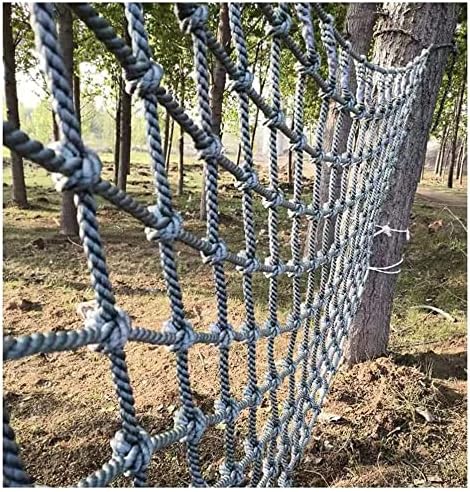
| Knot or joint type | Sliding joints let the mesh distort under load and change opening size | Fixed cross joints, either molded connectors or knots that cannot slip along the rope |
If you are still deciding between climbing options rather than shopping for one, our climbing and active play section compares the alternatives that fit a normal yard.
Rope Material: Nylon, Polyester, and Natural Fiber
Synthetic rope wins outdoors. Polyester holds up best against sunlight and keeps its stiffness when wet, nylon is stronger and stretchier but absorbs more water, and both resist rot in a way that untreated manila and sisal simply do not. Most quality playground nets use a synthetic braid wrapped around a steel or polypropylene core, which is what stops the net from stretching permanently once kids start using it.
Natural fiber rope looks the part and is genuinely pleasant to grip, but it swells and shrinks with the weather, splinters as it ages and needs replacing on a schedule rather than when it looks worn. It suits a decorative net under cover far better than a climbing net that lives outside year round.
Why the core matters
A cored rope does not elongate the way a plain braided rope does, and stretch is cumulative: every sag lowers the bottom edge, loosens the tension that keeps the mesh square, and turns rectangular openings into diamonds of a different size than the one printed on the box.

Mesh Size and Why It Matters
The size of the openings is the one specification worth checking against a published safety source rather than eyeballing. The CPSC Public Playground Safety Handbook identifies openings on playground equipment as a potential head entrapment hazard when the distance between opposing surfaces is greater than 3.5 inches (89 mm) and less than 9 inches (229 mm), and that range is the reason manufacturers state mesh dimensions at all.
Flexible nets complicate this, because the openings change shape as soon as weight goes on them. That is precisely why the handbook is worth reading directly if you are unsure, and why a net with fixed cross joints is a better buy than one whose knots can slide along the rope and open a gap that was not there in the photograph.
Match the net to the age, not the yard
Larger openings suit older children with a longer reach and a confident grip, while tighter mesh suits younger children who climb with more of their body and fewer deliberate hand placements. On a climbing net, the manufacturer’s stated age range is more useful than the dimensions alone.
Our Top Picks at a Glance
How we chose: we compared widely available climbing nets on rope construction and core type, stated mesh dimensions, and the mounting hardware included in the box. These picks lean on manufacturer specifications and recurring themes in customer reviews rather than any hands-on trial of our own.
🏆 Best Overall
A synthetic braided net over a steel core with molded fixed cross joints and stated mesh dimensions, the construction that holds its shape rather than stretching into a sag.

🧗 Upgrade Pick
A larger commercial grade net sized to span a full tower face or a wide frame, worth it when several kids climb at once and the net needs to hold tension across a bigger opening.
💚 Best Value
A compact net sized for a single swing set bay or a tower side, enough to add a climbing route without rebuilding anything.
Mounting Angle and Hardware
An angled net is easier to climb than a vertical one, because a climber can put weight through their feet instead of hanging entirely from their arms. Angling it also gives the net somewhere to go under load rather than pressing a child flat against a frame. Most playset nets are designed to run from the top of a tower down to a ground anchor at a slope, and that is the arrangement younger children get on with.
The top edge carries everything. Use the brackets or eye bolts the manufacturer supplies, fastened into structural timber or steel rather than a decorative rail, and check them at the start of each season the way you would check swing hangers. Anchor the bottom edge as well, since an unanchored net swings out from the frame and turns a straightforward climb into a pendulum.

What Goes Underneath a Climbing Net
Whatever the top of the net reaches is the height a child can fall from, and that height is what determines the surfacing you need underneath. The CPSC Public Playground Safety Handbook sets out how deep various loose fill materials need to be for a given fall height, and it also specifies a use zone extending a minimum of 6 feet (1.8 m) in all directions from the perimeter of stationary playground equipment.
Those figures are written for public playgrounds, but the reasoning holds in a backyard, where grass over compacted soil provides very little cushioning. Our guide to playground surfacing depth works through what the handbook specifies per material.
Common Mistakes to Avoid
- Ordering before measuring the frame opening. A net that is slightly too small cannot be stretched to fit, and one that is too large hangs slack from day one.
- Ignoring the stated mesh dimensions. Opening size is the specification with a published safety reason behind it.
- Leaving the bottom edge unanchored. An unanchored net swings away from the frame under load and can trap a foot as it returns.
- Assuming grass is enough of a landing surface. Compacted turf offers little cushioning, and the fall height under a net is the top of the net.
Frequently Asked Questions
What size cargo net do I need? Measure the frame opening or the span you plan to cover before ordering, since nets are sold by finished dimensions and cannot be stretched to fit. For a tower face, match the net width to the opening width and allow the height to reach a ground anchor at a slope.
Are cargo net openings a safety concern? Opening size matters. The CPSC Public Playground Safety Handbook flags openings between 3.5 inches (89 mm) and 9 inches (229 mm) as a head entrapment hazard on playground equipment, which is why manufacturers state mesh dimensions and an age range for each net.
What rope material lasts longest outdoors? A synthetic braid, polyester or nylon, over a steel or polypropylene core. Untreated natural fiber rope absorbs water, stiffens and frays, and needs replacing on a schedule rather than when it looks worn out.
Can I hang a climbing net from a tree? Yes, from a sound horizontal branch or beam using rated hanging hardware that spreads the load across the timber. Inspect the branch the same way you would before hanging a rope swing, and anchor the bottom edge so the net does not swing.
Do I need anything soft underneath a climbing net? The fall height is the height of the top of the net, and the CPSC handbook ties surfacing depth to fall height. Grass over compacted soil is the least forgiving option, so plan the surface at the same time as the net.
The Bottom Line
Buy a climbing net on three specifications: a synthetic rope over a proper core, a stated mesh opening size you have checked against CPSC guidance, and mounting hardware supplied for the job. Measure the frame first, hang the net at a slope rather than vertically, anchor the bottom edge, and plan the landing surface before the first climb rather than after.