Last updated: August 18, 2026
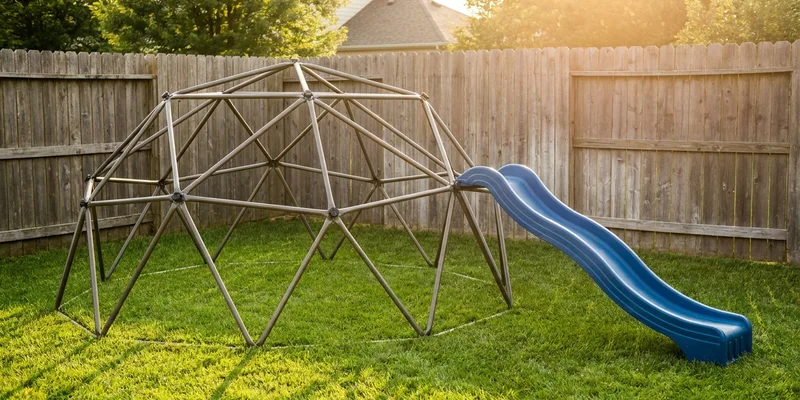
A climbing dome with slide is the version of the geodesic dome climber most families end up wanting, because the slide gives younger children a reason to get to the top and a way down that is not the way they came up. It also changes the footprint, the anchoring, and the surfacing you need, which is where most buyers get caught out.
This guide covers what the slide actually adds, how the attachment method differs between models, which dome size makes sense once a slide is bolted to it, and what to check on the listing before you order.
This article contains affiliate links. If you buy through them, we may earn a commission at no extra cost to you. Learn more.
Quick Answer
What should you look for in a climbing dome with slide?
- Check how the slide mounts. A slide bolted to the frame at a fixed hub is more stable than one that hooks over a bar, and it decides whether the slide can shift under a child.
- Add the slide’s run-out to your space plan, then keep the CPSC use zone clear around the whole thing. The CPSC Public Playground Safety Handbook calls for at least 6 feet (1.8 m) in all directions around stationary equipment.
- Anchor the dome. A slide pulls sideways on the frame every time a child pushes off, and an unanchored dome walks across a lawn over a season.
What to Check Before You Buy
Domes with slides vary more than the product photos suggest, and the differences that matter are all listed in the specifications or the manual. The rows below are the ones that separate a set that stays tight for years from one that develops a wobble by the second summer.
| What to check | Why it matters | What to look for |
|---|---|---|
| Slide attachment | A hooked slide can lift or shift; a bolted one cannot | Bolted mounting to a frame hub, with the fasteners specified in the parts list |
| Slide length and exit | The run-out extends the footprint beyond the dome itself | Slide dimensions in the manual, added to the clear space you plan around the dome |
| Dome diameter and height | Sets both the climbing challenge and the fall height | A stated diameter and height matched to the age group the manufacturer lists |
| Tube and connector quality | Thin tubing flexes and connectors are where movement starts | Powder coated steel tubing with a stated gauge, and metal connectors rather than plastic at load points |
| Anchoring hardware | Slide use pushes the frame sideways with every launch | Ground stakes or anchors included, or an anchoring method described in the manual |
| Weight capacity | Domes get used by several children at once, not one | Total capacity and per-child capacity, both stated by the manufacturer |
If you are still deciding on size, our guide comparing a climbing dome for kids in 6ft and 10ft versions works through the age fit in more detail.
What the Slide Actually Adds
The slide changes who uses the dome. A bare dome rewards children who already climb confidently, while a slide gives a younger child a clear goal and an easy exit, which usually means the whole structure gets used more and by a wider age range in the same household.
It also concentrates traffic. Every child heads for the same section of frame and the same landing spot, so the surfacing at the slide exit compacts and scatters faster than anywhere else. Worth knowing before you decide which way the slide should face.
The trade-off in climbing value
A slide occupies a section of the dome’s climbing surface and gives an easier route down, which slightly reduces the pure climbing challenge for older children. For most families with a range of ages that trade is worth making, but if your children are all confident climbers, a bare dome plus a separate accessory may give more play value.
Space, Anchoring, and What Goes Underneath
Plan the space around the assembled dome plus the slide run-out, not the dome alone. CPSC guidance for public playgrounds sets a use zone of at least 6 feet (1.8 m) in all directions around stationary equipment, and slides carry their own use zone requirements at the exit, which is the direction people most often forget when placing a dome against a fence.
Anchoring matters more on a dome with a slide than on a bare one, because sliding pushes the frame sideways with every launch. Use the stakes or anchors the manufacturer supplies, and if they look light for your soil, buy anchors rated for the ground you actually have. Our guide to ground anchors for play equipment covers the types and what they suit.

Surfacing Under a Dome and Slide
Protective surfacing is what makes the difference in a fall from the top of a dome, and CPSC guidance is clear that equipment should not be installed over concrete, asphalt, or packed earth, and that grass alone does not qualify as protective surfacing. The dome’s height sets the requirement, not the slide.
The CPSC handbook includes a surfacing table matching material and installed depth to the fall height it protects against, so take your depth from that table rather than estimating. Expect to rake loose fill back into place at the slide exit regularly, since that is where it scatters first.
Our Top Picks at a Glance
How we chose: we compared widely available dome climbers with slides on slide attachment method, tubing and connector quality, stated weight capacity, and how consistently owners report a stable frame and tight hardware after a season outdoors. Selections lean on manufacturer specifications and recurring themes in customer reviews rather than any hands-on trial of our own.
🏆 Best Overall
A mid-size steel dome climber with a bolted slide section, metal connectors at the load points, and anchors included, which covers a wide age range without dominating a normal yard.

🧒 Best for Younger Children
A smaller diameter dome with a short slide, sized so early climbers can reach the top and come down the intended way rather than the way they came up.

➕ Best Multi-Feature Set
A dome that combines the slide with a swing attachment or canopy, for families who want one structure to cover several kinds of play in a single footprint.

Accessories Worth Adding, and One Worth Skipping
Two accessories genuinely extend the season on a dome with a slide. A canopy keeps the top bars and the slide surface out of direct sun, which matters because a dark slide in full afternoon sun gets uncomfortably hot. A hammock or swing attachment gives quieter use on days when nobody wants to climb.
The accessory worth skipping is anything that changes how a child exits at speed, such as an add-on ramp at the slide bottom the dome maker did not supply. Slide exits are designed as a unit, and bolting on parts from elsewhere voids warranties and changes the landing.

Common Mistakes to Avoid
- Planning space for the dome but not the slide run-out. The slide extends the footprint in one direction, and that is usually the direction facing the fence.
- Leaving the dome unanchored. Sliding loads push the frame sideways every time a child launches, and an unanchored dome shifts across a lawn over a season.
- Assuming grass is enough underneath. CPSC guidance does not treat plain grass as protective surfacing, and the ground under a busy dome compacts quickly.
- Buying a size that only suits this year. A dome sized for a four year old stops being interesting fast. Match the diameter to the range of ages that will actually use it.
- Never rechecking the connectors. Domes have many bolted joints and they loosen with use. A tightening pass at the start of each season is the maintenance that keeps the frame rigid.
Frequently Asked Questions
Is a climbing dome with slide worth it over a plain dome? For households with a mix of ages, usually yes, because the slide gives younger children a goal and a safe exit, which broadens who uses the structure. If all your children are confident climbers, a bare dome preserves more of the climbing surface.
What age is a climbing dome with slide for? Follow the age range the manufacturer states for the specific model, since diameter and height vary widely. The CPSC Public Playground Safety Handbook groups playground equipment by age, with separate recommendations for children aged 6 to 23 months, 2 to 5 years, and 5 to 12 years.
Does a climbing dome need to be anchored? Yes, and more so with a slide fitted, because every launch pushes the frame sideways. Use the anchors the manufacturer supplies, or heavier ones rated for your soil if the included stakes look light.
What surfacing goes under a climbing dome? Protective surfacing at a depth taken from the surfacing table in the CPSC handbook for your equipment height. Concrete, asphalt, packed earth, and plain grass are all ruled out by CPSC guidance.
How much space does a climbing dome with slide need? The assembled diameter plus the slide run-out, plus the clear use zone around the whole thing. CPSC guidance calls for at least 6 feet (1.8 m) in all directions around stationary equipment, so measure before you order rather than after.
Can you add a slide to a dome you already own? Only with a section made for your model and mounting points. Aftermarket slides that hook over a bar rather than bolt to a hub are the ones owners most often report shifting under a child.
The Bottom Line
A climbing dome with slide earns its place when a household has a spread of ages, since the slide widens who uses the structure. Prioritize a bolted slide attachment, metal connectors at load points, and anchors that suit your soil. Plan the footprint to include the slide run-out and the clear use zone, and take your surfacing depth from the CPSC handbook rather than estimating it.