Last updated: August 18, 2026
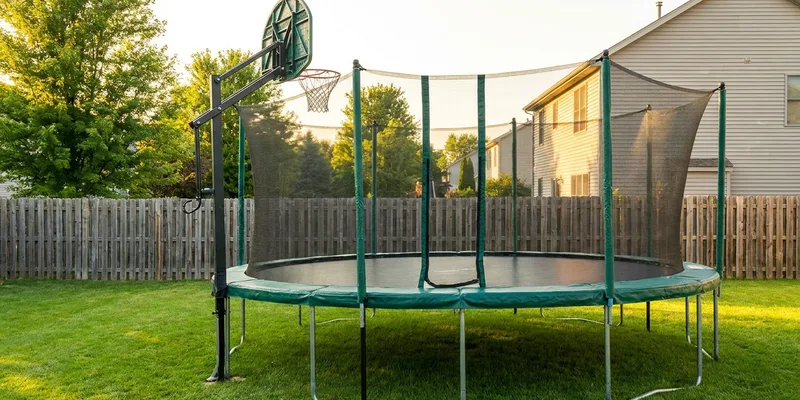
A trampoline with basketball hoop is the version kids actually keep using in year three, because it gives them something to do besides bounce. The catch is that the hoop is usually the cheapest part of the package, and a flimsy one bends, rusts, or snaps off its bracket long before the mat or the springs wear out.
This guide covers what separates a hoop that survives a few seasons from one that becomes yard clutter, how the mounting hardware differs between models, and the safety rules that change the moment a ball enters the enclosure.
This article contains affiliate links. If you buy through them, we may earn a commission at no extra cost to you. Learn more.
Quick Answer
Which trampoline with a basketball hoop should you buy?
- For most families, a 12 or 14 foot round trampoline with a full enclosure and a hoop mounted to the net poles rather than clipped to the netting is the version that lasts.
- Look for a padded backboard, a soft or foam basketball sized for the hoop, and a bracket that bolts through the pole instead of relying on a plastic clamp.
- If you already own a trampoline you like, a separate hoop attachment kit is usually the better move than replacing the whole unit.
- The hoop tempts kids to play together, but CPSC trampoline safety guidance is still one person on the mat at a time, so plan on taking turns.
What to Check Before You Buy
Every row below can be confirmed on the product listing or in the manual before you order. Hoop trampolines fail in predictable places, and almost all of those places are visible in the specifications if you know to look.
| What to check | Why it matters | What to look for |
|---|---|---|
| Hoop mounting | The single most common failure point on hoop trampolines | A bracket that bolts through or clamps around the enclosure poles, not one that hangs from the net fabric |
| Backboard material | Thin plastic cracks in cold weather and warps in summer sun | A padded or reinforced backboard rated for outdoor use, with the padding wrapping the lower edge |
| Ball type included | A hard regulation ball damages the net and the mat | A soft foam or inflatable ball sized for the hoop, ideally with a pump included |
| Enclosure pole count | Determines how rigid the frame is once a hoop adds leverage | Enough poles that the net stays taut, with foam sleeves covering the full pole length |
| Spring and frame padding | Chasing a ball is exactly when a foot finds the springs | Pads that fully cover springs, hooks and frame, as CPSC trampoline safety guidance calls for |
| Net entry | A zipper that fails leaves the enclosure open | A dual closure with both a zipper and buckles, reachable from inside and outside |
| Rust protection | The hoop assembly sits outside all season with no cover | Galvanized or powder coated hardware, and stated corrosion resistance on the bracket bolts |
Sizing is the other half of the decision, and it drives how many kids can realistically take turns. Our guide to trampoline sizes compared walks through what each diameter actually needs in yard space.
How the Hoop Attaches, and Why It Matters
The mounting method tells you more about long term durability than the brand name does. There are three common approaches, and they are not equally durable. A bolted bracket that wraps the enclosure pole transfers the load into the frame. A clamp style bracket relies on friction and needs re-tightening. A net mounted hoop, where the backboard hangs from the enclosure fabric, puts every dunk into the netting seams.
Net mounted hoops are the ones that sag within a season. They are common on lower cost bundles because they need no extra hardware, but they stretch the net, misalign the rim, and eventually tear at the attachment points. If a listing does not show the bracket clearly in the photos, that usually means there is not much of one.
Rim Height Is Fixed, and That Is Fine
Almost every trampoline hoop sits at a fixed height relative to the enclosure top, which means the effective rim height changes as a child grows and as the mat sinks under their weight. Adjustable rims exist but add another joint that loosens. For backyard play, a fixed rim that stays square is worth more than an adjustable one that drifts out of alignment.
Safety Rules That Change When a Ball Is Involved
Adding a hoop does not change the underlying trampoline safety guidance, but it does make that guidance harder to follow. CPSC trampoline safety guidance is clear on the core points: allow only one person on the trampoline at a time, do not allow somersaults, do not use the trampoline without shock absorbing pads that completely cover the springs, hooks and frame, and place the trampoline away from structures, trees and other play areas.
A hoop pulls directly against the first of those rules, because basketball is a game kids want to play together. The practical answer most families land on is a turn based game, one jumper shooting while the others rebound from outside the enclosure, rather than a free for all with three kids on the mat.
Age Is a Separate Question
CPSC trampoline safety guidance also states that no child under six years of age should use a full size trampoline. That applies whether or not a hoop is attached, and it is worth knowing before you buy a family sized unit for a household with a toddler in it. Smaller equipment designed for younger children is a different product category with different guidance.
Note that the CPSC Public Playground Safety Handbook, which sets the use zone and surfacing rules for playground equipment, does not treat trampolines as recommended playground equipment. The relevant consumer standards are ASTM F381 for the trampoline itself and ASTM F2225 for the enclosure, and manufacturers who follow them usually say so on the listing.
Our Top Picks at a Glance
How we chose: we compared widely available hoop trampolines on mounting hardware, backboard construction, enclosure quality, and the failure patterns that show up repeatedly in owner reviews after a full season outdoors. Selections lean on manufacturer specifications and recurring review themes rather than any hands-on trial of our own.
🏆 Best Overall
A 14 foot round trampoline with a full enclosure and a pole mounted, padded backboard hoop, the size that leaves room for a shot without crowding the net.

🏀 Best for Mid-Size Yards
A 12 foot version of the same configuration, which fits far more suburban yards while still giving a jumper room to land clear of the net.

Picks by Situation: Add-On Kits and Replacements
Two situations do not call for a new trampoline at all. If your current unit is sound, a hoop attachment adds the same play value for a fraction of the effort. And if only the ball or the backboard has given out, those are sold separately.
🔧 Best Add-On for an Existing Trampoline
A universal hoop attachment kit that clamps to the enclosure poles, the sensible route when the trampoline itself still has plenty of life in it.

⚽ Best Replacement Ball
A soft foam or lightweight inflatable basketball sized for a trampoline rim, which is easier on the net and the mat than a regulation ball.

Setup and Seasonal Upkeep
Install the hoop after the enclosure is fully tensioned, not before, because tightening the net afterwards shifts the bracket and pulls the rim out of square. Check the bracket bolts after the first week of heavy use and then monthly through the season, since that hardware works loose faster than anything else on the trampoline.
Take the hoop off before winter storage if you take the net down. Leaving a backboard bolted to a bare pole through freeze and thaw cycles is how brackets seize and plastic cracks. If you need to relocate the whole setup rather than store it, our guide on trampoline ground anchors covers securing it once it lands in its new spot.
Common Mistakes to Avoid
- Buying a net mounted hoop. Hanging the backboard from the enclosure fabric stretches the net and misaligns the rim within a season.
- Using a regulation basketball. A hard ball at speed damages netting seams and is a genuine hazard inside a small enclosure. Stick to the soft ball designed for the rim.
- Letting the hoop override the one jumper rule. CPSC trampoline safety guidance is one person on the mat at a time, and a hoop does not change that.
- Skipping the bracket bolt check. Dunking applies leverage the frame was not designed for, and loose bolts are the most common repair on these units.
- Choosing a size that fills the yard. The trampoline needs clearance from fences, structures and trees, so measure the space before you commit to a diameter.
Frequently Asked Questions
Can you add a basketball hoop to any trampoline? Most trampolines with a pole style enclosure can take a universal clamp on hoop kit, provided the pole diameter matches the bracket. Trampolines without an enclosure, or with an arched pole design, often cannot, so check the pole shape and diameter before ordering.
Is a trampoline basketball hoop safe? The hoop itself is not the risk; crowding is. CPSC trampoline safety guidance calls for one person on the trampoline at a time, no somersaults, and pads that fully cover the springs, hooks and frame, and a hoop makes those rules harder to keep. Using a soft ball and taking turns addresses most of it.
What size trampoline is best for a basketball hoop? Twelve and fourteen foot round models are the common sweet spot, since they leave a jumper room to land clear of the net after a shot. Smaller diameters work for one younger child but get cramped quickly.
What kind of ball should you use on a trampoline hoop? A soft foam or lightweight inflatable ball sized for the rim. Regulation basketballs are heavy enough to damage netting and are harder to control inside an enclosure.
Do trampoline hoops break easily? The bracket and the backboard are the parts that fail, usually because the hoop was mounted to the net rather than the poles, or because the bolts were never re-tightened. A bolted pole mount and a monthly hardware check prevent most of it.
Can two kids play basketball on a trampoline together? Not on the mat at the same time under CPSC trampoline safety guidance. A workable version is one jumper shooting while others rebound from outside the enclosure, then swapping.
The Bottom Line
Buy the mounting hardware, not the hoop. A 12 or 14 foot round trampoline with a full enclosure and a bolted, pole mounted backboard is the configuration that survives past the first season, and a soft ball keeps it from chewing through the net. If you already own a trampoline you are happy with, a clamp on attachment kit gets you the same result without replacing anything.