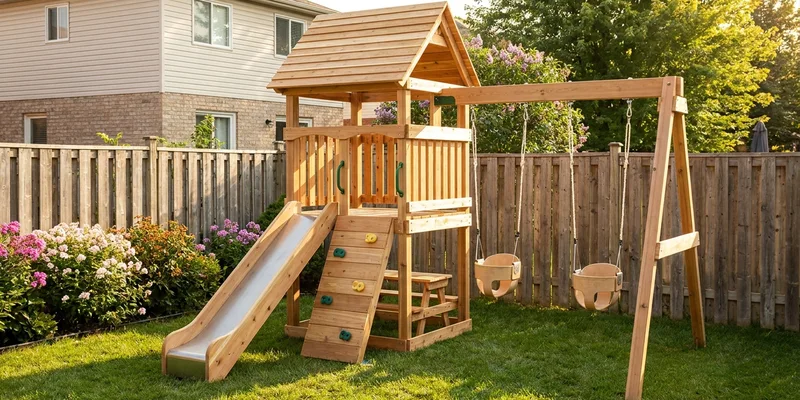
Last updated: August 18, 2026
Choosing a swing set for a small yard is less about finding a smaller product and more about understanding how much clear space a swing actually needs behind it and in front of it. A frame that measures eight feet wide does not need an eight foot patch of lawn; it needs that width plus a swept area on both sides of the arc, and that is where most small yard plans go wrong.
This guide covers how to measure your usable space first, which swing set styles hold up in a tight footprint, and what to look for on the listing before you commit. If you want a tower with a deck and a slide instead of a swing beam, our small yard playset guide covers that side of the decision separately.
This article contains affiliate links. If you buy through them, we may earn a commission at no extra cost to you. Learn more.
Quick Answer
Which swing set works in a small yard?
- A single beam metal A-frame set is the most space efficient option, because it has no deck, no tower and no fixed slide competing for square footage.
- Measure the swing path before the frame. CPSC guidance for home playgrounds puts the use zone in front of and behind a swing at twice the height of the pivot bar above the surface, and that number, not the frame width, is what usually rules a yard out.
- Two swing positions instead of three, and a shorter top bar, buy back more usable lawn than any other single choice.
- Anchor whatever you buy. A light frame in a small yard sits closer to fences and walls, so a set that walks or tips has less room to do it safely.
Small Yard Swing Set Styles Compared
Not every swing set shrinks the same way. Some styles lose their play value when scaled down, while others were compact to begin with. This table sums up how the main options behave when yard space is the limiting factor.
| Style | Space behavior | Best for | Watch out for |
|---|---|---|---|
| Metal A-frame, single beam | Narrowest overall footprint, splayed legs add width at the base | Yards where the swing arc is the only usable open strip | Legs need anchoring, and the base is wider than the top bar |
| Wooden A-frame swing beam | Similar footprint to metal, heavier and more stable | Owners who want the look of wood without a tower | Usually sold as a bracket kit plus your own lumber |
| Toddler frame with two seats | Smallest option, low pivot height so a short swing zone | Children still in the bucket seat stage | Outgrown quickly, so plan for a second purchase |
| Corner or single post swing | Fits along a fence line or beside a patio | Very narrow side yards | One swing position only, limited for siblings |
| Compact tower playset | Trades floor area for height, needs clearance on all sides | Square yards with a usable center | Slide exit adds a use zone the frame drawing does not show |
If the last row is where your yard lands, the tower versions are covered in our small yard playset guide, which weighs deck height against footprint.
How Much Clear Space a Swing Actually Needs
A swing needs open ground well beyond the frame itself. The CPSC Outdoor Home Playground Safety Handbook recommends protective surfacing extending at least 6 feet (1.8 m) in all directions from stationary play equipment, and for swings it recommends the zone in front of and behind the swing extend twice the height of the pivot bar measured from the surface below. On a swing set with the top bar at 8 feet, that is a long clear corridor.
That single rule is why a small yard shopper should measure the swing corridor first and the frame second. Sketch the corridor on the lawn with a hose or a length of rope before ordering, because a frame that technically fits between the fence and the patio can still leave a child’s feet arriving at a hard edge.
Where the Space Usually Runs Out
The three things that most often ruin a small yard layout are a fence directly behind the swing arc, a slope that puts the downhill leg lower than the uphill one, and a slide exit pointed at a wall. Deal with all three on paper before anything is delivered, since a set already bolted together is awkward to reposition.
Sloped ground is worth solving properly rather than shimming. Our guide on leveling ground for a playset walks through the approach that keeps a frame square without burying one leg.
What to Check on the Listing
Product pages for compact swing sets rarely lead with the numbers that matter to a small yard. Four specifications tell you almost everything: assembled width, assembled depth at the base, top bar height above the surface, and the stated weight limit per swing position. Everything else is secondary.
Base depth is the one people miss. An A-frame set splays outward at the ground, so the footprint at the legs is meaningfully wider than the top bar it is advertised with. Read the assembled dimensions rather than the beam length, and confirm the number is given for the frame set up, not folded flat in the box.
Our Top Picks for Small Yards
How we chose: we compared widely available compact swing sets on assembled footprint, top bar height, stated weight limits, and how consistently owners report a stable frame once anchored. Selections lean on manufacturer specifications and recurring themes in customer reviews rather than any hands-on trial of our own.
🏆 Best Overall
A metal A-frame swing set with two swing positions and a powder coated steel frame, the configuration that gives up the least play value for the smallest footprint.

🌱 Best for Toddlers
A low frame toddler swing set with bucket seats and a short pivot height, which keeps both the frame and the required swing corridor small.

🧰 Best Build Your Own
An A-frame bracket kit that turns your own lumber into a swing beam, so you can set the exact span your yard allows instead of the span the box decided.

Picks by Situation: Narrow Yards and Heavy Use
Two small yard situations call for something other than a standard frame: a long narrow strip where only one swing position will ever fit, and a yard where older or heavier children will use the set hard enough that frame stiffness matters more than compactness.
📏 Best for a Narrow Strip
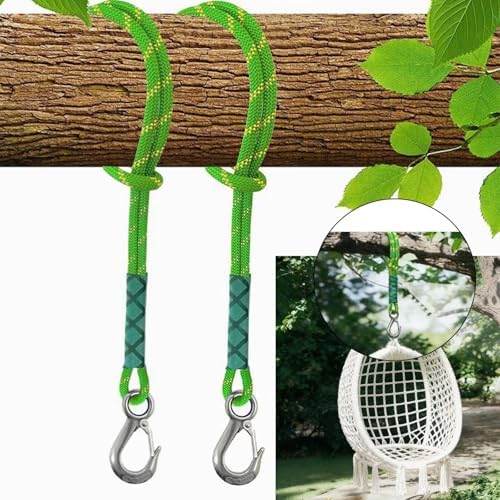
A single position swing hanger and seat set that mounts to a sturdy tree limb or an existing beam, using space you already have instead of adding a frame.
🛠️ Best for Heavy Use
A heavy gauge steel swing frame with a higher stated weight rating, worth the extra base width if older kids will be on it daily.

Setting Up on a Small Lot
Anchoring matters more in a small yard, not less. The CPSC Outdoor Home Playground Safety Handbook advises anchoring equipment securely with anchoring devices installed below ground level, which also removes the trip hazard a surface bracket creates in a space where children run close to the frame.
Surfacing is the other half. A compact set on bare turf packs the landing zone into hard ground quickly, since every user lands in nearly the same spot. Loose fill under the swing arc spreads that wear and gives the landing somewhere to go.
Fences, Sheds and Property Lines
Setback rules, easements and HOA restrictions vary widely by county and by association, so check with your own local building department and your HOA before you place a permanent structure near a boundary. We are not in a position to name a distance that applies to your lot.
Common Mistakes to Avoid
- Measuring the frame instead of the swing corridor. The clear space in front of and behind the arc is the number that decides whether a set fits.
- Setting the frame up against a fence. A fence directly behind the arc turns a normal backswing into a collision.
Frequently Asked Questions
How much space do you need for a swing set in a small yard? More than the frame dimensions suggest. CPSC guidance for home playgrounds calls for protective surfacing extending at least 6 feet (1.8 m) around stationary equipment, with the zone in front of and behind a swing extending twice the height of the pivot bar. Measure that corridor before you shop.
What is the smallest swing set you can buy? Toddler frames with two bucket seats are the smallest complete sets, followed by single position swings that hang from a bracket, a tree limb or an existing beam. Both trade capacity for footprint.
Can a swing set go right next to a fence? Not directly behind the arc. The backswing needs clear space, and a fence in that path is the most common layout mistake in a narrow yard. Along the side of the frame is a different matter.
Is a metal or wooden swing set better for a small yard? Metal A-frames are usually the lighter and narrower option and ship as complete sets. Wooden beams built from a bracket kit let you pick your own span, which can be the better fit when the available strip is an odd width.
Can you put a swing set on a slope? Only after leveling the ground under it. Shimming one leg leaves the frame twisted and the swing arc uneven, so level first and set the frame afterward.
The Bottom Line
For most small yards the answer is a two position metal A-frame with a modest top bar height, anchored below ground level and placed so the swing corridor runs along the longest clear line in the yard rather than into a fence. Measure that corridor first, check the assembled base width rather than the beam length, and treat the swing zone as part of the purchase.