Last updated: August 18, 2026
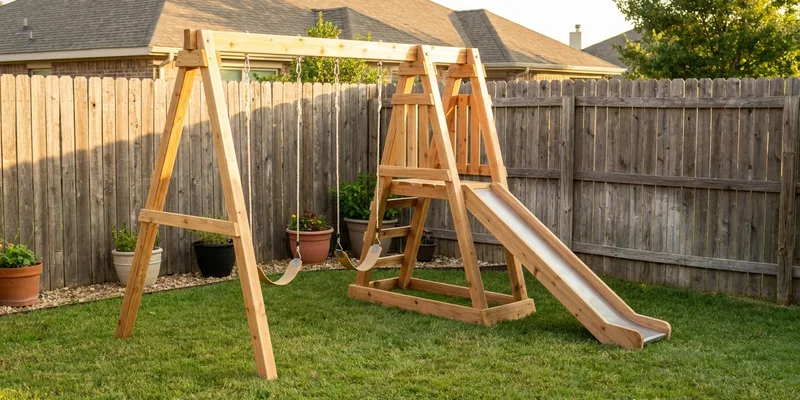
An outdoor playset for a small yard is a different purchase from a compact swing set. A playset brings a raised deck, a slide and usually a climbing route, so it buys play value by going upward rather than sideways. That is exactly why it can work on a lot where a long swing beam never would, and also why the slide exit becomes the measurement that decides everything.
This guide covers how a tower footprint really behaves on a small lot, which playset formats survive being scaled down, and where the honest answer is that a set of separate pieces beats one shrunken all-in-one structure. If a swing beam is what you actually want, our small yard swing set guide handles that case.
This article contains affiliate links. If you buy through them, we may earn a commission at no extra cost to you. Learn more.
Quick Answer
Which outdoor playset fits a small yard?
- A compact tower with a deck, a short slide and a climbing wall gives the most play per square foot, because the climbing route stacks vertically instead of stretching out.
- The slide exit, not the tower, is what needs planning. CPSC guidance for home playgrounds calls for protective surfacing extending at least 6 feet (1.8 m) in all directions from stationary equipment, and the space in front of a slide is where small yards run out.
- For preschoolers, a molded plastic climber and slide unit fits where a wooden tower cannot, and it moves if you change your mind about placement.
- Large wooden playsets are mostly a home center and warehouse club purchase rather than an online one, so shop those locally and buy accessories separately.
Playset Formats for a Tight Lot
Playsets scale down in three different ways, and each way costs you something. This table lays out what each format does to your usable yard and who it actually suits.
| Format | How it uses space | Best for | Trade-off |
|---|---|---|---|
| Molded plastic climber and slide | Smallest footprint, low deck, movable | Toddlers and preschoolers | Outgrown early, and it needs a flat spot to sit level |
| Compact wooden tower with slide | Tall and narrow, slide runs off one side | Mixed ages in a square yard | Slide exit adds a use zone beyond the tower outline |
| Tower with attached swing beam | Tower plus a long arm, the widest option | Yards with one long clear run | The swing arm alone often decides the set will not fit |
| Metal frame combo set | Lighter structure, slide and swings on one frame | Buyers who want a complete set delivered | Less deck space, and the frame needs anchoring |
| Separate pieces instead of one set | Distributes play around the yard’s odd corners | Awkward, narrow or sloped lots | No single structure the children treat as a base |
The last row is worth taking seriously. On a genuinely tight lot, a small climbing dome in one corner and a swing along the fence line often beats a shrunken tower squeezed into the middle, and our swing set and playset guides cover both routes.
Why the Slide Exit Decides the Layout
The clear ground a playset needs is set by its exits, not its outline. The CPSC Outdoor Home Playground Safety Handbook recommends protective surfacing extending at least 6 feet (1.8 m) in all directions from stationary play equipment, and a child leaving a slide keeps moving forward past the end of the chute. That forward run is the space small yards most often fail to allow for.
Practically, this means orienting the slide toward the longest open line in the yard, even if that leaves the tower in a spot that looks less tidy on paper. Rope out the tower outline and the slide run before ordering, and walk it, because a tower that fits between the deck and the fence is no use if the slide points at the deck.
Deck Height and Age Range
Deck height is the other lever. A lower deck reduces the fall height, keeps the slide shorter and shrinks the whole structure, at the cost of losing older children’s interest sooner. The CPSC handbook separates equipment guidance by age group, so match the deck and the climbing route to the ages actually using it rather than buying up for a growth spurt that is years away.
What to Check Before You Buy
Playset listings advertise the footprint of the structure and rarely the space the structure needs. Four numbers matter most: the assembled length and width, the deck height above the ground, the slide length, and the stated age range. Add clear ground beyond the slide end to the length before comparing it against your yard.
Also read how the set arrives. Compact wooden towers ship as long flat boxes that a small yard often cannot get to the back garden without going through the house, and gate width is a real constraint people discover on delivery day rather than before it.
Our Top Picks for Small Yards
How we chose: we compared widely available small footprint play structures on assembled dimensions, deck height, stated age range and how consistently owners report stable assembly on ordinary lawns. Selections lean on manufacturer specifications and recurring themes in customer reviews rather than any hands-on trial of our own. Note that full size wooden playsets are largely a home center purchase, so the picks below focus on what is genuinely available to order.
🏆 Best Overall
A compact climber and slide play structure with a low deck and a climbing wall, the format that delivers the most play in the least ground area.

🌱 Best for Toddlers
A molded plastic toddler climber with a short slide, light enough to reposition and low enough to suit the youngest age group.

🧗 Best Vertical Play
A climbing dome that uses a circle of ground instead of a rectangle, which often slots into a small yard corner a tower cannot reach.

Picks by Situation: Adding to What You Have
Two situations come up constantly on small lots: an existing tower that needs one more play feature without growing the footprint, and a slide that has weathered out while the rest of the structure is fine.
➕ Best Add-On
A climbing rock or rope ladder accessory that adds a route up an existing tower without extending the structure sideways.

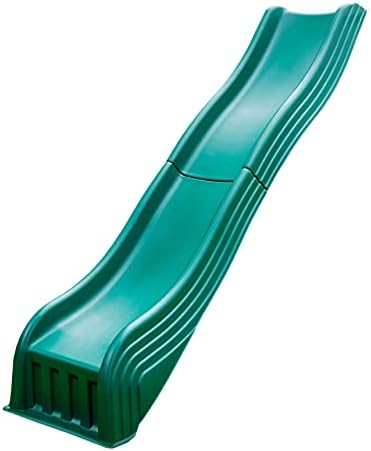
🛝 Best Slide Replacement
A wave slide sized to your existing deck height, the simplest way to bring an aging set back into service.
Ground Prep in a Confined Space
A tower concentrates wear at the ladder base and the slide exit, and on a small lot those two spots are close together. Loose fill surfacing under the whole use zone spreads that wear and gives the landings somewhere to go, which matters more where the same patch of ground takes every arrival.
Level ground first. A tower on uneven ground twists, the deck stops sitting square, and the slide picks up a sideways lean that grows over a season. Our guide on leveling ground for a playset covers doing that without digging half the yard up.
Boundaries, Permits and HOA Rules
Setback distances, fence line rules and HOA approval for permanent structures vary by county and by association, and a small lot puts a playset closer to a boundary by definition. Check with your local building department and your HOA before placing anything permanent, since we cannot give a distance that holds for your property.
Common Mistakes to Avoid
- Measuring the tower but not the slide run. Clear ground in front of the slide is part of the footprint, whatever the product drawing shows.
- Buying a tower with a swing arm you have no room to use. The swing arm is usually the piece that makes the set too big for the lot.
- Choosing a deck height for the oldest child. A taller deck raises the fall height and enlarges the whole structure for a child who is not using it yet.
- Forgetting to check gate and side passage width. Flat pack boxes for wooden towers are long, and a narrow side passage stops delivery at the front garden.
- Assuming a large wooden playset is an online purchase. Most of that category moves through home centers and warehouse clubs, so plan to shop those locally.
Frequently Asked Questions
How much room do you need for a small playset? The structure plus clear ground around it. CPSC guidance for home playgrounds calls for protective surfacing extending at least 6 feet (1.8 m) in all directions from stationary equipment, with extra allowance in front of a slide for the forward run.
What is the difference between a swing set and a playset? A swing set is a beam with swings hanging from it. A playset adds a raised deck, usually a slide and a climbing route, so it takes more ground but gives more kinds of play.
Can a playset go close to a fence? Keep exits and climbing routes clear of it, and check your own local setback and HOA rules for permanent structures, since those vary by county and by association.
What deck height suits preschoolers? Lower is better for the youngest group. Match the deck and climbing route to the stated age range on the listing, and use the age group guidance in the CPSC Outdoor Home Playground Safety Handbook rather than buying ahead.
Are large wooden playsets available to order online? Some are, but the category is dominated by home centers and warehouse clubs. Accessories, slides, climbing holds and hardware are far easier to source online than the structures themselves.
The Bottom Line
On a small lot, the playset that works is usually a compact tower with a low deck and a short slide, oriented so the slide runs along the longest open line in the yard. Measure the slide exit as part of the footprint, level the ground before assembly, and accept that separate pieces spread around the yard sometimes beat one squeezed in structure.