Last updated: August 18, 2026
A sandbox with a cover and seats solves two problems with one piece of plywood: the sand stays covered when nobody is playing, and there is somewhere to sit when they are. That second part matters more than it sounds, because children who have to kneel in the sand get sandy knees, get told off, and lose interest faster than children who can sit on an edge and dig.
The catch is that seating is implemented three different ways, and they are not equivalent. This guide separates the folding bench lid from the built in corner seat and the molded plastic shell, and covers the hardware details that decide whether the lid still works in year three.
This article contains affiliate links. If you buy through them, we may earn a commission at no extra cost to you. Learn more.
Quick Answer
Which sandbox with a cover and seats should you buy?
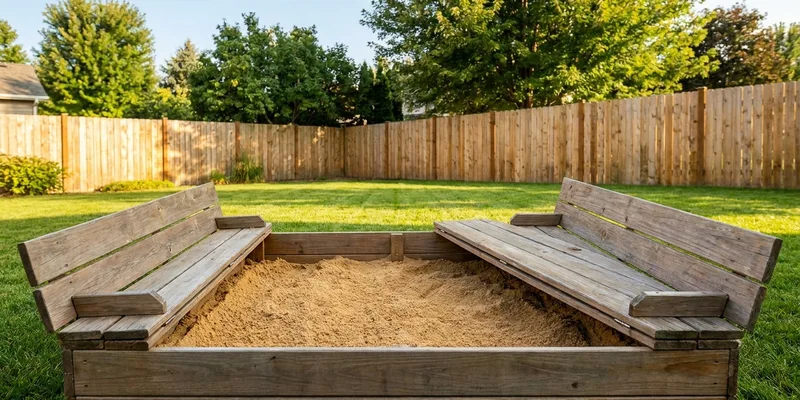
- The folding bench lid is the design to beat: two halves that meet in the middle when closed and fold outward into a seat on each side when open, so nothing has to be stored anywhere.
- Built in corner seats are the sturdier option and are always there, but they take up interior space and still need a separate cover, which is the part that goes missing.
- Check the hinge hardware before anything else. On a convertible lid the hinges carry both the closing job and a child’s weight, and they are the part that fails first.
- Whichever you pick, plan the base underneath: permeable fabric or drilled drainage, ground rather than a solid slab, and partial shade away from overhanging trees.
Three Ways a Sandbox Gives You Seating
Seating and covering are separate jobs, and each design combines them differently. That combination is what you are actually choosing between, because it determines how much space the box takes, whether a cover exists at all, and how much hardware there is to maintain. Every row below is visible in listing photos.
| Design | How the seating works | Strengths | Trade offs |
|---|---|---|---|
| Folding bench lid | Two lid halves fold outward and become a bench on each long side | Cover and seats in one part, nothing to store, full interior stays free | Seam down the middle sheds rain less completely; hinges carry weight |
| Built in corner seats | Fixed triangular or bench seats in two or four corners | Very sturdy, always available, no moving parts to break | Eats interior play space, and the cover is a separate item you can lose |
| Molded plastic with seat backs | Seating shapes molded into the shell, lift off lid on top | Light, easy to rinse out, low sides suit toddlers | Smaller interior volume, lid is separate and blows off if not secured |
If you are still weighing covered against uncovered in general, our broader guide to a sandbox with a cover compares all four cover styles including fabric and clamshell versions.
Why the Seats Change How the Sandbox Gets Used
Seating changes the play, not just the comfort. A child sitting on a rim can reach the middle of the box without crawling into it, two children can work opposite sides without colliding, and an adult has somewhere to sit that is not the lawn. Boxes without a seat get used from the outside, kneeling, and sessions end sooner.
The seating also solves the storage problem that kills most covers. A lid that folds into the seats is already in position, so closing it takes a second and there is nothing leaning against the fence collecting rain. For toddlers a low rim they can step over matters more than a formal seat; from preschool up, a bench with real width is what gets used.
The Hardware Details That Decide Longevity
On a convertible sandbox, the hinges are the product. They swing the lid several hundred times a season and then take a child’s weight in the open position, outdoors, all year. Hinge quality and how the hinge is fastened to the boards separate a box that lasts from one that is wobbling by the second summer.
Look on the listing for the fastener type and the hinge material. Through bolts with washers hold far better in softwood than short screws driven into end grain, and coated or stainless hardware survives weather that plain steel does not. Photographs from owners usually show the hardware more honestly than the manufacturer’s studio shots.
Pinch Points and Lid Weight
The CPSC Public Playground Safety Handbook treats pinch, crush and shear points on moving parts as a hazard category worth designing out, and a folding lid is a moving part. Look for designs where the fold is controlled rather than free swinging, and make closing the lid an adult job with young children present. A lid heavy enough to slam is a lid to skip.
Our Top Picks at a Glance
How we chose: we compared widely available covered sandboxes with seating on how the cover and seat combine, hinge and fastener quality visible in listing photos, interior space left after the seating, drainage provisions, and the recurring themes in owner reviews. Selections lean on manufacturer specifications and customer feedback rather than any hands on trial of our own.
🏆 Best Overall
A wooden box whose two lid halves fold outward into full length bench seats, with through bolted hinges and a finish stated as suitable for play equipment. The configuration that covers the sand and seats two children without a separate part to store.
🪵 Best Built In Seating
An octagon or square frame with fixed corner seats, which is the sturdiest arrangement and the one with nothing to break, provided you commit to buying and actually using a separate cover.

🧒 Best for Toddlers
A molded plastic shell with shaped seating and a lift off lid, low enough for a small child to step over unaided and light enough for one adult to tip out and rinse at the end of the season.

Picks by Situation: Sun and Small Yards
Two situations change the answer entirely. A yard with no natural shade over the sand needs a canopy version rather than a plain lid, and a patio or a narrow side yard rules out anything whose lid swings wide when it opens.
⛱️ Best With Shade
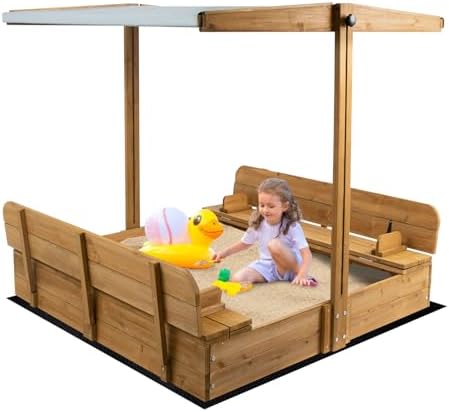
A design that pairs bench seating with a fabric canopy overhead, for open yards where the sand and the children both bake by midafternoon. Check that the canopy is removable so it can come off before winter and before storms.

🏡 Best for a Tight Space
A compact folding lid box with a footprint that stays the same open or closed, since a swinging lid that needs clearance on both sides is a problem against a fence or a wall.

Getting the Base and the Sand Right
The box on top is only half the job. Sandboxes need somewhere for water to go, which means drilled holes in a plastic shell or permeable landscape fabric under a timber frame, sitting on soil or gravel rather than on a solid slab where water simply pools. Avoid solid plastic sheeting underneath, which traps water instead of draining it.
Place it in partial shade and away from overhanging trees, which cuts both the midsummer heat on the sand and the leaf litter that ends up in it. Fill it with sand sold and labeled for play use, and check the manufacturer’s own safety information for the product you buy. If you want to work out how much you need before ordering, our guide on how much sand a sandbox takes walks through the arithmetic per size.
Common Mistakes to Avoid
- Judging the seat from the photo alone. Check the stated dimensions of the seating surface, because a narrow bench is a place to perch rather than sit.
- Ignoring the hinge specification. On a convertible lid the hinges do two jobs at once, and short screws into softwood end grain are the usual failure point.
- Choosing corner seats without buying a cover. Built in seating does not cover the sand, and an uncovered box goes downhill fast.
- Putting it on a patio slab. Water has nowhere to go, and the sand stays wet for days after rain.
- Siting it under a tree for the shade. The shade is welcome, the sap, seed pods and leaves are not.
Frequently Asked Questions
What is a convertible sandbox lid? It is a two piece cover whose halves fold outward and lie flat to form a bench on each side of the box. Closed, it covers the sand; open, it is the seating, so there is no separate cover to store.
Are built in seats better than a folding lid? They are sturdier and have nothing to break, but they take up interior space and do not cover the sand. A folding lid does both jobs at the cost of hinges that need checking each season.
Do sandboxes with seats still need drainage? Yes. The seating changes nothing about what happens underneath, so you still want drilled holes in a plastic shell or permeable fabric under a timber frame, on soil or gravel rather than a solid slab.
Should a sandbox be covered when not in use? The CPSC Public Playground Safety Handbook advises covering sandboxes when they are not in use, which in practice keeps out rain, leaves and animals. A cover that is fast to close is the one that actually gets used.
Are folding lids safe for small children? Treat the fold as a moving part with pinch potential, which is a hazard category the CPSC handbook addresses for play equipment generally. Favor controlled rather than free swinging designs, and make closing the lid an adult job while children are small.
The Bottom Line
Buy the seating design that fits your yard and your child’s age, then check the hardware. A folding bench lid gives you cover and seats in one part and is the strongest all round answer, built in corner seats are sturdier but still need a cover you have to remember, and a molded plastic shell suits toddlers best. Underneath all three the same rules apply: permeable drainage, ground rather than slab, partial shade, and sand labeled for play use.