Last updated: August 18, 2026
Figuring out how to keep cats out of a sandbox usually starts the morning someone finds the evidence. It is an unpleasant discovery, and the internet will happily sell you a dozen sprays, granules, and ultrasonic gadgets to fix it. Almost none of them are the actual answer.
The actual answer is a lid, closed every time. This guide explains why a cat picks a sandbox, which deterrents are worth trying when a cover is not practical, and how to handle sand that has already been used.
This article contains affiliate links. If you buy through them, we may earn a commission at no extra cost to you. Learn more.
Quick Answer
How do you keep cats out of a sandbox?
- Cover the sandbox every single time play ends. A fitted lid or a weighted mesh cover is the only method that works reliably, because it removes access rather than trying to change the cat’s mind.
- If a cover is not practical, deterrents can help at the margins: motion activated sprinklers, a physical barrier over the sand, and keeping the sand damp are the ones with any real track record.
- Sprays, granules, and ultrasonic devices are inconsistent at best, and outdoor rain and wind work against all of them.
- If a cat has already used the sandbox, remove the contaminated sand rather than raking it in, wear gloves, and wash hands afterward. See the hygiene section below and check current CDC guidance.
What Actually Works, and What Does Not
Deterrent methods fall into three groups: physical barriers, environmental changes, and things you apply to the sand. Only the first group is dependable outdoors. Here is how the common approaches hold up over a full season rather than the first week.
| Method | How well it works | Notes |
|---|---|---|
| Fitted lid or hard cover | Reliable | Removes access entirely. Only fails when someone forgets to close it, which is the real failure mode |
| Weighted mesh or tarp cover | Reliable if secured | Needs weights or stakes at the edges; a loose cover gets pushed aside or blows off |
| Motion activated sprinkler | Often effective | Works while it is set up and the water is on; needs a hose connection and winter storage |
| Keeping the sand damp | Somewhat effective | Cats prefer loose dry material. Damp sand is less appealing, but also less fun to play in |
| Scent sprays and granules | Inconsistent | Rain washes them out, and results vary from cat to cat. Reapplication becomes a chore |
| Ultrasonic repellers | Unreliable | Widely sold, weakly supported, and easy for a determined cat to simply walk past |
Why Cats Choose a Sandbox
To a cat, a sandbox is a large, clean, loose litter box in a quiet corner of the yard. Cats prefer soft, dry, diggable material where they can bury waste, and play sand matches that description better than anything else outdoors.
That is also why deterrent products underperform. You are not correcting a bad habit, you are competing with a strong natural preference for exactly the material you deliberately put there. The reliable fix is to make the sand unavailable rather than unappealing.
Cover It: The Fix That Actually Holds
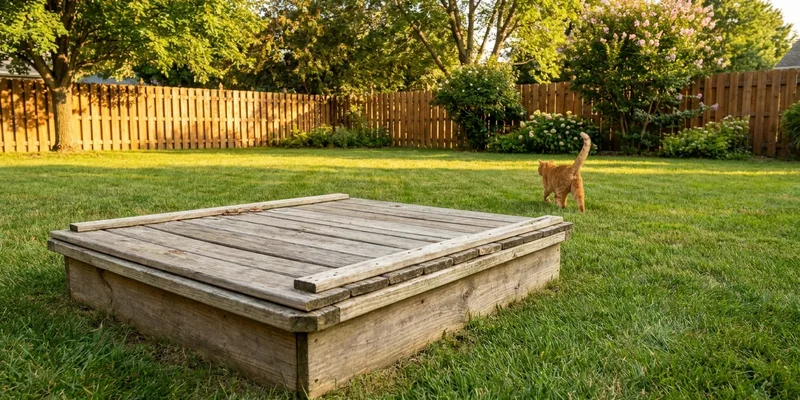
A cover ends the problem the day you start using it. The important part is not which cover you buy but whether it gets closed every time, which is why hinged lids that a child can open and shut themselves outperform heavy panels an adult has to move. A cover leaning against the fence protects nothing.
For an existing box without a lid, a heavy mesh or tarp cover pulled taut and weighted at the corners works well and costs little. Mesh has the advantage of letting rain drain through instead of pooling on top, which is the usual complaint with a solid tarp.
Choosing a Cover for a Box You Already Own
Measure the outside dimensions of the box and buy a cover with enough overlap to reach past the frame on every side, then secure the edges with stakes, bungee cords, or something heavy. A cover a cat can nose under is a cover a cat will nose under.

If you are buying a new box rather than covering an old one, a lid that folds into bench seats is the design most likely to stay closed. Our guide to a wooden sandbox with a lid covers what to look for, and our sandbox with a cover guide covers the molded plastic versions.
Deterrents Worth Trying When a Cover Is Not Practical
Some sand play areas cannot be covered, such as a large open pit or a play area built into landscaping. In those cases you are stacking partial measures rather than solving it outright, and the two with the best track record are a motion activated sprinkler and a physical barrier laid over the sand between sessions.
A motion sprinkler startles rather than harms, and cats generally stop visiting an area that sprays them. It needs a hose connection and storing before the first freeze.

Barriers and Texture
Cats avoid surfaces that are awkward underfoot, so a lattice panel or plastic garden grid laid over the sand between sessions makes the area less attractive without changing the sand itself. Keep it flat and secured, and lift it entirely during play.
If a Cat Has Already Used the Sandbox
Remove the affected sand rather than raking it into the rest of the box. Scoop out the visible waste along with a generous margin of surrounding sand, bag it, and dispose of it in household trash. Wear disposable gloves, keep children away while you work, and wash your hands thoroughly afterward.
If the box has been used repeatedly or has sat open for a long stretch, replacing the sand entirely is the straightforward call, and it is a good moment to add a cover.
The Hygiene Point, Stated Plainly
Cat feces can carry Toxoplasma gondii, the parasite responsible for toxoplasmosis, and public health guidance treats sandboxes used by outdoor cats as a route worth taking seriously. The Centers for Disease Control and Prevention publishes current guidance on toxoplasmosis, including specific advice for pregnant people and anyone with a weakened immune system.
We are not a medical source and this is not medical advice. Read the CDC’s current guidance for the details, and talk to your own doctor about your household’s situation rather than relying on a backyard site for it. The practical takeaway on our side is simple: keep the box covered, remove contaminated sand promptly, and have children wash their hands after sand play as a matter of routine.
Common Mistakes to Avoid
- Raking the waste into the sand instead of removing it. That spreads the problem through the entire box rather than taking it out.
- Relying on a spray or granule alone. Rain washes it out, results vary by cat, and reapplying it forever is a worse routine than closing a lid.
- Using a cover that is not secured. A loose tarp gets pushed aside or lifted by wind, and by morning you are back where you started.
- Trapping or harming a neighborhood cat. Local ordinances govern this and it is not a backyard decision. Contact your local animal services if a stray is a persistent issue.
Frequently Asked Questions
What is the best way to keep cats out of a sandbox? Cover it every time play ends. A fitted lid or a weighted mesh cover removes access completely, which no scent based deterrent does reliably outdoors.
Do coffee grounds or citrus peels keep cats out of sand? Results are inconsistent and short lived outdoors, since rain and wind disperse them quickly. They are not a substitute for a cover.
Does a motion activated sprinkler work on cats? Often, yes, for as long as it is set up and connected to water. Cats tend to avoid areas where they get sprayed, though the device needs a hose, a sensible spray direction, and storing before freezing weather.
Is sand a cat used dangerous for children? Cat feces can carry the parasite that causes toxoplasmosis, which is why contaminated sand should be removed rather than mixed in. The CDC publishes current guidance on the risk, and questions about your own household belong with your doctor.
Should you replace all the sand after a cat uses the sandbox? For a single incident, removing the waste plus a generous margin of surrounding sand is usually enough. For repeated use, replacing the sand entirely is the more certain option.
Do ultrasonic cat repellers work in a backyard? They are unreliable in open outdoor settings. A determined cat can walk past one, and the sound is easily blocked by obstacles, so treat any result as a bonus rather than a plan.
The Bottom Line
There is no spray that beats a lid. Cats use sandboxes because loose dry sand is exactly what they look for, so the fix is to take away access rather than argue with the instinct. Cover the box every time, secure the edges, add a motion sprinkler if the area cannot be covered, and remove contaminated sand rather than raking it in. For the hygiene questions behind all of this, read the CDC’s current toxoplasmosis guidance and speak with your own doctor.