Last updated: August 18, 2026
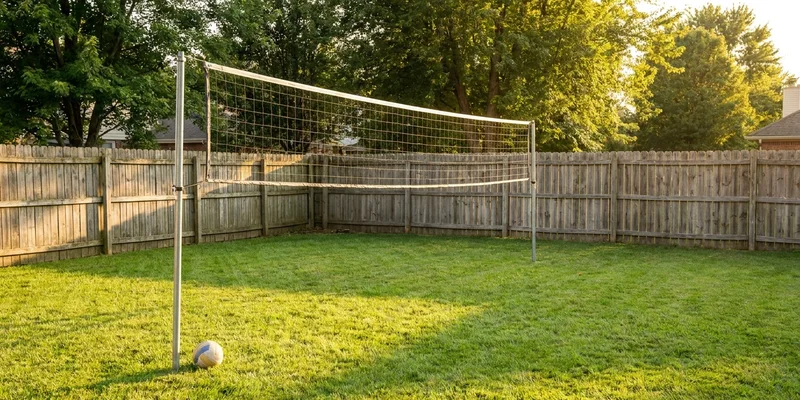
A volleyball net for backyard use has to survive things a gym net never faces: wind, sprinklers, a lawn that is not perfectly flat, and poles that get pulled sideways every time someone dives for a ball. The cheap sets that look identical online mostly fail in the same two places, at the poles and at the cable that holds the top of the net.
This guide covers how much space a net needs, what separates one that stays taut from one that sags by the second game, and which setup suits grass, sand, or a yard you clear again by dinner.
This article contains affiliate links. If you buy through them, we may earn a commission at no extra cost to you. Learn more.
Quick Answer
Which volleyball net should you buy for a backyard?
- For most yards, a portable system with adjustable-height poles and guy lines is the practical pick, because it handles casual play and packs away when the yard is needed for something else.
- Check the top of the net first. A steel cable or a heavy rope in the top hem is what keeps the net tight; a plain nylon cord stretches and sags within a season.
- Measure before you order. A regulation court plus the free space around it is larger than most people expect, so a shorter net or a shorter court line is often the honest answer.
- Anchoring matters more than the net itself. Poles that are staked and guyed stay upright; poles resting on a flat plate do not.
What to Check Before You Buy a Backyard Volleyball Net
Every row below is something you can verify on the listing before ordering. These six points explain almost all the difference between a net that holds tension through a summer and one that ends up drooping in the middle by the third weekend.
| What to check | Why it matters | What to look for |
|---|---|---|
| Top cable or cord | This is what carries the tension across the whole net | A steel cable or thick braided rope in the top hem, not a thin nylon line |
| Pole material and diameter | Thin poles bow inward and let the net sag no matter how tight you pull | Steel or thick-walled aluminum with a stated diameter, and a locking height adjustment |
| Anchoring system | Backyard ground is soft and uneven, so poles need help staying vertical | Included ground stakes plus guy lines, or sand-anchor bags for beach setups |
| Net mesh and edge binding | Sun and moisture destroy unbound polyethylene mesh first | Bound edges on all four sides, and a mesh described as UV resistant |
| Height adjustment range | Kids, mixed groups, and adults all want a different height | Poles with marked stops so you can reset the same height each time |
| Carry bag and setup time | A net that takes half an hour to raise gets used far less | A single carry bag, tool-free poles, and a stated setup time under 15 minutes |
If your yard is doing double duty for several activities, it is worth planning the whole space at once rather than buying equipment piece by piece. Our other backyard games guides cover the setups that share the same patch of lawn.
Regulation Height and How Much Room You Really Need
Official volleyball dimensions are fixed, and they are bigger than most backyards. The FIVB Official Volleyball Rules, which USA Volleyball follows for domestic play, put the court at 29 feet 6 inches by 59 feet (9 m by 18 m), with the top of the net at 7 feet 11 5/8 inches (2.43 m) for men’s competition and 7 feet 4 1/8 inches (2.24 m) for women’s competition.
Those same rules call for a free zone around the court, a minimum of about 10 feet (3 m) on every side in the baseline requirement, which pushes the full footprint well past what a typical suburban lot has to spare. Most backyard players simply shorten the court and keep the net height, and that works fine for casual games.
Setting the Height for Mixed Groups
Adjustable poles exist because nobody plays at one height all summer. Younger players struggle badly at adult height, and USA Volleyball publishes age-based net heights for junior play, so check their current age definitions rather than guessing. Families set the net lower for kids and raise it when the adults take over, which is why a locking, marked adjustment is worth looking for.
Grass, Sand, and Ground That Is Not Level
The surface decides the anchoring system, not the net. On grass, long stakes driven at an angle plus guy lines running back from each pole are what keep tension in the net. On sand, stakes pull straight out, so buried sand-anchor bags are the standard answer and are usually sold as part of a beach set.
Slope is the other backyard reality. A court running downhill plays unevenly but is playable; a court that slopes sideways under the net is not, because one side effectively plays at a different height. If your only flat area runs the wrong way, a shorter court along the level axis is the better trade.
Our Top Picks at a Glance
How we chose: we compared widely available backyard volleyball systems on top cable construction, pole diameter and adjustment, the anchoring hardware included, and how consistently owners report the net holding tension across a season. Selections lean on manufacturer specifications and recurring themes in customer reviews rather than any hands-on trial of our own.
🏆 Best Overall
A portable system with adjustable-height steel poles, guy lines, and ground stakes in the box, which covers casual family play on grass without a permanent installation.

⬆️ Upgrade Pick
A heavier system with a steel cable top and thicker poles, worth it if the net stays up all season and gets played on hard rather than occasionally.

💚 Best Value
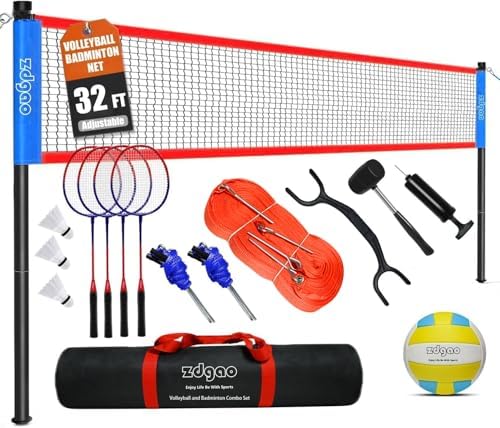
A complete set with poles, net, and a ball, aimed at households that want one box to open rather than parts assembled from three listings.
Picks by Situation: Sand Courts and Soft Ground
Two setups need different hardware than the standard grass system: a dedicated sand court, and any yard where stakes will not hold because the ground is loose, sandy, or heavily irrigated.
🏖️ Best for Sand
A beach-style set with boundary lines and sand anchors instead of stakes, which is the configuration that actually holds in loose ground.

⚓ Best Anchoring Add-On
A set of longer ground stakes and guy lines to replace the thin hardware that ships with most budget systems, the single cheapest fix for a sagging net.

Setup and Takedown That Actually Works
Tension the top cable last, after both poles are staked and guyed. Raising the net first and then straightening the poles is why a new system looks crooked, because every adjustment at the base changes the tension across the top. Work outward: poles vertical, stakes in, guy lines snug, then the top cable.
For takedown, dry the net before it goes in the bag. Mesh packed away damp is where mildew and the first broken strands begin, and a net left standing through winter weather loses a season of life for no gain.
Common Mistakes to Avoid
- Buying on net height alone. Nearly every system reaches regulation height. What varies is whether the poles stay vertical under load.
- Skipping the guy lines because setup is faster without them. Guy lines are the reason the net stays taut. Without them, the poles slowly lean inward all game.
- Assuming the included stakes are adequate. Budget sets ship with short, thin stakes that pull out of soft ground almost immediately.
- Measuring the court but not the run-off space. Players chase balls past the sideline, so a court against a fence or a deck rail turns that into an injury risk.
- Storing the net wet. It is the fastest way to lose a net that is otherwise fine.
Frequently Asked Questions
How high should a backyard volleyball net be? The FIVB Official Volleyball Rules set the top of the net at 7 feet 11 5/8 inches (2.43 m) for men’s competition and 7 feet 4 1/8 inches (2.24 m) for women’s competition. Backyard players often set it lower for mixed or younger groups, which is fine for casual play.
How much space does a volleyball court need? The FIVB rules put the court itself at 29 feet 6 inches by 59 feet (9 m by 18 m), plus a free zone around it. Most backyards cannot fit that, so shortening the court while keeping the net height is the usual compromise.
Can you set up a volleyball net on grass? Yes, and grass is the most common backyard surface for it. Grass needs long ground stakes driven at an angle plus guy lines from each pole, since a flat base plate alone will not hold the tension.
Do I need a different net for sand? The net itself can be the same, but the anchoring is not. Stakes pull straight out of sand, so beach setups use buried sand-anchor bags at the base of each pole instead.
Why does my volleyball net keep sagging? Usually the top cord, the poles, or the anchors. A thin nylon top cord stretches, thin poles bow inward under tension, and short stakes creep out of soft ground. Retensioning without fixing the underlying part only buys a few games.
Can you leave a volleyball net up all year? You can, but the mesh and the cord will age faster from sun and moisture. Taking the net down and storing it dry between sessions is the single biggest thing that extends its life.
The Bottom Line
The best backyard volleyball net for most families is a portable system with adjustable steel poles, a cable or braided rope top, and real anchoring hardware in the box. Measure your flat space first, accept a shortened court if that is what fits, and put your attention into the stakes and guy lines, because that is where backyard setups fail.