Last updated: August 18, 2026
A badminton set for backyard play is one of the cheapest ways to get a group of mixed ages moving in the same space, which is why almost every set on the shelf looks the same and why so many of them are disappointing. The differences that matter are not on the front of the box: they are the net cord, the pole bases, and whether the shuttlecocks can handle a breeze.
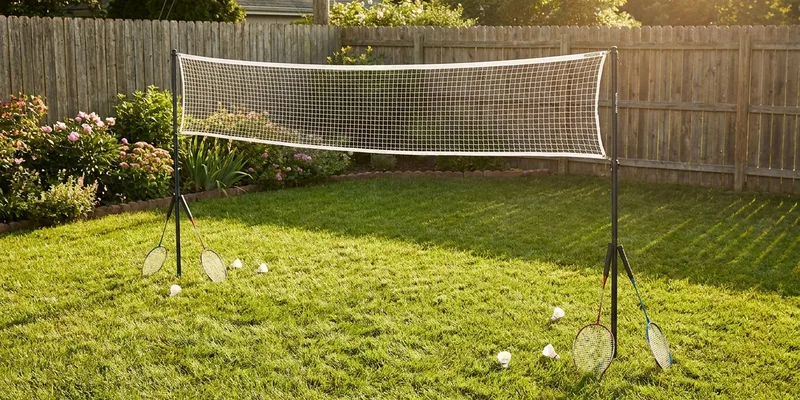
This guide covers how much lawn you need, the parts of a set that are worth spending on, and how to keep a backyard net from turning into a sagging line by August.
This article contains affiliate links. If you buy through them, we may earn a commission at no extra cost to you. Learn more.
Quick Answer
What should you look for in a backyard badminton set?
- Buy for the net system first. Steel poles with real ground stakes and guy lines keep the net taut; plastic poles with fill-in-with-water bases sag as soon as anyone leans on the line.
- Plan on replacing the shuttlecocks. Nylon shuttles handle outdoor use and wind far better than the feather ones packed in most bundles.
- Four rackets is the practical minimum for a family. Sets of two get outgrown the first time cousins visit.
- Check the court space before you buy. Full doubles dimensions are published by the BWF and are larger than a lot of usable lawn areas.
What to Check Before You Buy a Badminton Set
Almost every complaint about backyard badminton sets traces back to one of the rows below, and every one of them can be checked on the listing before you order. The net system carries the most weight in the decision, because a good net makes mediocre rackets tolerable and a bad net ruins good ones.
| What to check | Why it matters | What to look for |
|---|---|---|
| Pole material and base | Poles are what fail first on cheap sets | Steel or thick aluminum poles with ground stakes and guy lines, rather than plastic poles in a flat base |
| Net top cord | A stretchy top cord means the net sags mid-game | A braided or cable-reinforced top with a tensioning strap at each pole |
| Net height adjustment | Kids and adults do not want the same height | Marked or notched adjustment so you can return to the same setting |
| Racket shaft and grip | Aluminum-and-steel rackets bend permanently after a few clashes | Steel shafts for durability with kids, graphite composite if adults will use them seriously |
| Shuttlecocks included | The included shuttles are usually the first thing you replace | Nylon shuttles for outdoor use; treat any feather shuttles in the box as a bonus, not a plan |
| Carry bag and setup time | Sets left in a heap in the garage get used once | One bag that fits the poles, and tool-free assembly |
If the same patch of lawn also has to host other activities, it helps to plan the whole space rather than buying each game separately. Our other backyard games guides cover setups that share the same footprint.
Court Size and Net Height for a Backyard
Official dimensions are published in the Laws of Badminton by the Badminton World Federation. A full court measures 44 feet (13.4 m) long, 20 feet (6.1 m) wide for doubles and 17 feet (5.18 m) wide for singles, with the top of the net at 5 feet (1.524 m) in the center and 5 feet 1 inch (1.55 m) at the posts.
Backyard play rarely fits that exactly, and it does not have to. What matters more than the court markings is the run-off space at each end and enough overhead clearance for a clear, since a shuttle that hits a branch on every high shot ruins the rally faster than a slightly short court does.
Setting the Net Lower for Kids
Regulation height is a genuine barrier for younger children, who cannot clear it consistently and stop enjoying the game. Dropping the net for a family session and raising it again for the adults is the normal approach, which is why an adjustable pole with a marked setting is worth having instead of a fixed-height system.
Where Cheap Sets Cut Corners
The three savings on a budget set are always the same: plastic poles, a thin unreinforced top cord, and shuttlecocks that are barely usable outdoors. Poles and cord together decide whether the net stays at the height you set it, and neither is visible in a product photo, so the specification text and the review complaints are where you find out.
Rackets are the part people over-weigh. A steel-shaft racket is perfectly adequate for backyard play and survives being dropped, stepped on, and left in the rain better than a light composite frame. If adults in the household actually play, buying a decent pair separately alongside a good net system usually beats paying up for a premium all-in-one bundle.
Our Top Picks at a Glance
How we chose: we compared widely available backyard badminton sets on pole material and anchoring, top cord construction, racket shaft type, and how consistently owners report the net holding its height through a season. Selections lean on manufacturer specifications and recurring themes in customer reviews rather than any hands-on trial of our own.
🏆 Best Overall
A complete set built around steel poles, ground stakes, and four rackets, which is the configuration that survives a family summer rather than a single weekend.

⬆️ Upgrade Pick
A standalone portable net system with adjustable height and proper tensioning, for households that would rather buy rackets separately and keep the net for years.

💚 Best Value
A combination set that covers badminton and volleyball from one net and pole system, sensible when yard space has to serve more than one game.
Picks by Situation: Windy Yards and Bigger Groups
Two situations exhaust a standard set quickly: an open, breezy yard, and a household where more than four people want to play at once.
🌬️ Best for Windy Yards
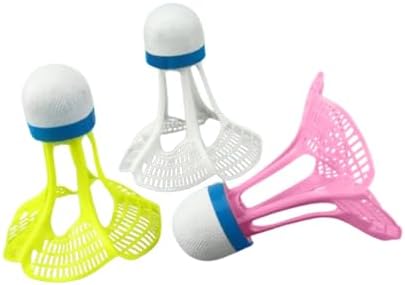
A tube of nylon outdoor shuttlecocks, heavier and far more wind tolerant than the feather shuttles that come in most bundles, and the single upgrade that changes outdoor play the most.
👨👩👧👦 Best for Larger Groups
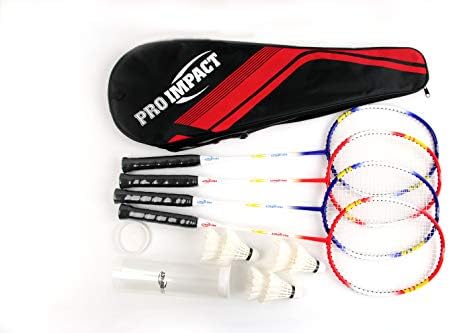
A four-racket set with steel shafts, so doubles works without anyone sitting out and a bent frame does not end the afternoon.
Setting Up on Grass and Keeping the Net Tight
Stake the poles before tensioning the net, and run guy lines back from each pole at an angle rather than straight down. Backyard soil gives, so a stake driven vertically works loose within a few games while an angled stake pulls against the ground instead of out of it. Once both poles are secure, tension the top cord and then adjust the height, not the other way around.
Take the net down between sessions if you can. Sun degrades the mesh, sprinklers leave deposits on it, and a net left standing through a windy night is the most common way poles get bent. If the set has to stay up, at least loosen the top tension so the cord is not stretched permanently while nobody is playing.
Common Mistakes to Avoid
- Judging the set by the rackets. Rackets are the cheapest part to replace. The net system is what you actually live with.
- Using feather shuttlecocks outdoors. They are made for indoor play, drift badly in any breeze, and break quickly on grass.
- Setting the net at regulation height for young children. They cannot clear it, they stop enjoying it, and the set goes back in the garage.
- Skipping guy lines to save setup time. Without them the poles lean inward and the net sags no matter how hard you pull the cord.
- Ignoring overhead clearance. A branch over the court intercepts every high clear and makes real rallies impossible.
Frequently Asked Questions
How much space do you need for backyard badminton? The BWF Laws of Badminton put a full court at 44 feet (13.4 m) long and 20 feet (6.1 m) wide for doubles. Backyard games work on less, but you still want run-off space at both ends and clear space overhead.
How high should a badminton net be? The BWF sets the top of the net at 5 feet (1.524 m) at the center and 5 feet 1 inch (1.55 m) at the posts. Families commonly set it lower when younger children are playing.
Are nylon or feather shuttlecocks better for outdoors? Nylon, clearly. They are heavier, handle a breeze far better, and survive contact with grass and paving, while feather shuttles are built for indoor play and break quickly outside.
Can you use a badminton net for volleyball? Only with a combination system designed for both. A badminton net and its poles are not built for the tension and impact of volleyball, and a shared set will state that it supports both games.
Why does my badminton net keep sagging? Almost always the poles or the top cord. Plastic poles bow inward, thin cord stretches, and short stakes lift out of soft ground. Retensioning helps for one game; replacing the weak part fixes it.
How many rackets should a family set include? Four, if there is any chance of doubles or visiting kids. Two-racket sets are fine for a couple but are the most common reason people end up buying a second set.
The Bottom Line
Buy the badminton set for its net system, not its rackets. Steel poles, real stakes, guy lines, and a reinforced top cord are what keep the game playable, and a tube of nylon outdoor shuttlecocks fixes most of what is left. Set the net low enough that the kids can actually clear it, and take it down between sessions if you want it to last more than one summer.