Last updated: August 18, 2026
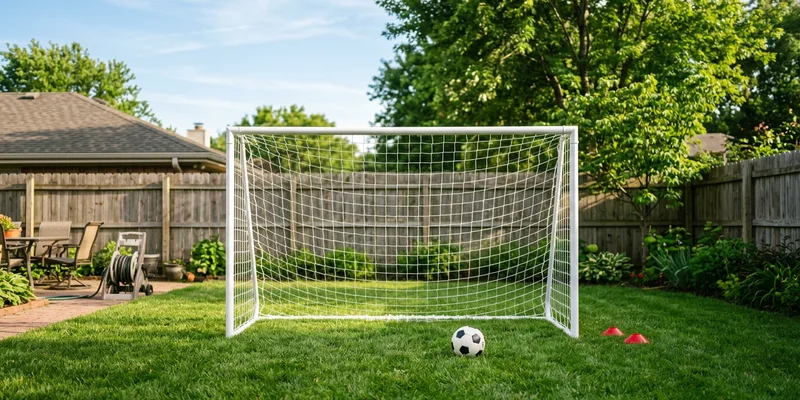
A soccer goal for backyard practice is one of the few pieces of yard equipment that gets used almost every day it is dry, which is exactly why the flimsy ones fail so fast. The decision comes down to three things: how big a goal your yard can actually hold, what the frame is made of, and whether the thing stays anchored when a kid hangs off the crossbar.
This guide covers the sizes that are commonly sold, how frame material changes what you can leave outside, and the anchoring point that safety guidance treats as non-negotiable for any movable goal.
This article contains affiliate links. If you buy through them, we may earn a commission at no extra cost to you. Learn more.
Quick Answer
Which soccer goal should you buy for a backyard?
- For most yards, a 6 by 12 foot steel-frame goal hits the balance between being big enough to practice shooting and small enough to fit on a normal lawn.
- Anchor it, every time it is up. The Consumer Product Safety Commission publishes specific guidance on movable soccer goal safety because unanchored goals tip over onto the people using them.
- Pop-up goals are for young kids and travel, not for shooting practice. The frames flex and the pegs pull out under a hard shot.
- If the goal will live outside year round, look for powder-coated steel and a UV-treated net, and plan on replacing the net before the frame.
What Size Soccer Goal Fits Your Yard
Goal size is the first decision because it constrains everything else. Full-size goals are fixed by the Laws of the Game, published by the IFAB, at 8 feet high by 24 feet wide (2.44 m by 7.32 m) measured between the inside of the posts, and that is far larger than most backyards can hold. The sizes below are what is commonly sold for home use.
| Common size | Who it suits | What to know |
|---|---|---|
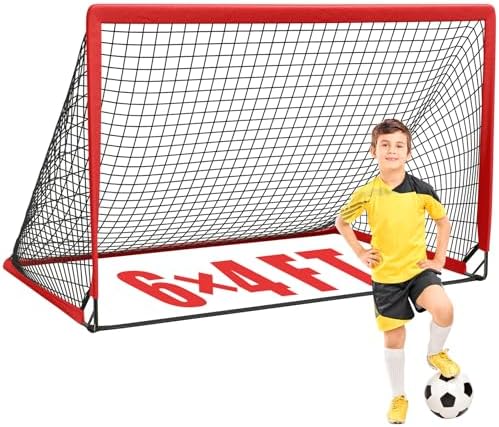
| 4 by 6 feet | Preschool and early elementary players | Light enough to move alone, but outgrown quickly; often sold in pairs for small-sided games |
| 6 by 12 feet | The common backyard choice for elementary and middle school players | Big enough to practice placement, still fits on most lawns with room to run up |
| 6.5 by 18.5 feet | Older players who want a wider target | Needs a genuinely large flat area; heavy enough that it stays where you put it |
| 7 by 21 feet | Serious practice for teenage players | Approaching full size; realistic only for large properties |
| 8 by 24 feet | Match-size, per the IFAB Laws of the Game | A field goal rather than a yard goal, and priced and shipped accordingly |
| Pop-up, typically 2 to 4 feet | Toddlers, travel, and warm-up drills | Fold-flat frames that are not built to take repeated hard shots |
Youth leagues set their own goal sizes by age group, and those vary between organizations. If the goal is meant to match what your child plays on, ask the league rather than assuming.
Anchoring Is the Safety Issue, Not an Accessory
Movable soccer goals tip forward when someone climbs or swings on the crossbar, and the CPSC publishes dedicated guidance on movable soccer goal safety for exactly this reason. The practical rules from that guidance are simple: anchor or counterweight a movable goal whenever it is in use, never let anyone climb on the net or frame, and secure or disassemble goals that are not being used.
What that means in a backyard is that the anchor stakes are not an upsell, they are part of the product. A goal sitting on grass under its own weight is exactly the configuration the guidance warns about, and lightweight aluminum and PVC frames need anchoring more than heavy steel ones, not less.
Anchoring on Different Surfaces
Grass and soil take long auger or J-hook stakes driven at an angle through the ground bar. Loose or sandy soil needs longer stakes or sandbag counterweights, since short pegs simply lift out. On a hard surface such as a driveway, staking is not an option at all, so weighted bases or sandbags are the only workable approach, and it is worth asking whether a hard surface is the right place for a goal in the first place.
Steel, Aluminum, PVC, and Pop-Up Frames
Frame material decides whether the goal can stay outside and how it handles a hard shot. Powder-coated steel is the standard for backyard goals that live outdoors permanently: heavy, stable, and slow to rust as long as the coating stays intact. Aluminum is lighter and does not rust, which suits a goal that moves around the yard, though thin-walled aluminum bends where steel would not.
PVC frames are the budget option and are genuinely fine for young children, but the joints work loose over a season and the tubing goes brittle after enough sun exposure. Pop-up goals with fiberglass or spring-steel rings sit in a different category entirely: they are portable targets, not practice goals, and repeated hard shots deform the ring.
Our Top Picks at a Glance
How we chose: we compared widely available backyard goals on frame material and wall thickness, the anchoring hardware included, net attachment method, and how consistently owners report the frame staying square after a season outdoors. Selections lean on manufacturer specifications and recurring themes in customer reviews rather than any hands-on trial of our own.
🏆 Best Overall
A 6 by 12 foot powder-coated steel goal with ground anchors included, the size and build that suits the widest range of backyards and player ages.

⚽ Best for Small-Sided Play
A pair of pop-up goals that set up in seconds for two-goal games and pack into a flat carry bag, aimed at younger kids rather than shooting practice.

💚 Best Value
A compact 4 by 6 foot goal for early elementary players, sized so a young child can actually fill the frame instead of shooting into empty space.
Picks by Situation: Solo Practice and Soft Ground
Two situations call for something beyond a plain goal: a player who mostly practices alone, and a yard where standard stakes will not hold.
🔁 Best for Solo Practice
A goal paired with a rebounder panel, so shots come back instead of being fetched, which is what keeps solo practice going longer than ten minutes.

⚓ Best Anchoring Upgrade
Longer, heavier ground anchors to replace the short pegs that ship with most goals, the cheapest way to fix the one thing safety guidance is emphatic about.

Where to Put It and How to Protect the Lawn
The grass in front of a goal dies. That is what happens when a goalmouth takes the same footfall every day, and the fix is to move the goal a few feet every couple of weeks so the worn patch shifts and recovers. Setting the goal near a fence line protects the rest of the yard, as long as there is run-off space behind it for missed shots.
Think about what is behind the goal before you place it. A net stops most shots but not all of them, and a goal aimed at a window or a neighbor’s fence creates a weekly argument. If your only sensible position points at something breakable, a backstop net behind the goal solves it.
Common Mistakes to Avoid
- Leaving the goal unanchored because it feels heavy enough. CPSC guidance on movable goals exists because that assumption has caused serious injuries.
- Buying the biggest goal that will physically fit. A goal with no run-up space in front of it is worse to practice with than a smaller one placed properly.
- Treating a pop-up goal as a practice goal. The frames are built for portability, and hard repeated shooting deforms them.
- Ignoring the net in the specification. The net wears out long before the frame, so check whether replacements in that size are easy to find.
- Setting it up and never moving it. A fixed goalmouth kills the grass and turns to mud by the second wet week.
Frequently Asked Questions
What size soccer goal is best for a backyard? A 6 by 12 foot goal is the common backyard choice, large enough for real shooting practice while still fitting on an average lawn. Younger children are better served by a 4 by 6 foot goal they can actually fill.
How big is a regulation soccer goal? The Laws of the Game published by the IFAB set a full-size goal at 8 feet high by 24 feet wide (2.44 m by 7.32 m), measured between the inside of the posts. Youth league sizes vary by organization and age group.
Do backyard soccer goals need to be anchored? Yes. The Consumer Product Safety Commission publishes guidance on movable soccer goal safety that calls for anchoring or counterweighting a movable goal whenever it is in use, and for securing goals that are not in use.
Can you leave a soccer goal outside all year? A powder-coated steel or aluminum goal can stay out, though the net ages faster than the frame. PVC frames and pop-up goals hold up much better if they are stored between seasons.
Is a pop-up soccer goal worth it? For young children, small-sided games, and travel, yes. For a player who wants to strike the ball hard at a target repeatedly, the frame is the wrong tool and will lose its shape.
How do you stop grass dying in front of the goal? Move the goal a few feet every couple of weeks so the worn area shifts before it turns bare. Nothing else reliably keeps grass alive in a goalmouth that gets daily use.
The Bottom Line
For most backyards, a 6 by 12 foot powder-coated steel goal with proper ground anchors is the right answer, sized down to 4 by 6 feet for younger children. Anchor it every time it is up, keep run-off space in front and behind it, and expect to replace the net well before the frame gives out.