Last updated: August 18, 2026
Buying Spikeball for kids starts with a naming point that saves a lot of confusion later: Spikeball is a brand, and the game it sells is roundnet. Plenty of sets on the market are roundnet sets from other makers, and the reason it matters here is that the tournament grade equipment the brand is known for is not automatically the right equipment for a nine year old.
This guide covers what separates a set a child can actually rally on from one built for competitive adults, what the official rules specify, how much clear space the game needs, and the rule tweaks that make it playable for mixed ages.
This article contains affiliate links. If you buy through them, we may earn a commission at no extra cost to you. Learn more.
Quick Answer
Which roundnet set should you buy for kids?
- For children roughly eight and up, a standard roundnet set works, provided you loosen the net a little so the ball comes off slower and rallies last longer.
- Younger than that, look for a junior set with a larger, softer ball. Ball size is what decides whether a child can hit it at all.
- Check the frame, not the branding. Steel legs and a rim that snaps together without flexing are what separate a set that lasts from one that collapses mid-game.
- Space is the hidden requirement. The game is played all the way around the net, so you need clear ground on every side, not a corner of the lawn.
What to Check in a Roundnet Set Before You Buy
Roundnet sets look nearly identical in photos, and the differences that matter are all in the hardware. Each point below can be checked on the listing, and together they explain why one set survives several summers of backyard play while another goes out of shape in a month.
| What to check | Why it matters | What to look for |
|---|---|---|
| Ball size and firmness | Ball size decides whether a young child can strike it cleanly | A larger, softer ball for under eights; the standard smaller ball for older kids |
| Rim construction | A flexing rim changes the bounce and eventually cracks at the joints | Rigid snap-together sections, ideally with metal reinforcement at the joins |
| Legs and feet | Legs are what fold or splay when someone dives into the set | Steel legs with wide feet, not thin plastic tubes |
| Net tension system | Tension controls speed, and adjustability is what makes it playable for kids | Hooks or ties you can genuinely loosen and retighten, not a fixed sewn net |
| Included spares | The ball is the part that disappears or splits first | At least one spare ball, plus a pump if the balls are inflatable |
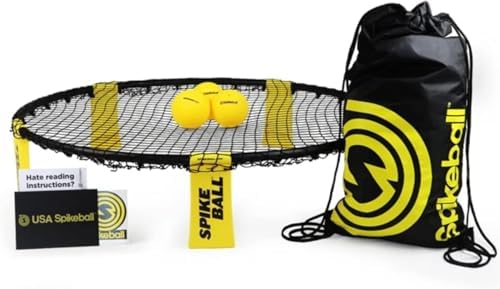
| Carry bag | Loose legs and a rim in a garage become an incomplete set | A drawstring bag that fits the disassembled frame and the balls together |
If this is one of several games sharing the same lawn, it is worth planning the whole space rather than buying game by game. Our other backyard games guides cover the setups that compete for the same open ground.
Spikeball, Roundnet, and Which Word Means What
Roundnet is the game: two teams of two, a circular net at ankle height, and a ball that has to be bounced off that net rather than over it. Spikeball is a brand that popularized the game and gives its name to the sport’s governing body, the Spikeball Roundnet Association, which publishes the rules that tournaments play by.
For a buyer, searching only for the brand name narrows the field unnecessarily. Searching for roundnet sets shows the same game across every maker, from beach toy to tournament equipment, which is a far more useful comparison when the player is a child.
Official Dimensions and the Space the Game Needs
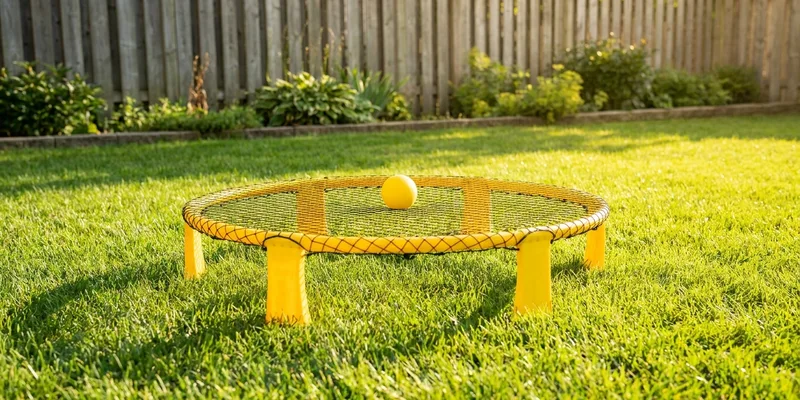
The Spikeball Roundnet Association rules put the net at 36 inches (91 cm) in diameter, sitting low so the rim is at roughly ankle height. Those same rules have players start a serve from at least 6 feet (1.8 m) away from the edge of the set, which gives you the minimum radius of clear ground before you account for anyone chasing a ball.
In practice the game needs a lot more room than the net suggests, because play continues in every direction around it. A set placed in a corner of the yard turns into a game where half the possible shots are unplayable, so put it near the middle of the open area with room to run on all sides.
Grass, Sand, and Hard Surfaces
Grass is the usual backyard surface and is fine. Sand is the classic setting because diving is part of the adult game and landing is soft. Hard surfaces are where roundnet stops being a good idea for children, since the game genuinely encourages players to throw themselves at low balls, and a driveway punishes that immediately.
Our Top Picks at a Glance
How we chose: we compared widely available roundnet sets on ball size and firmness, rim rigidity and joint design, leg material, and whether net tension can be adjusted. Selections lean on manufacturer specifications and recurring themes in customer reviews rather than any trial of our own.
🏆 Best Overall for Families
A standard roundnet set with steel legs, an adjustable net, and a spare ball, which suits children from around eight upward and holds up when adults join in.

🧒 Best for Younger Kids
A junior set built around a larger, softer ball, which is the change that lets a six or seven year old make contact instead of swinging at air.
💚 Best Value
A complete beginner roundnet set with a carry bag, aimed at households trying the game for the first time without committing to tournament grade hardware.

Picks by Situation: Travel and Replacement Balls
Two things come up after the first set: the game travels well and gets packed for beaches and campgrounds, and the balls go missing or lose their shape long before the frame does.
🏖️ Best for Beach and Travel
A lightweight set that breaks down small and packs into a shoulder bag, for sand, campsites, and anywhere the game moves with you.

⚪ Best Restock
A multi-pack of replacement balls, since a lost or split ball is what actually retires most sets rather than any failure of the frame.

Making It Playable for Mixed Ages
Three adjustments do most of the work. Loosen the net so the ball comes off slower and rallies last longer, allow more than the standard number of touches per side so beginners get a second chance, and let younger players serve from closer than the adults do. None of that changes what the game is, and all of it changes whether a child wants to play again.
The other useful tweak is team composition. Roundnet is played two against two, and pairing an adult with a child on each side keeps the rallies going far better than adults against kids, which turns into a very short game in one direction.
Safety Points Worth Setting Out Loud
Diving is the part parents should think about. In a soft grass yard with room on every side it is a non-issue, and on hard ground it is a broken wrist waiting to happen. Set the rule that nobody plays roundnet on pavement, clear the area of hoses and garden edging, and keep the set well away from fences and steps that someone could reach at speed.
Common Mistakes to Avoid
- Buying a tournament set for a young child. A tight net and a small firm ball make for a fast game that beginners cannot rally in.
- Setting it up in a corner. The game runs 360 degrees around the net, so a corner removes most of the playable area.
- Leaving the net tight for beginners. Loosening it is free, reversible, and the biggest single improvement for kids.
- Playing on the driveway. Roundnet rewards diving, and a hard surface turns that instinct into an injury.
- Assuming any ball will do. Ball size and firmness are matched to the net tension, so an unrelated ball changes the whole bounce.
Frequently Asked Questions
What age is Spikeball suitable for? Children from around eight upward can usually rally on a standard roundnet set, particularly with the net loosened. Younger players do much better with a junior set that uses a larger, softer ball.
Is Spikeball the same as roundnet? Roundnet is the game and Spikeball is the brand that popularized it. The sport’s governing body is the Spikeball Roundnet Association, and sets from other makers play the same game.
How big is a Spikeball net? The Spikeball Roundnet Association rules put the net at 36 inches (91 cm) in diameter, positioned low so the rim sits at about ankle height.
How much space do you need to play roundnet? More than the net footprint suggests. The rules have servers start at least 6 feet (1.8 m) from the edge of the set, and because play goes all the way around, you want clear ground on every side rather than a corner.
Can you play roundnet on grass? Yes, and grass is the normal backyard surface for it. Sand is softer for diving, while hard surfaces such as driveways are the one setting worth avoiding with children.
How do you make the game easier for beginners? Loosen the net, allow extra touches per side, let younger players serve from closer in, and pair each child with an adult rather than playing kids against grown-ups.
The Bottom Line
For children around eight and up, a standard roundnet set with steel legs and an adjustable net is the right buy, loosened off until rallies hold together. For younger kids, the junior set with a bigger, softer ball is the version that actually gets played. Put it in the middle of open grass, keep it off pavement, and buy spare balls before you need them.