Last updated: August 18, 2026
Rubber mulch mats for playground areas solve a problem that loose fill never quite does: the bare, scooped out hollow under the swings and at the bottom of the slide, where the mulch you spread in April has been kicked into the lawn by June. A bonded mat stays where you put it, which is exactly why the CPSC names wear mats as a way to reduce displacement in those high traffic spots.
This guide covers the three kinds of mat sold for backyard play areas, what to verify on a listing before you buy, and where a mat is the right answer versus where you still need depth of loose fill underneath the equipment.
This article contains affiliate links. If you buy through them, we may earn a commission at no extra cost to you. Learn more.
Quick Answer
Which rubber mulch mats should you use in a play area?
- For the worn patch under a swing or at a slide exit, a heavy wear mat is the right tool. The CPSC notes wear mats can be installed in these areas to reduce displacement of loose fill.
- For a whole play area surface, look for bonded rubber mats or interlocking tiles with published ASTM F1292 test data and a stated critical height that meets or exceeds your equipment’s fall height.
- Check the site requirements before ordering. The CPSC points out that some unitary surfaces require installation over a hard surface and others do not.
- A thin decorative mat is not protective surfacing. Without a critical height rating, treat it as a doormat for the lawn, not as fall protection.
What to Check Before You Buy a Rubber Mat
Every row below is something you can confirm on the product page or by asking the seller, and each one separates a mat that does a real job from one that only looks the part. The safety related rows follow the CPSC guidance for unitary surfacing materials.
| What to check | Why it matters | What to look for |
|---|---|---|
| ASTM F1292 test data | This is the standard the CPSC points to for impact attenuation of playground surfacing | A published critical height rating from the manufacturer, not just the word “safety” in the title |
| Critical height versus your fall height | The rating has to cover the distance from the highest play surface to the ground | A stated critical height equal to or greater than your equipment’s fall height |
| Installation base | The CPSC notes some unitary materials need a hard base and others do not | Clear manufacturer instructions on whether the mat goes over soil, compacted base, or a hard surface |
| Thickness and weight | Thin mats curl, slide, and get flipped by a running child | A thickness the manufacturer ties to a rating, and enough weight that it stays flat |
| Drainage | Standing water under a mat rots the ground and makes the surface slick | Perforations or an open bonded structure that lets rain through |
| Anchoring method | An unanchored mat becomes the trip hazard you installed it to prevent | Included spikes or stakes, or interlocking edges that lock adjacent tiles together |
| Firmness and stability | Wheelchair and stroller access depends on it | A reference to ASTM F1951, the standard the CPSC cites for accessible surfacing |
If a listing cannot answer the first two rows, the mat is a comfort product rather than fall protection.
The Three Kinds of Mat Sold for Backyards
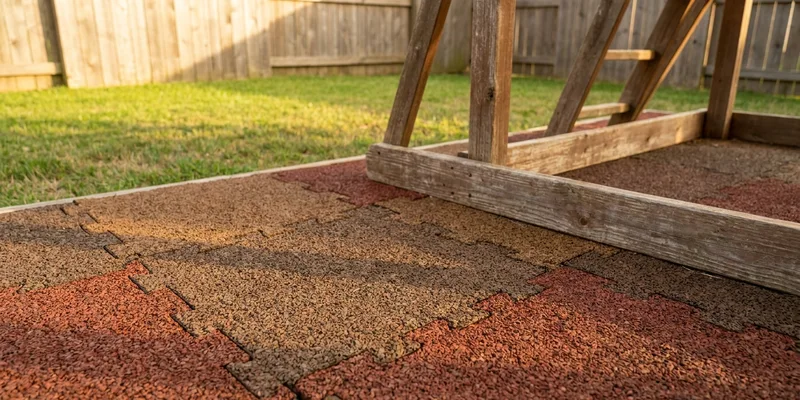
Wear mats are heavy, single piece rubber mats meant to sit in one specific spot, most often directly under a swing seat or at the bottom of a slide. Bonded rubber mulch mats are made of rubber granules held together with a binder, giving a surface that looks like mulch but behaves like one solid piece. Interlocking rubber tiles are modular squares that connect edge to edge to cover a defined area.
They are not interchangeable. A wear mat is a patch for the worst spot in an otherwise loose fill area. Bonded mats and interlocking tiles are the start of a unitary surface, which is a different approach to the same problem and usually a bigger project.
Where mats sit in the CPSC picture
The CPSC treats rubber mats and tiles as unitary surfacing, and the guidance is to request ASTM F1292 test data from the manufacturer identifying the critical height rating of the surface. For the layered build over a hard surface, the handbook puts impact mats under swings as a distinct layer on top of the loose fill, which is precisely the wear mat use case.
Our Top Picks at a Glance
How we chose: we compared widely available rubber mats on whether the seller publishes impact test data, how the mat anchors, whether it drains, and how consistently owners report the mat staying flat through a season. Selections lean on manufacturer specifications and recurring themes in customer reviews rather than any hands-on trial of our own.
🏆 Best Overall
A bonded rubber mulch mat sized for a play area section, with published impact data and an open structure that lets rain drain straight through instead of pooling underneath.

🏋️ Best for the Worn Spot Under a Swing
A heavy duty rubber wear mat built to sit under a single swing seat, thick enough to stay put and stop the mulch below it from being kicked out.

🧩 Best Modular Option
Interlocking rubber playground tiles that connect edge to edge, so you can cover an awkward shaped area and extend it later without redoing the whole surface.

Picks by Situation: Slide Exits and Loose Ground
Two spots cause most of the complaints people have about mats. The slide exit takes a sliding, scuffing load rather than a vertical one, and soft or uneven ground lets a mat rock and lift at the corners.
🛝 Best for a Slide Exit
A wide rubber mat with a low profile edge, so a child landing and running off does not catch a toe on a raised lip. The CPSC flags slide exits alongside swing areas as the spots most susceptible to surfacing displacement.

🔩 Best for Soft or Uneven Ground
A mat sold with ground spikes or an anchoring kit, which keeps the corners down on ground that heaves through a freeze and thaw cycle.

Installing Mats Without Creating a Trip Hazard
Level the ground first and remove roots and stones, because a mat only sits flat if what is underneath it is flat. The CPSC maintenance checklist specifically calls out trip hazards in a use zone, including exposed footings and anchoring devices, so the goal is a mat whose edges sit flush with the surrounding surface rather than proud of it.
Where a mat meets loose fill, dig the mat in slightly so the mulch or chips can be raked up level with the mat’s top surface. That gives you one continuous walking plane instead of a step, and it stops the mat’s edge from acting as a dam that traps water. Anchor with the manufacturer’s spikes rather than improvised stakes, and bury or cover any anchor head.
What mats do not replace
A wear mat does not change the depth requirement for the loose fill around it. The CPSC advises never using less than 9 inches of loose fill material, with shredded or recycled rubber the exception at a recommended 6 inches, and that applies to the rest of the use zone whether or not there is a mat under the swing. Our playground surfacing depth guide works through the full depth table.
Mats Versus a Full Loose Fill Surface
For most backyards, mats supplement loose fill rather than replace it. Covering an entire use zone in tested rubber tiles is a substantial project, and the CPSC home guidance notes that poured in place surfaces and pre manufactured rubber tiles generally require a professional installer rather than being do it yourself work.
Mats earn their place in the two or three square yards that take the most abuse. If you are still choosing the base material for the whole area, our comparison of rubber mulch, pea gravel, sand, and stone is the place to start.
Common Mistakes to Avoid
- Buying a mat with no published critical height. Without ASTM F1292 data there is no way to know what fall height it protects against, which is the whole point of protective surfacing.
- Laying a mat over grass and calling it done. Grass compresses unevenly, the mat rocks, and the edges lift within a few weeks.
- Leaving the mat edge proud of the surrounding surface. That lip is a trip hazard in exactly the spot where children are running.
- Assuming a mat under the swing fixes the whole use zone. The rest of the zone still needs the full depth of loose fill.
- Skipping drainage. A solid mat with no perforations on flat ground holds water underneath and turns the ground beneath it to mud.
Frequently Asked Questions
Do rubber mulch mats count as playground safety surfacing? Only if the manufacturer publishes ASTM F1292 test data with a critical height rating. The CPSC directs buyers of unitary surfacing to request that data and match the rating to the equipment’s fall height.
Where should I put a wear mat? Under swing seats and at slide exits. The CPSC identifies those as the areas most susceptible to surfacing displacement and notes that wear mats can be installed there to reduce it.
Can I put rubber mats directly on grass? It is not a good base. Grass compresses unevenly and holds water, so the mat rocks and lifts. Level the ground and remove the sod first, then anchor the mat.
Do rubber mats get hot in the sun? Dark colored surfacing exposed to intense sun can get hot enough to be uncomfortable on bare feet, a point the CPSC raises for playground surfacing generally. Lighter colors or a shaded position help.
Are interlocking tiles better than one large mat? They cover awkward shapes and can be extended later, but every seam is a place where edges can lift. One large mat is simpler where the shape allows it.
Do mats work over concrete or a patio? Some unitary surfaces are designed for a hard base and some are not, which the CPSC flags explicitly. Check the manufacturer’s site requirements before ordering, and never assume a mat rated for soil performs the same over concrete.
The Bottom Line
Rubber mats are the right answer for the worn spots under swings and at slide exits, and a reasonable whole surface only when the mat carries a published ASTM F1292 critical height that covers your equipment. Check the rating, check the base the manufacturer requires, set the mat flush so no edge sticks up, and keep the loose fill around it at full depth.