Last updated: August 18, 2026
An outdoor playhouse for toddlers is a different purchase from a playhouse for a five year old, and most of the disappointment in this category comes from buying the second when you needed the first. A two year old wants a small room they can walk into on their own, without a step to negotiate, a ladder to climb or a doorway they have to duck through.
This guide covers the sizing and safety details that decide whether a house suits a toddler, what to check on a listing before you buy, and which formats hold up in a real yard. It also says plainly where a playhouse is the wrong answer for this age group.
This article contains affiliate links. If you buy through them, we may earn a commission at no extra cost to you. Learn more.
Quick Answer
What makes a playhouse right for a toddler?
- Ground level, not raised. A house that sits flat on the ground with no platform keeps the fall height question out of the purchase entirely.
- A low sill and a door opening the child can pass through unaided, without ducking and without a step up.
- Molded plastic in most cases, because it is light, rounded, splinter free and washable, which matters more at this age than longevity does.
- Check the age recommendation on the box, and check listing photographs for gaps in the range the CPSC handbook flags for head entrapment.
What Toddlers Actually Need From a Playhouse
They need a room, not a structure. At two and three years old, the appeal of a playhouse is having a space of their own that adults have to stoop to enter, and everything a manufacturer adds beyond that, decks, ladders, slides, climbing walls, either goes unused or becomes something you have to supervise.
| Feature | Why it matters for a toddler | What to check on the listing |
|---|---|---|
| Ground level floor | No platform means no fall height and no surfacing question | Photos from the side; look for a house sitting flat rather than on posts |
| Door opening | A toddler should walk in without ducking or climbing over a sill | A stated door or interior height, not just the overall height to the roof peak |
| Window cutouts | Openings and railing gaps are where entrapment sized spaces appear | Close product photos of every opening, plus any gap under the walls |
| Weight of the structure | Light enough to reposition, which also means light enough to move in wind | A stated anchoring method in the manual or the specification tab |
| Surface finish | Rounded edges and wipeable panels suit an age that puts hands everywhere | Molded plastic construction, or a sanded and sealed timber kit |
If you are still weighing plastic against timber more broadly, our guide to choosing a playhouse for backyard use compares the two materials on longevity, maintenance and age fit.
Sizing It for a Two or Three Year Old
Measure the footprint, then add clear space on every side. Running around the outside of the house is most of how a toddler uses it, and a cottage pushed against a fence loses that entirely while creating a narrow gap that collects leaves, standing water and wasp nests.
Interior room matters less than parents expect. One toddler needs very little floor area, and two toddlers will not reliably share a small house anyway. What does matter is the door opening, because a child who has to be lifted in or who bumps their head on the frame stops using the house within a week.
Reading the Height Figures
Listings almost always quote overall height to the roof peak, which is a decorative number rather than a useful one. Look for a stated interior height or door height, and if neither is given, judge from a photograph with a child in it and treat the figure as approximate until the box arrives.
Safety Checks You Can Do Before Buying
Three checks cover most of it: openings that could trap a head, whether the model has any raised platform, and how the house is meant to be secured to the ground. All three can be assessed from product photographs and the specification sheet, so none of them require seeing the house in person.
The CPSC Public Playground Safety Handbook identifies openings between 3.5 inches (9 cm) and 9 inches (23 cm) as a head entrapment hazard, because a small child can pass their body through a gap in that range but not their head. On a toddler playhouse this shows up around window cutouts, decorative railings and the gap between a wall panel and the ground.
Age Bands and Raised Platforms
The same handbook groups play equipment by age band, with separate guidance for children aged 6 to 23 months, 2 to 5 years, and 5 to 12 years, and it ties protective surfacing to fall height rather than to the type of equipment. That is the practical argument for keeping toddler houses at ground level: with no platform, the surfacing question does not arise. If you do choose a model with a low deck and slide, read the handbook’s surfacing guidance rather than estimating a depth.
Our Top Picks at a Glance
How we chose: we compared widely available toddler playhouses on ground clearance, door and interior dimensions where manufacturers state them, absence of climbing elements, anchoring provisions and how easily the unit can be cleaned and stored. Selections lean on manufacturer specifications and recurring themes in owner reviews rather than any hands-on trial of our own.
🏆 Best Overall
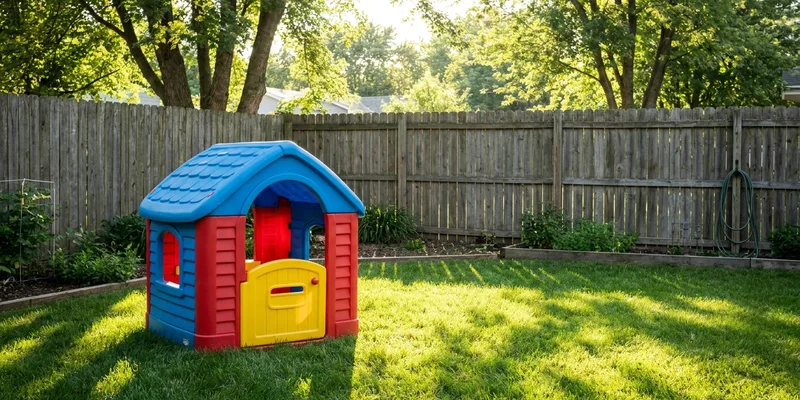
A molded plastic cottage sitting flat on the ground, with a walk in door opening, one or two window cutouts and no climbing element anywhere on it. Light enough for two adults to reposition, and simple enough to hose down at the end of the season.

🧸 Best for the Youngest End
An activity or garden style playhouse with interactive wall panels rather than an enclosed room, which suits a child who is not yet playing inside a space and wants something to do at the walls instead.

🛝 Best With a Low Slide
A cottage with a short attached slide for a confident three year old, chosen with the platform height and the surfacing underneath thought through in advance rather than after assembly.

Picks by Situation: Small Yards and Windy Sites
Two situations need something other than the general recommendation: a yard where the footprint is the binding constraint, and an exposed site where a light molded structure will not stay put on its own. Both are common and both are solvable at the point of purchase.
📐 Best for a Small Yard
A compact single room cottage with a flat or lean to roof rather than a wide peak, which tucks into a corner or onto a patio while still leaving the clear space around it that makes a playhouse worth having.

🌬️ Best for an Exposed Site
Whichever house you prefer, bought together with a ground anchor kit rather than hoping the supplied pegs are enough. This is the accessory owners most often add after the first storm.

Once the house is standing, a short list of extras makes it more usable rather than merely more decorated, and our roundup of playhouse accessories separates the two.
Where a Playhouse Is the Wrong Answer
Sometimes it is. A child under about eighteen months usually gets more out of a sand and water setup than out of an enclosed room, because the room concept has not landed yet. And in a yard with a large shade tree, a simple play tent and a sandpit will hold a toddler’s attention just as well for a fraction of the outlay.
The other honest caveat is time horizon. Toddler cottages get outgrown, often around the point a child starts school, and a small molded house has limited resale appeal once it has faded. Buy it for the two or three years you will actually get, and treat anything beyond that as a bonus.
Common Mistakes to Avoid
- Buying for the age your child will be in four years. A toddler house gets used now or it does not get used at all.
- Choosing a model with a deck because it looks better value. A platform brings a fall height, a use zone and a surfacing question with it.
- Reading the roof peak height as headroom. The usable figure is the door or interior height, which listings often omit.
- Skipping the anchoring step. Light panels catch wind well, and an unanchored cottage can travel a long way in a storm.
- Placing it in all day sun. Fading and brittleness in molded panels are cumulative and cannot be undone.
Frequently Asked Questions
What age is an outdoor playhouse suitable for? Molded plastic cottages generally suit toddlers and preschoolers, roughly from the point a child walks confidently. Check the age recommendation printed on the box for the specific model, since anything with a climbing element or a raised deck carries its own rating.
Is a plastic or wooden playhouse better for a toddler? Plastic, in most cases. It is lighter, has rounded moldings rather than edges and fasteners, needs no sanding or sealing, and wipes clean. A timber house makes more sense once a child is old enough to want real headroom and a structure that lasts a decade.
Does a toddler playhouse need protective surfacing underneath? A house sitting flat on the ground with no raised platform generally does not raise that question. The CPSC Public Playground Safety Handbook keys protective surfacing to fall height, so if your model has a deck or a slide, follow the handbook’s surfacing guidance rather than guessing at a depth.
How do you anchor a plastic playhouse? Most manufacturers specify a method in the assembly manual, usually stakes or anchors through moldings in the base. Level the ground first so the panels settle evenly, and treat the manual’s method as the minimum in an exposed yard.
Can a toddler playhouse stay outside all year? It can, but it ages faster. Sun and freeze cycles fade and embrittle molded panels over time, so a shaded placement and, where you have the space, storing the house under cover through winter both extend its usable life.
How much space do you need around a playhouse? Enough for a child to run all the way around the outside, since that circling is a large part of how the house gets used. Avoid pushing it against a fence, where the narrow gap collects debris and standing water.
The Bottom Line
For a toddler, buy small, buy low and buy washable. A ground level molded cottage with a walk in door and no climbing element gives a two or three year old everything they want from a playhouse and keeps fall height, surfacing and supervision out of the equation. Check the openings against the CPSC handbook’s entrapment range, leave clear space on all sides, and anchor it before the first windy week.