Last updated: August 18, 2026
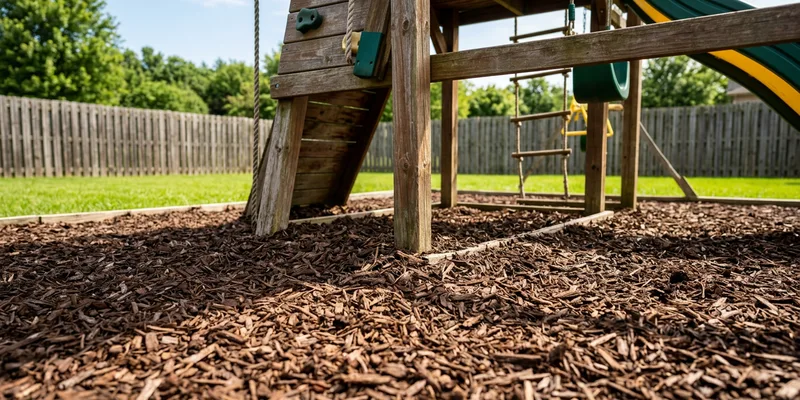
Choosing mulch for playground use is not the same job as choosing mulch for a flower bed, even though the bags sit on the same aisle. Playground surfacing has one function that landscaping mulch does not: it has to absorb the energy of a child falling off the equipment, and the Consumer Product Safety Commission publishes depth guidance for exactly that purpose.
This guide covers which mulch types are rated for play areas, what to check on a listing before you order, how much depth each material needs, and the smaller items that decide whether the layer stays where you put it.
This article contains affiliate links. If you buy through them, we may earn a commission at no extra cost to you. Learn more.
Quick Answer
Which mulch should you use under a play set?
- Engineered wood fiber is the default choice for most backyards: it is milled specifically for play surfacing, cushions well, stays cool and packs into a firm walkable surface.
- Shredded and recycled rubber is the low maintenance alternative. It never decomposes and needs less depth for the same rated fall height, but it holds heat in direct sun.
- Ordinary bagged landscape mulch is the weakest option. The CPSC Public Playground Safety Handbook rates non-CCA wood mulch lower than wood chips at the same depth.
- Depth and containment decide whether any of it works. Budget for a border and a weed barrier before you decide how many bags of the fancy stuff you can afford.
What to Check Before You Order
Every row below can be confirmed on a product listing or a supplier’s spec sheet before anything is delivered. Getting these right is the difference between a surface that does its job for years and a layer you end up raking back into place every weekend.
| What to check | Why it matters | What to look for |
|---|---|---|
| Material grade | Playground grades are milled and screened; landscape grades are not | Engineered wood fiber tested to the playground standards, or shredded rubber processed for wire removal |
| Rated fall height | The whole point of the surface is the fall it is meant to absorb | A stated critical height from the manufacturer, or the depth listed in the CPSC handbook table for that material |
| Coverage per unit | Under-ordering is the most common planning error | Square feet covered at your target depth, not at a shallower demo depth |
| Wire and tramp metal | Steel belt fragments turn a safety surface into a hazard | An explicit wire free or magnetically separated claim on recycled rubber product |
| Splinter and particle size | Coarse chips are the main source of splinter complaints | A graded, screened fiber rather than raw arborist chip of mixed size |
| Dye and treatment | Treated wood is not appropriate under a play area | Non-CCA wood, and colorant described as non-toxic on the listing |
| Drainage plan | Standing water compacts the layer and, with wood, invites mold | A permeable weed barrier underneath, not solid plastic sheeting |
If your ground is uneven or the area holds water, sort that first. Our section on safety and ground preparation covers the base work that goes under all of this.
How Deep Each Material Needs to Be
The CPSC Public Playground Safety Handbook publishes minimum compressed loose-fill depths against the fall height each protects. Six inches of compressed shredded or recycled rubber is rated for 10 feet. Nine inches of compressed wood chips is rated for 10 feet. Nine inches of compressed non-CCA wood mulch is rated for 7 feet. Sand and pea gravel are rated lower again.
Two things follow from that table. First, plain landscape wood mulch is not the same product as playground wood chips and does not carry the same rating, so the cheapest bag on the shelf is also the least protective. Second, those are compressed figures, meaning the depth after the layer has settled, so loose material has to go down deeper than the number to end up at the number.
Match the depth to your equipment, not to a rule of thumb
Fall height is measured from the highest surface a child stands or sits on, which for a swing is the pivot point rather than the seat. A low toddler frame and a tall climbing tower do not need the same layer. Our guide to how deep playground surfacing should be walks through the handbook’s figures in detail.
Our Picks by Situation
How we chose: we compared widely available playground surfacing products on stated grade and testing, coverage per unit, wire and splinter handling, and the issues owners raise most often after a season of use. Selections lean on manufacturer specifications and recurring themes in customer reviews rather than any hands-on trial of our own.
🏆 Best Overall
Engineered wood fiber, the milled and screened grade made specifically for play surfacing. It knits together into a firm walkable layer, stays cooler than rubber, and carries a stated critical height from the manufacturer.

♻️ Lowest Maintenance
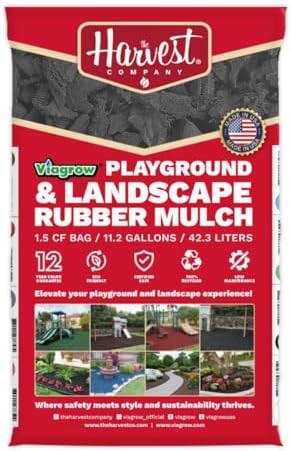
Shredded recycled rubber processed for wire removal. It does not decompose, so the layer you install stays put, and it reaches the same rated fall height from a shallower bed than wood.
🧱 The Layer Underneath
A heavy duty permeable weed barrier. It keeps the mulch from sinking into soil and stops weeds coming up through it, without trapping water the way solid sheeting does.

The Two Items People Forget
Containment and wear protection are what separate a play surface that holds its depth from one that migrates into the lawn by midsummer. Neither is expensive relative to the mulch itself, and skipping them is the most common reason a correctly installed layer stops meeting the depth it started at.
🚧 Best for Containment
Flexible playground border edging, set deep enough to hold a full mulch bed rather than the shallow profile sold for flower beds.
🎯 Best for High Wear Spots
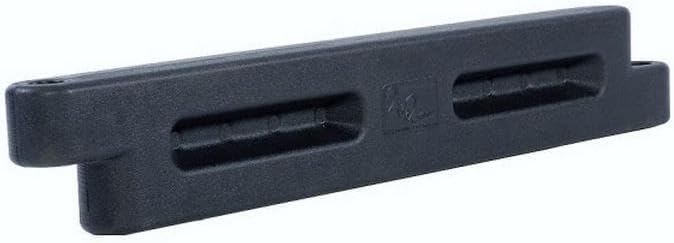
Rubber wear mats for under each swing seat and at the bottom of the slide, the two places where loose fill thins out first no matter what material you choose.

Installing the Layer So It Stays at Depth
Clear and level the area, set the border first so you know exactly what you are filling, lay permeable fabric across the base, then bring the mulch in and rake it out evenly. Fill above your target depth because the layer will settle, and check it again after the first few weeks of real use.
The maintenance rhythm afterwards is short and specific. Rake the layer level every few weeks in the swing and slide zones, top up wherever the base is showing through, and pull leaves and debris out of organic mulch before they compost into the layer. Wood needs topping up on a yearly or two yearly cycle; rubber mostly needs sweeping back inside the border.
Common Mistakes to Avoid
- Buying landscape mulch and treating it as playground surfacing. CPSC guidance rates non-CCA wood mulch lower than wood chips at the same depth.
- Ordering for the listed depth without allowing for settling. The handbook figures are compressed depths, so loose material goes in deeper.
- Using solid plastic sheeting as a base. It traps water, the layer stays wet, and organic mulch turns into a compacted mat.
- Skipping the border. Without containment, loose fill spreads and the protective depth quietly disappears.
- Ignoring the swing and slide zones. These wear thin first and need raking level far more often than the rest of the area.
- Using treated or reclaimed wood chips. Only non-CCA material belongs under a play structure.
Frequently Asked Questions
What kind of mulch is best for a playground? Engineered wood fiber is the usual answer for backyards because it is milled specifically for play surfacing, cushions well and stays cool. Shredded recycled rubber is the low maintenance alternative for families who do not want to top up a layer every year.
How deep should playground mulch be? The CPSC Public Playground Safety Handbook rates 9 inches of compressed wood chips for a 10 foot fall height, 9 inches of compressed non-CCA wood mulch for 7 feet, and 6 inches of compressed shredded or recycled rubber for 10 feet.
Can I use regular bagged mulch from the garden center? It is the weakest option. Landscape mulch is not milled or screened for play surfacing and carries a lower rating in the CPSC table than playground wood chips at the same depth.
Do I need landscape fabric under playground mulch? A permeable weed barrier is worth using. It stops the mulch sinking into soil and keeps weeds down, while still letting water through, which solid plastic sheeting does not.
How often does playground mulch need topping up? Organic mulch usually needs a top up every year or two as it settles and decomposes. Rubber holds its volume and mostly needs sweeping or raking back inside the border.
Does playground mulch attract bugs? Any organic material can host insects when it stays damp and compacted, which is why drainage and raking matter. Recycled rubber removes the issue since there is nothing organic in it.
Is rubber mulch better than wood for a play area? It lasts longer and needs less depth, but it costs more up front and holds heat in the sun. Our full comparison covers the trade-offs in detail.
The Bottom Line
Engineered wood fiber is the sensible default for most backyard play areas, with shredded recycled rubber as the low maintenance alternative for anyone who would rather not re-mulch each spring. Skip ordinary landscape mulch, which CPSC guidance rates lower at the same depth. Then spend the last of your budget on a proper border, a permeable weed barrier and wear mats under the swings, because a contained layer at full depth protects far better than a premium material spread too thin.