Last updated: August 18, 2026
Putting landscape fabric under playground mulch is one of those steps that is easy to skip on the day and impossible to add later without shoveling the whole bed out again. It is worth doing, but only with the right kind of fabric, and the wrong kind actively makes a play surface worse.
This guide covers what the fabric is really there for, the difference between woven, nonwoven and plastic sheeting, what to check on a listing before you order, and how to lay it so it does not surface through the mulch by midsummer.
This article contains affiliate links. If you buy through them, we may earn a commission at no extra cost to you. Learn more.
Quick Answer
Do you need landscape fabric under playground mulch?
- Yes, if it is permeable. A geotextile layer keeps loose fill from sinking into soil and keeps weeds from growing up through it, so the depth you installed stays the depth you have.
- Never solid plastic sheeting. It traps water underneath, and the CPSC Public Playground Safety Handbook warns that standing water reduces surfacing effectiveness and leads to compaction and decomposition.
- The fabric is not a safety layer on its own. It supports the depth, and depth is what the CPSC guidance is written around.
- Weight and pin spacing matter more than brand. Light garden grade fabric tears under a mulch bed with children running on it.
What to Check Before You Order
Landscape fabric is sold mainly to gardeners, so listings lead with weed control and say little about what happens under nine inches of loose fill with children on top. The rows below are the ones that decide whether the layer survives a play area.
| What to check | Why it matters | What to look for |
|---|---|---|
| Permeability | Water has to leave the base, or the surfacing above it compacts and rots | An explicit water permeable or geotextile description; reject anything described as a moisture barrier |
| Weight or grade | A play area puts far more load on the fabric than a flower bed | A heavy duty, contractor or driveway grade rather than the lightest garden roll |
| Puncture and tear rating | Rakes, spikes and settling stone all work against it | A stated tear or puncture figure, or at minimum a woven or needle punched construction |
| Roll width | Every seam is a place for weeds and sinking mulch | The widest roll that covers your area in the fewest passes |
| UV stability | Exposed edges degrade fastest, and edges are always exposed eventually | A UV stabilized or UV resistant claim |
| Fastening hardware | Fabric that lifts at a corner ends up visible through the mulch | Long galvanized staples sold separately in quantity, not the handful included on the roll |
| Total coverage | The surfaced area is much larger than the equipment footprint | Square footage for the whole use zone plus overlap at every seam |
The area you are covering is set by the play equipment, not by the frame. Our swing set safety zone guide walks through marking that out before you buy anything by the square foot.
What the Fabric Is Actually For
Two jobs, and neither of them is cushioning. The first is separation: without a barrier, loose fill grinds down into soil at the wear points and the bed loses depth from the bottom while looking fine from the top. The second is weed suppression, which matters less for appearance than for the fact that pulling weeds out of a mulch bed disturbs and displaces it.
What the fabric must not do is hold water. The CPSC Public Playground Safety Handbook is direct about drainage, warning that standing water reduces surfacing effectiveness and leads to compaction and decomposition, and it lists poor drainage among the conditions that need correcting. A permeable geotextile helps that; a solid sheet defeats it.
Where geotextile appears in the handbook
The handbook describes a layered build for existing sites where a hard surface cannot be removed, using a drainage layer of loose fill, geotextile cloth, the surfacing itself, and impact mats under high traffic areas. That is not a backyard recipe, and CPSC staff strongly recommend against installing over hard surfaces at all, but it does show where a geotextile sits in a professionally specified section: between the drainage layer and the surfacing, never as a sealed membrane.

Woven, Nonwoven and the One to Avoid
Woven fabric is the common heavy duty choice: strong in tension, cheap by the roll, and permeable through the weave. Nonwoven geotextile is the needle punched felt used under driveways and gravel, better at separation and generally more permeable, and it is the more appropriate product where the ground stays damp. Solid plastic sheeting is the one to avoid outright.
For most backyard play areas either woven or nonwoven works. Pick nonwoven if you have clay soil, a low spot, or a base that has held water before, and pick woven if the ground drains well and you want the toughest surface for the money.
Fabric does not fix a drainage problem
If water pools where the play area is going, a geotextile will not solve it, it will simply sit in the puddle. Grade the base first so water leaves the area, then lay fabric on ground that already drains. Ground that stays wet under mulch stays wet under mulch and fabric too.
Our Picks by Situation
How we chose: we compared widely available geotextile products on stated grade and weight, permeability, roll width and the fastening hardware they need, and on the failures owners describe after a full season under mulch. Selections lean on manufacturer specifications and recurring themes in customer reviews rather than any hands-on trial of our own.
🏆 Best Overall
Heavy duty woven landscape fabric in a wide roll. It takes the load of a deep mulch bed, passes water through the weave, and a wide roll means fewer seams across the play area.
💧 Best for Damp or Clay Ground
Nonwoven geotextile of the type used under driveways and gravel. It separates the base from the surfacing while letting water through more freely than a tight weave, which is the priority where the soil holds moisture.

📌 Best Fastening
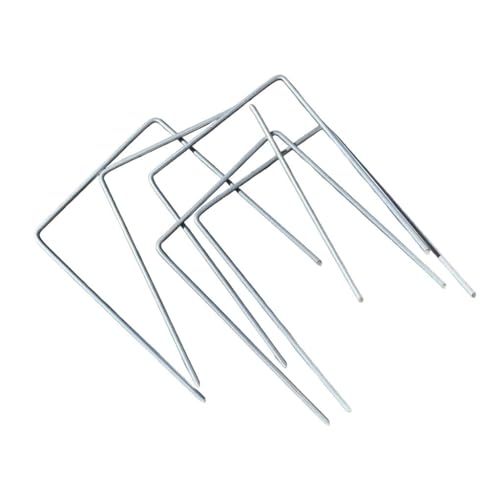
Long galvanized landscape staples bought by the box. Fabric that lifts at an edge works its way to the surface through the mulch, and the pins included on a roll are never enough for a play area.
Laying It So It Disappears
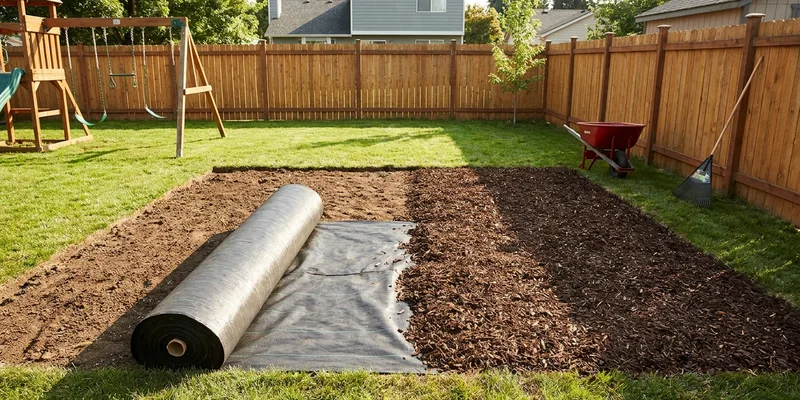
Clear and grade the base first, remove roots and stones, and set the border before the fabric goes down so you know exactly where the edges land. Roll the fabric out across the shortest dimension, overlap every seam generously, and pin along the seams as well as the perimeter rather than only at the corners.
Run the fabric out to the border and slightly up behind it, because that seam is where weeds appear first. Then get the mulch on quickly. Fabric left bare in the sun for a week degrades at the exposed edges and blows loose in the first wind.
Cutting around posts
Cut a slit rather than a hole where a support post passes through, slide the fabric around it, then overlap and pin the cut closed. A generous cutout leaves a gap at the base of every post, and the base of a post is a high wear spot where you least want the mulch sinking away.
Common Mistakes to Avoid
- Using solid plastic sheeting. It traps water, and the CPSC warns that standing water reduces surfacing effectiveness and causes compaction and decomposition.
- Buying the lightest garden grade. It tears under a loose fill bed with children on it, and torn fabric is worse than none because the pieces migrate upward.
- Pinning only the perimeter. Unpinned seams separate as the mulch shifts, and the gap fills from below.
- Laying fabric on unlevelled or poorly draining ground. The barrier does nothing about a low spot; grade first, then lay.
- Treating fabric as part of the cushioning. Impact protection comes from material depth, not from the layer underneath it.
- Leaving it exposed for days. UV and wind get to the edges long before the mulch arrives.
Frequently Asked Questions
Do you need landscape fabric under playground mulch? It is worth using. A permeable barrier keeps loose fill from sinking into the soil and keeps weeds from growing up through the bed, which is how a correctly installed depth quietly disappears from the bottom.
Can I use plastic sheeting instead? No. Solid plastic traps water under the surfacing, and the CPSC Public Playground Safety Handbook warns that standing water reduces effectiveness and leads to compaction and decomposition. Use a permeable geotextile.
Woven or nonwoven fabric for a play area? Either works on ground that drains. Nonwoven geotextile is the better choice on clay or in a spot that stays damp, because it separates the layers while passing water more freely.
Does fabric change how deep the mulch needs to be? No. The depth comes from the CPSC surfacing guidance for the material and your fall height, and the fabric simply helps the bed hold that depth for longer.
Will weeds still come through? Some will, mostly from seed landing in the mulch itself rather than growing up from below, and mostly along seams and edges. Overlapping seams generously and pinning them cuts it down.
How do I stop the fabric showing through the mulch? Pin it properly, keep the surfacing at full depth, and rake the high wear spots back level. Fabric appears at the surface where the bed has gone thin, which is a depth problem before it is a fabric problem.
Can I lay fabric over existing mulch? Take the old material out first. Anything decomposing under the barrier keeps settling, and you lose the compressed depth you thought you had installed.
The Bottom Line
Use a permeable geotextile under playground mulch and never a solid sheet, since the CPSC guidance treats standing water as something that actively degrades a surfacing layer. Buy a heavy grade in the widest roll you can, add a box of long staples, grade and drain the base before anything goes down, and pin the seams as carefully as the perimeter. The fabric does not cushion anything, it just keeps your depth honest.