Last updated: August 18, 2026
Choosing between an in-ground vs above-ground trampoline comes down to one honest question: are you solving a look problem or a safety problem? Sinking a trampoline flush with the lawn genuinely transforms how a yard reads, and it does remove the climb up onto a raised frame. What it does not do is remove the reasons trampolines cause injuries in the first place.
This comparison sets out what actually differs between the two, where the extra work goes, and which situations point clearly to one or the other.
This article contains affiliate links. If you buy through them, we may earn a commission at no extra cost to you. Learn more.
Quick Answer
In-ground or above-ground trampoline: which is better?
- Above-ground wins on cost, speed, and the ability to move or remove it later. It is the right default for most families and for anyone renting.
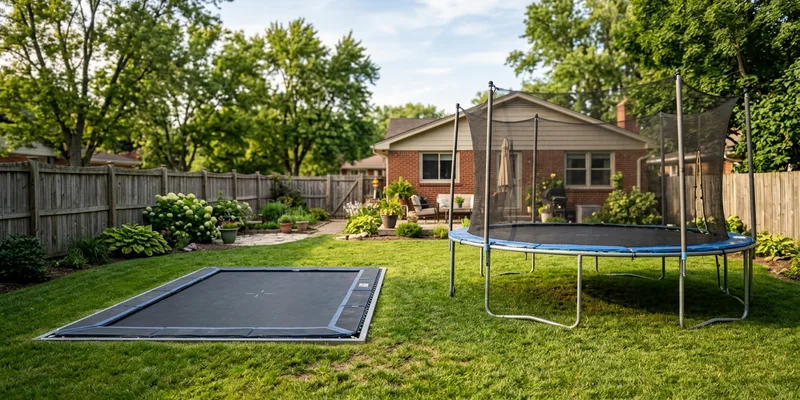
- In-ground wins on sightlines, on not having a raised frame to climb, and on wind, since there is no tall structure to lift.
- In-ground is a permanent excavation with drainage, a retaining wall and a ventilated mat. It is a landscaping project, not an afternoon of assembly.
- Neither version removes the main injury risks. CPSC trampoline safety guidance still applies to both: one person at a time, no somersaults, and pads covering the springs, hooks and frame.
Differences at a Glance
The two versions share the same mat, springs and frame logic. What differs is everything around them: installation, drainage, mowing, wind exposure and how permanent the decision is. The table below is the short form of the whole comparison.
| Factor | In-ground | Above-ground |
|---|---|---|
| Installation | Excavation, drainage layer, retaining wall, then assembly | Assembly on levelled ground, typically one session with two people |
| Permanence | Permanent; moving it means backfilling the pit | Movable, and can be taken down for winter or when the kids outgrow it |
| Mat and pad | Needs a vented mat or pad so air escapes on the down bounce | Open underneath, so airflow is never an issue |
| Wind exposure | Very low; there is no raised structure to lift | Significant; anchors or stakes are essential in exposed yards |
| Yard appearance | Sits flush with the lawn and keeps sightlines open | A large visible structure that dominates a small yard |
| Mowing and upkeep | Mow up to the pad; the pit edge and drainage need checking | Mow around or under; the frame legs make trimming fiddly |
| Enclosure fit | Needs a net designed for a ground level frame | Wide choice of nets, and replacements are easy to source |
If you are leaning toward digging, our guide to the in-ground trampoline kit covers the components and the ground prep in detail.
Does Sinking a Trampoline Make It Safer?
Partly, and not in the way most buyers assume. An in-ground trampoline removes the fall from the frame to the ground, which is a real hazard on a raised unit, particularly for younger children climbing on and off. It does not change what happens on the mat, and the mat is where the serious injuries happen.
CPSC trampoline safety guidance is the same for both versions: allow only one person on the trampoline at a time, do not allow somersaults, do not use the trampoline without shock absorbing pads that completely cover the springs, hooks and frame, and place the trampoline away from structures, trees and other play areas. CPSC also states that no child under six years of age should use a full size trampoline. Burying the frame does not soften any of that.
What Changes at Ground Level
Two genuine differences are worth naming. First, an in-ground trampoline has no ladder, which removes the unsupervised access route that a raised frame creates for a toddler. Second, the gap between the mat edge and the surrounding lawn becomes the thing to watch, which is what the perimeter pad is for. A pad that has shifted or degraded leaves an opening at exactly foot height.
The CPSC Public Playground Safety Handbook, which sets use zones and surfacing depths for playground equipment, does not treat trampolines as recommended playground equipment, so its surfacing tables are not the right reference here. The applicable consumer standards are ASTM F381 for the trampoline and ASTM F2225 for the enclosure.
Installation Effort and What It Really Involves
An above-ground trampoline is a flat pad of level ground, a few hours of assembly, and anchors if you are anywhere windy. An in-ground trampoline is a bowl shaped excavation, a gravel drainage layer, often a sump and a pump, a retaining wall that has to hold soil back permanently, and a trampoline specifically designed to be buried.
That gap matters more than the product difference. Plenty of people who wanted the sunken look end up hiring out the excavation and the wall, which turns a purchase into a project with a schedule. If that appeals, good; if it does not, an above-ground unit with proper anchoring gets the kids jumping this weekend.
Drainage Decides Whether It Was Worth It
Every in-ground installation lives or dies on drainage. Fast draining soil on a slightly raised site can work with a gravel base alone. Clay soil, or a pit dug at the yard’s low point, needs a sump and a pump, and skipping that step is the single most common regret owners describe. Run a percolation test in the intended spot before committing to the idea.
Which One Fits Your Situation
Pick by circumstance rather than by preference, because the constraints usually decide it for you. Renting, an unclear long term plan for the yard, or a low lying site all point to above-ground. A permanent home, a flat well draining lawn, and a strong dislike of a large structure in the sightline point to in-ground.
🏡 Choose above-ground if you want it usable quickly, you might move it, you rent, your yard drains poorly, or you want the option of taking it down when the kids lose interest.
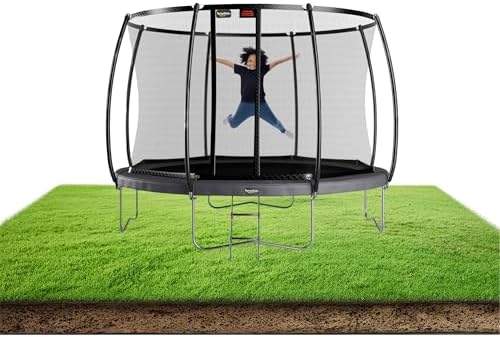
⛏️ Choose in-ground if the location is settled, the site drains well, you want the trampoline out of the sightline, and you are willing to treat the pit as a real landscaping job.

Common Mistakes to Avoid
- Assuming in-ground means you can skip the net. Falling off the mat sideways is still falling, and enclosures made for ground level frames exist for that reason.
- Burying a standard above-ground trampoline. Without a vented mat or pad the trapped air ruins the bounce and stresses the mat. Buy a model specified for in-ground use.
- Digging at the yard’s low point. Water goes there. Test drainage before you choose the spot, not after the wall is built.
- Leaving an above-ground trampoline unanchored. A raised trampoline is a large sail. Anchors are not optional in an exposed yard.
- Treating either version as supervision proof. The CPSC guidance on one jumper at a time and no somersaults applies equally to both.
Frequently Asked Questions
Are in-ground trampolines safer than above-ground trampolines? They remove the fall from the raised frame and the ladder that gives young children unsupervised access, which is a real benefit. They do not change the risks on the mat itself, and CPSC trampoline safety guidance applies identically to both: one person at a time, no somersaults, and full pad coverage over springs, hooks and frame.
Do in-ground trampolines bounce as well as above-ground ones? Purpose built in-ground models do, because their mats or pads are vented so air can escape on the down bounce. A standard above-ground trampoline dropped into a pit bounces noticeably worse for exactly that reason.
Can you move an in-ground trampoline later? Only by backfilling the pit and starting over somewhere else, which is a substantial job. Treat the location as permanent before you dig.
Do in-ground trampolines need a net? Not by requirement, but many owners fit one, and enclosures designed for ground level frames are sold for that purpose. The consumer standard for trampoline enclosures is ASTM F2225.
Which one lasts longer? Frame life is similar, since both use the same galvanized steel and spring construction. The difference is that an in-ground unit sits in a pit, so drainage failure and moisture around the pad become the practical limits rather than the frame itself.
Do you need a permit for an in-ground trampoline? That varies by county and by homeowners association and is not something we can answer for your address. Check with your local building department and your association, and call the national 811 service to have buried utilities marked before digging.
The Bottom Line
Above-ground is the right answer for most families: cheaper in effort, quicker, movable, and easy to fit with a replacement net when the original wears out. In-ground earns its extra work when the location is settled, the site drains well, and you genuinely want the trampoline out of the sightline. Whichever you pick, the safety rules are identical, so choose on yard and permanence rather than on the belief that one version is inherently safe.