Last updated: August 18, 2026
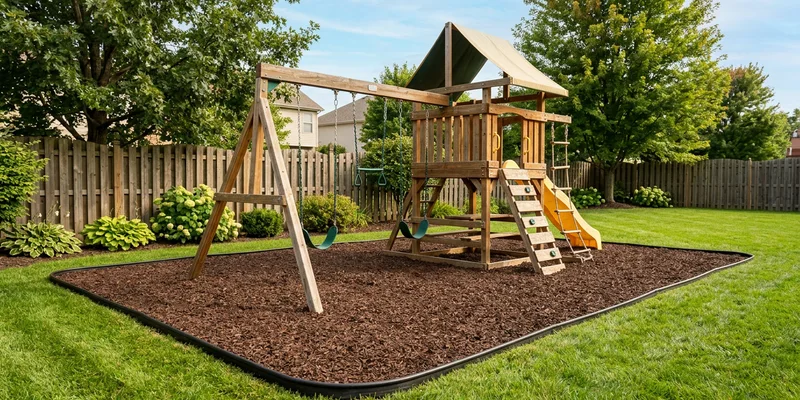
Deciding what ground cover under a swing set should be is the last step of the build and the one that does the most for safety. Every option in the aisle looks plausible, but the CPSC only recognises a short list as protective surfacing, and two of the most popular backyard answers, grass and bare dirt, are not on it.
This guide compares the realistic options side by side, sets out what CPSC guidance says about each, explains how much area you actually have to cover, and covers the wear spots under the seats that fail first no matter which material you pick.
This article contains affiliate links. If you buy through them, we may earn a commission at no extra cost to you. Learn more.
Quick Answer
What should you put under a swing set?
- Engineered wood fiber or wood chips are the default for most backyards. CPSC Table 2 rates 9 inches of compressed wood chips for a fall height of 10 feet.
- Shredded or recycled rubber gets the same 10 foot rating from 6 inches compressed, which is why it suits shallow beds and sloped ground, though it holds heat in sun.
- Pea gravel and sand rate lower, at 5 feet and 4 feet respectively for 9 inches compressed, and the CPSC advises against loose fill for toddlers.
- Grass and dirt are not protective surfacing. The CPSC Outdoor Home Playground Safety Handbook says wear and environmental factors reduce their shock absorbing effectiveness.
The Options Side by Side
The comparison below uses the depth and fall height figures published in the CPSC Public Playground Safety Handbook, so the first column is not a matter of opinion. What varies is upkeep, comfort and how each material behaves in your particular yard.
| Ground cover | What CPSC guidance rates it at | Upkeep | Suits |
|---|---|---|---|
| Wood chips | 9 inches compressed, rated to a 10 foot fall height | Tops up as it settles and decomposes | Most backyards with a tall play set |
| Engineered wood fiber | Milled and graded product with a critical height from the manufacturer’s own testing | Raking and periodic top up | Families who want a firm, walkable natural surface |
| Wood mulch, not CCA treated | 9 inches compressed, rated to 7 feet | Same as wood chips, from a lower starting rating | Lower frames, where the fall height is modest |
| Shredded or recycled rubber | 6 inches compressed, rated to 10 feet | Sweeping back inside the border; does not rot | Shallow excavation, shade, insect prone yards |
| Pea gravel | 9 inches compressed, rated to 5 feet | Raking; migrates into the lawn | Low equipment, older children only |
| Sand | 9 inches compressed, rated to 4 feet | Frequent raking, attracts animals | Low frames; the weakest rating of the loose fills |
| Grass or bare dirt | Not protective surfacing; effectiveness reduced by wear and weather | Mowing, and a bald patch under every seat | Nothing, once a swing is standing on it |
Depth is the other half of every row above, and the numbers are compressed depths rather than what you pour. Our guide to how deep playground surfacing should be sets out the full table with the initial fill depths.
Why Grass Under a Swing Set Does Not Count
It is the most common backyard setup and the CPSC addresses it directly. The Outdoor Home Playground Safety Handbook states that grass and dirt are not considered protective surfacing because wear and environmental factors reduce their shock absorbing effectiveness. That is not a technicality; the bald compacted patch under a well used swing seat is the exact spot where a fall is most likely to land.
The same handbook is unambiguous about the harder end of the scale: do not install home playground equipment over concrete, asphalt or any other hard surface, and do not install loose fill surfacing over hard surfaces such as concrete or asphalt.
Where no surfacing is needed at all
Ground level equipment such as sandboxes, playhouses and activity walls needs no protective surfacing, since there is nothing to fall from. A swing set is the opposite case. The CPSC measures the fall height of swings from the pivot point at the top bar rather than from the seat, which usually makes the swing beam the tallest number on a backyard play set and therefore the one that sets your material and depth.
How Much Area You Have to Cover
Surfacing under the frame alone is not enough, and this is where most orders come up short. The CPSC Outdoor Home Playground Safety Handbook advises extending surfacing at least 6 feet from the equipment in all directions, and further to the front and rear of swings: a distance equal to twice the height of the top bar from which the swing is suspended.
Tire swings get their own figure. The handbook recommends a circle whose radius equals the height of the suspending chain or rope plus 6 feet in all directions. Marking those distances out with paint or a hose before ordering is what turns a guess into a square footage. Our swing set safety zone guide walks through laying it out.
Our Picks by Situation
How we chose: we compared widely available surfacing products on stated grade and testing, coverage per unit, drainage behaviour and the complaints owners raise after a season outdoors, alongside the material ratings published by the CPSC. Selections lean on manufacturer specifications and recurring themes in customer reviews rather than any hands-on trial of our own.
🏆 Best Overall
Engineered wood fiber, milled and screened specifically for play surfacing. It knits into a firm walkable layer, stays cooler than rubber underfoot, and carries a critical height stated by the manufacturer rather than inferred from a general table.

♻️ Lowest Maintenance
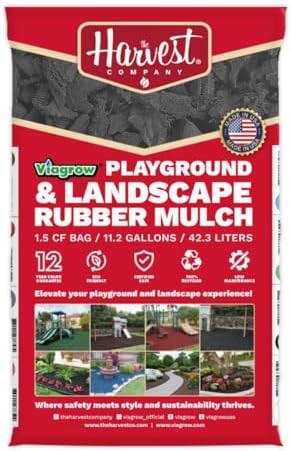
Shredded recycled rubber processed for wire removal. It reaches a 10 foot rating from 6 inches compressed in the CPSC table, and since it does not decompose the bed you install is the bed you keep.
🌱 Best Tidy Alternative
Artificial turf laid over a shock pad. It keeps a lawn look without the bald patch, but the protection comes from the pad and its tested rating, not from the grass layer, so check what the pad is rated for.

The Two Spots That Fail First
Whatever material you choose, it thins out in the same two places. The CPSC singles out the areas under swings and at slide exits as more susceptible to displacement, and calls for frequent maintenance so levels never drop below the minimum depth. Planning for that is cheaper than re-mulching the whole area every spring.
🎯 Best for High Wear Spots
Rubber wear mats under each seat and at the slide exit. They take the scuffing that otherwise digs a hollow straight through the loose fill.

🚧 Best for Containment
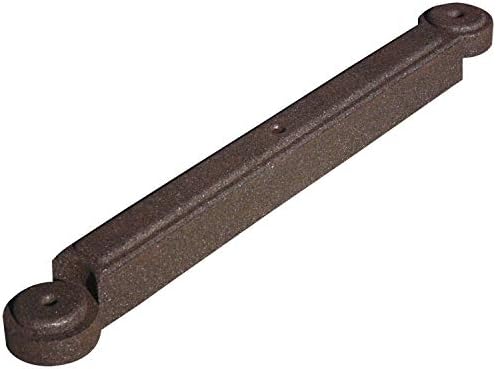
A deep profile playground border. Loose fill migrates outward constantly, and the depth under the swings goes first when there is nothing holding the perimeter.
Common Mistakes to Avoid
- Leaving grass under the swings. The CPSC does not count grass or dirt as protective surfacing, and it wears to bare compacted soil exactly where children land.
- Surfacing the footprint instead of the use zone. The guidance calls for at least 6 feet in all directions and twice the top bar height front and rear of swings.
- Choosing sand or pea gravel for a tall set. At 9 inches compressed they rate to 4 feet and 5 feet, well below the swing beam on most play sets.
- Loose fill for toddlers. The CPSC advises avoiding loose fill on playgrounds intended for toddlers, which points toward a tested unitary surface instead.
- Installing over a hard surface. The home handbook rules out concrete and asphalt both for the equipment and for loose fill laid over them.
- Ordering to the listed depth. Those figures are compressed depths, so loose material goes in deeper and settles down to them.
Frequently Asked Questions
What is the best ground cover under a swing set? Engineered wood fiber or wood chips suit most backyards, with shredded recycled rubber as the low maintenance alternative. CPSC Table 2 rates 9 inches of compressed wood chips and 6 inches of compressed shredded or recycled rubber for a 10 foot fall height.
Can I just leave grass under the swing set? The CPSC Outdoor Home Playground Safety Handbook states that grass and dirt are not considered protective surfacing, because wear and environmental factors reduce their shock absorbing effectiveness.
Is pea gravel good under a swing set? It rates lower than wood or rubber. Nine inches of compressed pea gravel is rated for a 5 foot fall height in the CPSC table, and sand at the same depth for 4 feet, which is short of most swing beams.
How far does the ground cover have to extend? At least 6 feet from the equipment in all directions per the CPSC home handbook, and to the front and rear of swings a distance equal to twice the height of the top bar the swing hangs from.
Does artificial turf work under a swing set? Only over a shock pad with a tested critical height. The turf itself is a surface finish, and the impact protection comes from what is underneath it.
Can I put loose fill over a concrete pad? The CPSC home handbook advises against installing loose fill surfacing over hard surfaces such as concrete or asphalt, and against siting home play equipment over them in the first place.
Why does the mulch disappear under the seats? That is displacement, and the CPSC flags the areas under swings and at slide exits as the most susceptible. Wear mats and regular raking are the standard answers.
The Bottom Line
Match the material to the fall height of the swing beam, not to what looks tidiest. Wood chips at 9 inches compressed and shredded rubber at 6 inches both carry a 10 foot rating in the CPSC table, sand and pea gravel rate far lower, and grass and dirt do not count at all. Then cover the whole use zone rather than the footprint, put wear mats under the seats, and hold the perimeter with a proper border.