Last updated: August 18, 2026
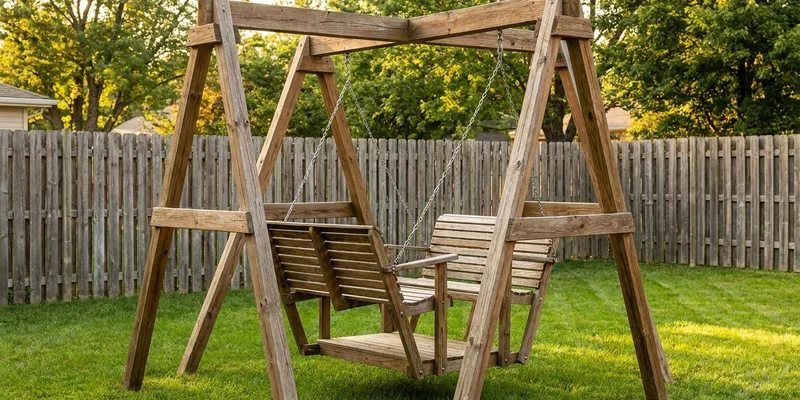
A glider swing for a swing set is the seat that gets two kids facing each other, pumping in rhythm, and it is the accessory most often added to a tower that already has belt swings. It also asks the most of the frame, because two riders in a coordinated arc load the beam differently from one child on a belt seat.
That does not make a glider a bad idea, but the swap is more than clipping a new seat onto an existing hanger. This guide covers how gliders differ from other seats, what the frame and hardware need to handle, and how much clear space the arc requires.
This article contains affiliate links. If you buy through them, we may earn a commission at no extra cost to you. Learn more.
Quick Answer
What should you look for in a glider swing for a swing set?
- Check the frame first. A glider carries two riders and swings as one mass, so the beam, the hanger bolts and the ground anchors all need to be sound before you hang it.
- Match the hanger spacing to your beam. Gliders hang from two points set well apart, not from a single belt swing hanger.
- Give it the end position on the beam only if there is room; a glider’s arc needs clear space at both ends and away from other swings.
- Note that the CPSC advises against multiple occupancy swings other than tire swings on public playgrounds, because of the impact risk from the extra mass. Supervision and spacing matter more with a glider than with a belt seat.
What to Check Before You Buy a Glider Swing
A glider is heavier and wider than anything else on a residential swing beam, so the checks are as much about your tower as about the product. Each can be confirmed from the listing or with a wrench and a tape measure.
| What to check | Why it matters | What to look for |
|---|---|---|
| Hanger spacing | Gliders hang from two widely spaced points, unlike a belt swing | The listed distance between the two top attachment points, checked against your beam’s existing hanger positions |
| Stated weight capacity | Two riders on one seat is the load the frame was often not sized for | A clearly stated combined capacity from the manufacturer, plus your set’s own listed limit |
| Seat and frame material | Molded plastic, coated steel and wood age very differently outdoors | UV stabilized molded plastic for light use, powder coated steel for heavier or older riders |
| Chain or rope covering | Bare chain pinches fingers, which is the most common minor injury on gliders | Plastic coated chain or a covered link section where hands naturally grip |
| Clear arc space | A glider’s swing arc is longer and wider than a belt seat’s | Room to swing at both ends without reaching another swing, a post, a slide or the frame |
If the beam flexes visibly under a single rider today, adding a glider is the wrong next step. Our guide to swing set bracket kits covers the frame connections that carry this kind of load.
How a Glider Differs From Other Swing Seats
A belt swing carries one rider close to the seat, and the arc is short and predictable. A glider carries two riders facing each other on a rigid platform and swings as a single mass, with a longer arc and considerably more momentum at the ends. That momentum is the appeal and the engineering problem at once.
So a glider hangs from two spaced attachment points instead of one and cannot take over a belt swing’s hanger. Most residential towers have room for exactly one glider, at the end of the beam, and only if nothing else sits in the arc.
What the CPSC says about multi occupancy swings
The CPSC Public Playground Safety Handbook advises against multiple occupancy swings on public playgrounds, with the exception of tire swings, because their greater mass compared with a single occupancy swing presents a risk of impact injury. That guidance is written for public playgrounds rather than for backyard sets, and residential gliders remain widely sold, but the physics behind it does not change in your yard. It is a reasonable argument for keeping the glider well away from other swings and for keeping younger children out of the arc.
Frame, Hardware and Ground Anchoring
What determines whether a glider suits your set is the beam, the hanger hardware and whether the legs are anchored. A wooden A frame that has stood for several seasons with belt swings is not automatically ready for a two rider glider, and the check takes about ten minutes.
Look at the beam for splits running along the grain near the hanger bolts, at the hangers for elongated holes or rust, and at the leg to beam joints for movement when you push the frame hard sideways. Any of those is a repair to do first.
Anchoring matters more with a glider
Two riders swinging in rhythm can lift the legs of a light frame at the end of the arc, and a frame that hops will eventually walk out of position or tip. Ground anchors are the single best thing to add before a glider goes on. Our guide to ground anchors for play equipment covers the types and how they go in.

Our Top Picks at a Glance
How we chose: we compared widely available glider swings on stated combined weight capacity, how clearly the hanger spacing is documented, and the seat and chain materials. Selections rely on manufacturer specifications and recurring themes in customer reviews rather than any hands-on trial of our own.
🏆 Best Overall
A two seat molded plastic glider with coated chains and a clearly stated combined capacity, the standard configuration for a residential wooden or metal swing beam.

🛠️ Best for Heavier Riders
A powder coated steel frame glider for older children and mixed age use, where a light molded seat flexes more than you want it to.

🔗 Best Simple Swap
A glider seat sold with chains and hooks, so the whole assembly goes on as one unit rather than being pieced together from mismatched hardware.

Picks by Situation: Hanging It Properly
The most common complaint about gliders in owner reviews is not the seat, it is the hardware. Undersized S hooks open up under repeated load, and a hook that has worked open is how a seat drops mid swing.
🔩 Best for a Secure Hang
Heavy duty spring clips or fully closed connectors to replace open S hooks, closed properly so nothing can work its way free over a season of use.

Placement and Clear Space
Give the glider the end position on the beam, with nothing adjacent that a rider could swing into. The CPSC Public Playground Safety Handbook describes the use zone in front of and behind a swing as extending twice the height of the pivot point measured from the ground, with 6 feet (1.8 m) to the sides of the supporting structure.
Those figures are written for public playgrounds, but they are a sensible baseline at home, and a glider’s longer arc is exactly where cutting the distance short shows up. Our article on the swing set safety zone works through what that means on a normal lot.
Common Mistakes to Avoid
- Hanging a glider on a belt swing’s single hanger. Gliders need two spaced attachment points, and improvising one is how beams split.
- Reusing tired hangers. Elongated bolt holes and rusted hangers are already at their limit before you double the load on them.
- Putting the glider in a middle position. The arc will eventually reach whatever is next to it. End position or nothing.
- Skipping ground anchors. Two riders in rhythm can lift the legs of a light frame, and an unanchored frame walks over a season.
- Leaving open S hooks in the assembly. They work open under cyclic load. Close them properly or replace them with clips.
Frequently Asked Questions
What is a glider swing? It is a two seat swing where riders sit facing each other on a rigid platform that swings back and forth as one unit, hung from two spaced attachment points rather than the single point used for a belt seat.
Can I add a glider swing to my existing swing set? Often yes, but only after checking the beam for splits, the hangers for wear and the frame’s stated weight capacity. A glider carries two riders and loads the frame more heavily than the belt swing it replaces.
What age is a glider swing for? Follow the manufacturer’s stated age and weight range for the specific model, since these vary. Gliders reward riders who can coordinate their pumping, which in practice means older children rather than toddlers.
Are glider swings safe? They are widely sold for residential use, but the CPSC Public Playground Safety Handbook advises against multiple occupancy swings other than tire swings on public playgrounds because of the impact risk from the extra mass. Keep the arc clear, place the glider at the end of the beam, and supervise younger children nearby.
Does a glider swing need special hardware? It needs two swing hangers set at the spacing the glider lists, rated for the combined load, plus closed connectors rather than open S hooks. Check whether the hardware is included before you order.
How much clear space does a glider need? More than a belt swing, because the arc is longer. The CPSC handbook’s guidance for swings is a use zone extending twice the pivot height front and back, with 6 feet (1.8 m) to the sides, which is a sound planning baseline at home.
The Bottom Line
A glider is a genuine upgrade for a tower with two children past the belt swing stage, provided the frame is up to it. Check the beam and hangers, match the two point spacing, put the glider at the end of the beam with a clear arc, anchor the legs, and replace open S hooks with closed connectors.