Last updated: August 18, 2026
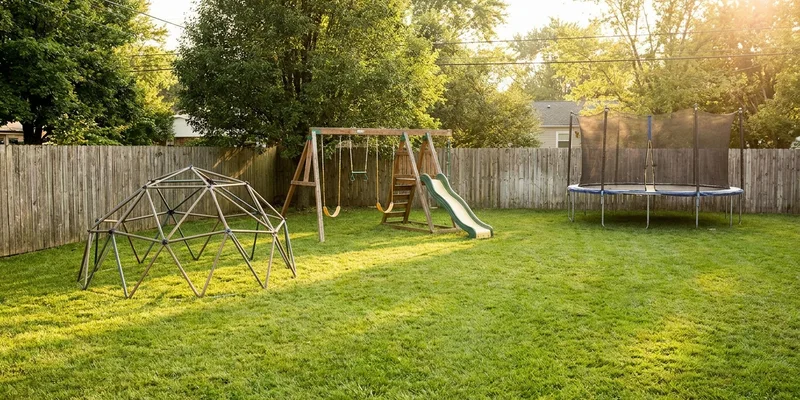
Deciding between a climbing dome, a swing set and a trampoline is really a question about your yard rather than about the equipment. All three keep children busy outdoors, but they take up space in completely different shapes, suit different ages, and place very different demands on the ground underneath and on the person supervising.
This comparison works through the footprint each one needs, the ages they suit, the upkeep they bring, and which of the three fits a small or sloped yard.
This article contains affiliate links. If you buy through them, we may earn a commission at no extra cost to you. Learn more.
Quick Answer
Climbing dome, swing set or trampoline: which one fits your yard?
- A climbing dome needs the least total space of the three, because its clear zone is a circle rather than a long corridor, and it suits a mixed age group best.
- A swing set needs the most length, since CPSC guidance calls for a use zone extending in front of and behind a swing to twice the height of the pivot.
- A trampoline needs the most consistently level ground, brings the most upkeep, and is the one with the clearest supervision rules attached to it.
- If your children are under four, the swing set is the only one of the three with seats designed for that age group.
The Three Compared at a Glance
The table below sets the three side by side on the factors that decide the purchase. Space is the one most people underestimate, because the equipment footprint and the clear zone around it are two different numbers.
| Factor | Climbing dome | Swing set | Trampoline |
|---|---|---|---|
| Shape of the space it needs | A circle, roughly even in all directions | A long corridor, mostly in front and behind | A circle or rectangle, plus clearance overhead |
| Ages it suits | Roughly preschool through early teens, depending on dome size | Infant seats through school-age, the widest range of the three | School-age and up, with adult rules attached |
| Ground it needs | Level enough to sit flat, protective surfacing underneath | Level, with anchoring into firm ground | The most level of the three, and anchored |
| Upkeep across a season | Lowest: bolt checks and rust spots | Moderate: hardware, chains, seats and canopy | Highest: springs, mat, pads and net |
| Main safety consideration | Fall height and the surface below | Clearance in the swing path | One jumper at a time and an intact enclosure |
| Budget class | Entry level to mid range | Widest range, from a metal A-frame to a full wooden playset | Mid range, with recurring replacement parts |
If you already know which category you want, our climbing and active play section covers domes and the alternatives that share their footprint.
Space: What Each One Actually Takes Up
The footprint on the box is not the space you need. Every piece of play equipment needs a clear zone around it, and the shape of that zone differs sharply between these three. The CPSC Public Playground Safety Handbook specifies a use zone extending at least 6 feet (1.8 m) in all directions from the perimeter of stationary equipment, the figure that applies to a climbing dome.
Swings are the exception, and the reason they eat yards. The handbook calls for the use zone in front of and behind a single axis swing to extend a minimum of twice the height of the pivot point, in both directions. A swing hung from a tall beam therefore needs a long clear corridor, not a tidy rectangle, and that requirement is what rules swing sets out of many narrow yards.
The dome is the space efficient one
A climbing dome puts its play value inside its own footprint. Kids climb over it, hang under it and sit in it, so almost all of the activity happens within the circle. In a yard where you can spare a round patch but not a corridor, that decides the question on its own.

Ages: Who Each One Suits
Swing sets cover the widest age range, because a bucket seat suits a toddler while the same frame carries a belt seat, a glider or a trapeze bar later. That upgrade path is the strongest argument for a swing set in a household with a new baby and a five year old.
Climbing domes start later and last longer. A dome only works once a child can pull themselves up and hold on, and it keeps working into the early teens on the larger sizes. Trampolines start later still, and the supervision expectations stay in place for as long as one is in the yard.
What the pediatric guidance says about trampolines
The American Academy of Pediatrics has long advised caution about home trampolines and recommends that only one person jump at a time, with adult supervision and no somersaults. That position has not changed with the arrival of nets and padded frames, so treat it as part of the decision rather than a detail to sort out after delivery.
Play Value Over Time
All three get heavy use in the first month, and what separates them is the second year. Trampolines and swing sets hold attention through repetition, which is why they work for younger children and why older ones drift away from them. A climbing dome changes as the child does, since the same structure can be climbed over, hung from, crawled through or draped with a sheet as a den.
Sociability matters too. A dome takes several children at once without turns, a trampoline takes several but should not, and a swing set takes as many as it has seats.
Upkeep, Weather, and Winter
The trampoline asks the most of you. Springs stretch, the mat wears, the frame pads degrade in sunlight and the enclosure net is a consumable. Add wind, which is why anchoring is not optional, and it is the one piece of equipment here you check regularly rather than annually.
A swing set sits in the middle: chains, hangers, seats and the canopy all wear, and a wooden frame needs sealing on a schedule. A climbing dome is the quietest of the three, with bolts to check and powder coat to watch for chips. None of them enjoy a harsh winter without an inspection in spring.
Ground preparation is the hidden job
The ground work is the part that gets underestimated. A trampoline needs the most consistently level ground, a swing set needs firm ground it can be anchored into, and a dome needs a flat enough patch to sit without rocking. Our guide to ground anchors for play equipment covers the fixings each takes.

Budget Class Without the Sticker
It is more useful to think in classes than in figures. Climbing domes cluster from entry level up to mid range, with size the main driver. Trampolines land in the mid range but carry a recurring outlay the other two do not, since nets, pads and mats are replacement items.
Swing sets span the widest range by far, from a simple metal A-frame to a full wooden playset with a tower and slide. That range is why the category needs the most careful shopping: two products with the same name can sit in completely different classes.
Which One for Your Yard
- Small or narrow yard. The climbing dome, because its clear zone is a circle rather than a corridor. Our climbing dome guide compares the common sizes.
- Sloped ground. The dome tolerates a gentle slope best; a trampoline is the least forgiving and needs genuine leveling first.
- Older children who want intensity. A trampoline delivers it, provided the one jumper at a time rule is one you will actually enforce.
Common Mistakes to Avoid
- Measuring the equipment instead of the clear zone. The use zone is the number that decides whether it fits, and for swings it extends far further than people expect.
- Skipping anchoring because the equipment feels heavy. Wind moves trampolines and light frames, and a shifted structure loses its clear zone.
- Assuming a net makes a trampoline supervision free. Pediatric guidance still calls for one jumper at a time and adult supervision, enclosure or not.
- Forgetting the local rules. Setbacks, permits and homeowners association restrictions vary by county and by association, so check yours before you order.
Frequently Asked Questions
Which takes up the least space, a climbing dome, a swing set or a trampoline? The climbing dome, in practical terms. Its use zone is a circle around the structure, whereas a swing needs a long clear corridor in front and behind, and a trampoline needs a large level area plus overhead clearance.
How much clear space does a swing set need? The CPSC Public Playground Safety Handbook calls for the use zone in front of and behind a single axis swing to extend at least twice the height of the pivot point in each direction, which is considerably more than the frame footprint suggests.
Is a climbing dome safer than a trampoline? They carry different risks rather than more or less of the same one. A dome’s main risk is a fall onto the surface below, while a trampoline’s is collision between jumpers, which is why pediatric guidance recommends one person at a time.
Which is best for toddlers? The swing set, because bucket style seats are made for that age group. Climbing domes need a child who can already pull up and hold on, and trampolines are recommended for older children with supervision.
Which one needs the most maintenance? The trampoline. Springs, mat, frame pads and enclosure net all wear and are replacement items, whereas a dome mostly needs its bolts checked.
The Bottom Line
Choose on the shape of the space you have and the ages you are buying for. A climbing dome is the space efficient, low upkeep option. A swing set covers the youngest children and the widest age spread, but needs a long clear corridor because of the swing use zone. A trampoline delivers the most intensity and asks the most back in level ground, upkeep and supervision.