Last updated: August 18, 2026
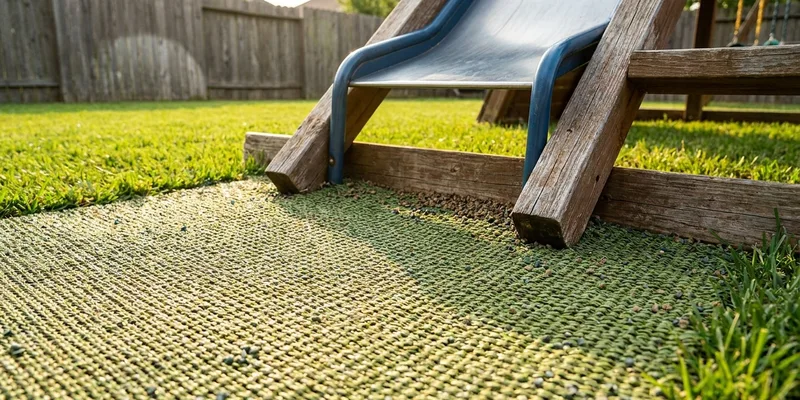
Artificial turf for play area installations solve a real problem: a patch of yard that never grows grass, turns to mud after rain and gets churned up by the same six feet every afternoon. Turf ends the mud and the mowing. What it does not do, on its own, is protect a child falling off a climbing frame, and that is the single most misunderstood thing about it.
This guide covers what turf can and cannot do as a play surface, what a shock pad adds and why the CPSC approach to unitary surfacing depends on it, what to check on a listing, and the components a DIY installation actually needs.
This article contains affiliate links. If you buy through them, we may earn a commission at no extra cost to you. Learn more.
Quick Answer
Is artificial turf a good surface for a backyard play area?
- For open play, running around and general yard use, yes. It ends the mud, needs no mowing and holds up to constant traffic that kills real grass.
- Under climbing equipment it is only a safety surface when it is installed over a shock pad, and the manufacturer states a critical height for that system.
- The CPSC Public Playground Safety Handbook treats manufactured surfacing as a system whose critical height comes from impact testing under ASTM F1292. A turf listing with no tested critical height is telling you it is landscaping, not fall protection.
- Turf runs hot in direct sun, so shade over the area matters, and the base and drainage under it matter more than the pile height on the spec sheet.
What to Check Before You Buy Turf
Most of what determines whether a turf play area works is checkable before anything ships. Drainage, backing, pile and infill are on the listing. The critical height, if the product is meant to sit under equipment, comes from the manufacturer’s test data rather than from the marketing copy.
| What to check | Why it matters | What to look for |
|---|---|---|
| Tested critical height | Turf alone is not fall protection; the system with a pad is what gets rated | A stated critical height from impact testing under ASTM F1292, quoted for a named pad thickness |
| Drainage holes in the backing | Without them, water sits on the surface and under it | A perforated backing with a stated drainage rate, not a solid membrane |
| Pile height and density | Density decides how the turf holds up under repeated traffic | A denser face weight rather than the longest pile; long thin blades flatten fastest in play zones |
| UV stability | Cheap turf fades and goes brittle in a couple of summers | A stated UV stabilization treatment and a meaningful warranty period |
| Infill type | Infill keeps blades upright and adds ballast | Rounded silica sand for most residential play areas; check what the manufacturer specifies |
| Lead and material claims | Worth confirming rather than assuming on a children’s surface | A lead free statement and any certification the manufacturer names on the spec sheet |
| Seam and edge system | Lifted edges and open seams are the top DIY failure | Seam tape with adhesive, plus enough turf nails or staples for the perimeter and seams |
If the play area is going under a climbing structure, read this alongside our guide to how deep playground surfacing should be, since the two approaches solve the same problem differently.
Turf Alone Is Not Fall Protection
A turf carpet over a compacted base is a firm surface. It looks soft and it feels soft against a bare knee, but the energy of a fall goes almost straight through it into the ground below. What creates fall protection is a shock pad, a foam layer laid under the turf, and the rating belongs to the combination rather than to either part.
That is why the CPSC handbook’s approach to manufactured surfacing centers on a critical height established by impact testing under ASTM F1292. For loose fill, the handbook publishes a depth table. For a turf and pad system, the equivalent number comes from the manufacturer, tested at a stated pad thickness. If nobody will give you that number, the product is a landscaping surface.
How to use that when you are shopping
Decide first whether this area sits under equipment or beside it. An open lawn replacement, a toddler play space with nothing to fall from, or the ground around a sandbox needs no rating at all. The moment there is a climbing frame or a swing beam involved, the pad and its tested critical height stop being optional extras and become the whole specification.
Our Picks by Situation
How we chose: we compared widely available residential turf products and installation components on drainage, backing and density claims, UV stabilization, and the problems owners report after a season or two outdoors. Selections lean on manufacturer specifications and recurring themes in customer reviews rather than any hands-on trial of our own.
🏆 Best Overall
A dense, UV stabilized turf roll with a perforated drainage backing, sold specifically for play and pet areas rather than as decorative lawn. Density matters more than pile length where the same feet run every day.

🛡️ The Part That Adds Safety
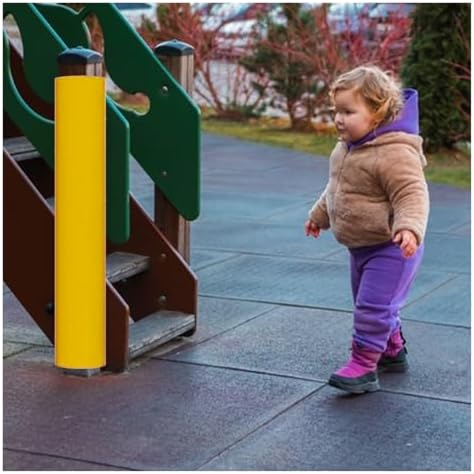
A playground shock pad or foam underlayment, laid under the turf. This is what turns a firm carpet into a system with a tested critical height, and it is not optional under climbing equipment.
📌 Anchoring
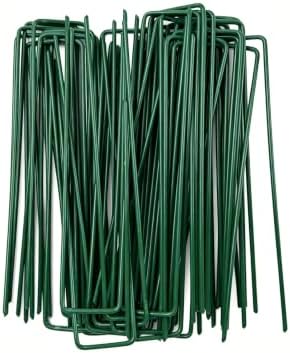
Turf nails or landscape staples in sufficient quantity for the perimeter and every seam. Lifted edges are the most common DIY complaint and almost always come down to under-fastening.
The Finishing Components
Two more items decide whether the finished area looks installed or looks improvised. Seams are the giveaway, and infill is what keeps the blades standing up instead of matting flat in the traffic lanes within a season.
🧵 Best for Seams
Turf seam tape with the matching adhesive, so joins between rolls stay closed and flat rather than opening into a trip edge.

⚖️ Best for Blade Support
Rounded silica sand infill, brushed in to weigh the turf down and hold the blades upright where the play traffic is heaviest.

Installing Turf in a Play Area
The base is the job. Excavate, grade the area so water runs away from the house, lay and compact a permeable aggregate base, then add the shock pad if the area sits under equipment, then the turf. Every failure people report later, standing water, dips, waves in the surface, traces back to a base that was rushed.
Lay the turf with all rolls running the same direction so the blades catch light identically, let it relax in the sun before you cut and fasten, then tape and glue the seams, fasten the perimeter, and brush in the infill. Take the time to plan around obstacles and equipment legs before cutting, because turf does not forgive a short cut the way sod does.
Common Mistakes to Avoid
- Treating turf as fall protection on its own. Without a shock pad and a tested critical height, it is a surface, not a safety system.
- Buying turf with a solid backing. Perforated drainage backing is what stops water sitting in the play area after rain.
- Chasing the longest pile. Density holds up to traffic; long thin blades mat down in the paths children actually walk.
- Skipping the compacted base. Dips and waves appear in the first season and cannot be fixed from the top.
- Under-fastening the perimeter and seams. Lifted edges are the most reported DIY problem and the easiest to prevent.
- Forgetting about heat. Synthetic surfaces run hotter than grass in direct sun, so plan shade over the area if it faces full afternoon exposure.
Frequently Asked Questions
Is artificial turf safe for a kids play area? For open play it works well and removes the mud problem entirely. Under climbing equipment it only counts as a safety surface when it is installed over a shock pad and the manufacturer states a critical height from impact testing.
Does artificial turf need a shock pad under a swing set? Yes, if you want the area to function as fall protection. CPSC guidance treats manufactured surfacing as a tested system under ASTM F1292, and the pad is what produces the rated critical height.
Does artificial turf get hot? Synthetic surfaces run hotter than natural grass in direct sun, which is the most common owner complaint in warm states. Shade over the play area is the practical answer.
Does artificial turf drain after rain? A perforated backing over a compacted permeable base drains well. Turf with a solid backing, or turf laid on unprepared clay, will hold water regardless of what the product page claims.
Can you install artificial turf yourself? Yes, and plenty of families do. The work is in the base preparation and the seams rather than the turf itself, and those two stages are where DIY installations most often go wrong.
Do you need infill on residential turf? Most manufacturers specify it. Infill weighs the turf down and keeps the blades upright, and skipping it is why some installations look matted flat after one season.
How long does artificial turf last in a play area? UV stabilized products backed by a meaningful warranty hold up for years under residential use, while cheap unstabilized turf fades and goes brittle much sooner. The warranty period is the most useful signal on the listing.
The Bottom Line
Artificial turf is an excellent fix for a muddy, worn out play area and a poor substitute for real fall protection on its own. If the space sits under climbing equipment, buy a shock pad and insist on a critical height the manufacturer has tested under ASTM F1292. If it is open play space, focus on drainage backing, density, UV stability and a properly compacted base, then fasten the perimeter and seams properly and brush in the infill.