Last updated: August 18, 2026
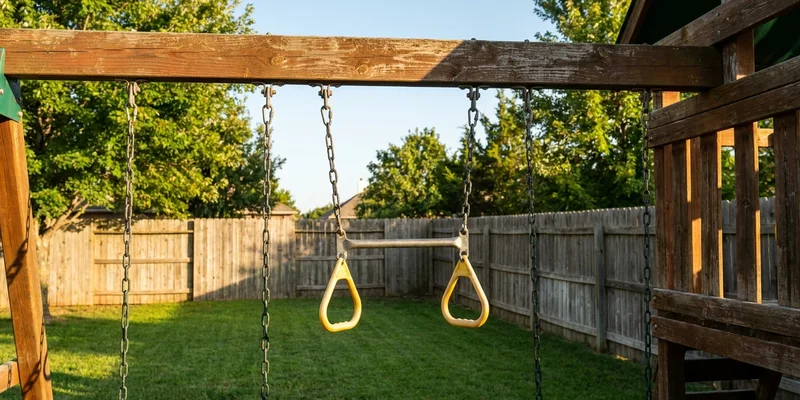
A trapeze bar for a swing set turns a spare hanger position on the beam into upper body equipment, and it is usually bought for the child who has lost interest in sitting on a belt seat. It hangs like a swing and is used like a pull up bar with momentum, which is a different job for the same frame.
Three things decide whether it works: which combination of bar and rings suits your child, whether the beam has a free position with clear space, and whether the hardware in the box matches your set. This guide covers all three, plus what the CPSC Public Playground Safety Handbook says about grip diameter, age and clear space.
This article contains affiliate links. If you buy through them, we may earn a commission at no extra cost to you. Learn more.
Quick Answer
What should you look for in a trapeze bar for a swing set?
- Buy for the hanger position you actually have free. A trapeze wants an end position on the beam with clear space in front of it, behind it and beside it.
- Choose between a plain bar, a bar with rings on either side, and separate gymnastic rings. The combination bar covers the widest age range on one hanger pair.
- Check the grip. The CPSC Public Playground Safety Handbook caps components intended to be grasped at 1.55 inches (39 mm) in diameter, because a bar a child cannot close a hand around cannot be held reliably.
- Adjustable chains or ropes matter more than the bar does, since a trapeze is only usable at a height the child can reach and drop from.
- The handbook treats hanging bars as upper body equipment and notes that four year olds are generally the youngest children able to use that kind of equipment.
What to Check Before You Buy a Trapeze Bar
Every line in the table below can be settled from the product listing or with a tape measure at your own beam, before anything is ordered. Most disappointment with a trapeze bar traces back to the beam or the hardware rather than to the bar itself.
| What to check | Why it matters | What to look for |
|---|---|---|
| Free hanger position | A trapeze needs two hangers at its own spacing, not one belt swing hanger | An unused pair of hangers at the end of the beam, or room to add a pair at the spacing the bar lists |
| Chain or rope adjustment | Bar height decides whether a child can start and stop under their own control | Adjustable links, a rope with a stated length range, or a chain long enough to shorten later |
| Grip diameter and coating | Small hands lose a thick or slick bar exactly when the load peaks | A stated bar diameter within the handbook’s 1.55 inch (39 mm) cap, with a textured or coated surface |
| Rings, bar, or both | Rings suit hanging and turning, the bar suits swinging and pulling | A combination model if two children of different ages will share it |
| Stated weight capacity | Older children swinging by the arms load a beam differently from a seated rider | A capacity stated by the manufacturer, checked against the limit for your own set |
If the beam already carries two belt seats and a slide tower, the honest answer may be that there is no clear position left. Adding a trapeze in a middle bay puts a swinging child within reach of the seat next to it.
Trapeze Bar, Rings, or Both
A plain trapeze bar is a horizontal bar on two chains, used for hanging, swinging by the arms and knee hangs. Rings hang on separate straps or chains and rotate freely, which suits hanging, turning and gymnastic play. The combination model puts small rings on the outside of a bar, so one hanger pair covers both.
For a single child, the combination bar is usually the better buy, because interest moves from one to the other as strength develops. For two children a few years apart, separate rings hung alongside the bar avoid the argument about whose turn it is.
When separate rings make more sense
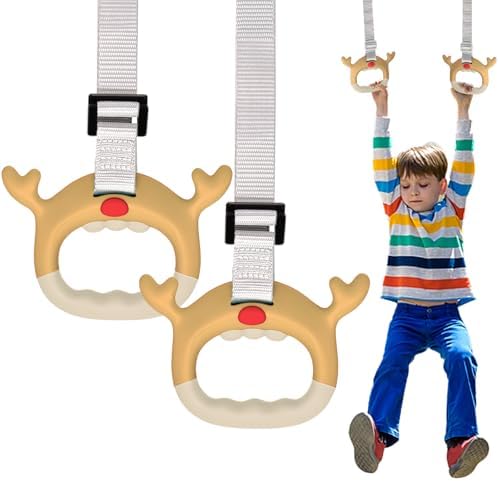
Rings on adjustable straps can be dropped low for a younger child and raised again in a minute, which a fixed chain trapeze cannot match. They also fold away over winter without unbolting anything. The trade off is that rings move under load in a way beginners find harder than a fixed bar, so a child new to hanging generally gets further with the bar first.

Height, Hardware and Clear Space
Set the bar so your child can reach it with a small jump and get down without dropping from full extension. That is the practical rule, and it matters more than any figure on the box, because a bar hung at adult reach is one a child can neither start nor stop safely.
Hardware is the second half of the job. A trapeze puts cyclic load into the hangers, which is what works open S hooks apart. Fit closed connectors, and check the beam around the hanger bolts for splits before you hang anything new.
What the handbook says about the space
The CPSC Public Playground Safety Handbook describes the use zone in front of and behind a swing as extending twice the height of the pivot point measured from the ground, with 6 feet (1.8 m) to the sides of the supporting structure. Those figures are written for public playgrounds, but a trapeze swings further than a belt seat does once a child gets going, so they are a sensible planning baseline at home. Our guide to the swing set safety zone works that out on a normal lot.
Our Top Picks at a Glance
How we chose: we compared widely available trapeze bars on stated grip diameter, whether the chains or ropes adjust, what hardware is included, and how clearly the manufacturer states a weight capacity. Selections rely on manufacturer specifications and recurring themes in customer reviews rather than any hands-on trial of our own.
🏆 Best Overall
A trapeze bar with rings on coated chains, adjustable in length, which is the configuration that stays useful longest on a residential beam.
💪 Best for Older Kids
A steel bar on heavier chain with a clearly stated capacity, for children past the age where a light plastic coated bar flexes under them.

🔁 Best Adjustable Option
Rings or a bar on adjustable straps, so the height moves with the child instead of being fixed by chain links.
Picks by Situation: Getting It Onto the Beam
Two situations come up repeatedly: a beam with no free hanger position, which means adding hangers rather than buying longer chain, and a trapeze that arrives with open S hooks.
🔩 Best for a Secure Hang
A pair of rated swing hangers with through bolts, plus closed connectors to replace any open hooks, so the new bar goes up on fresh hardware rather than whatever was left over.

Common Mistakes to Avoid
- Hanging the trapeze in a middle bay. An arm swinging child covers more ground than a seated one and will reach the seat next door.
- Setting it at adult reach. A bar a child needs lifting to reach is one they can only leave by dropping.
- Reusing tired hangers. Elongated bolt holes and rust are already at their limit before you add a new kind of load.
- Ignoring the bar diameter. Thick steel tube feels solid in an adult hand and can sit above what a small hand can close around.
- Forgetting the surfacing. Hanging by the arms means falls land flat, and the protective surfacing under the beam is what absorbs them.
Frequently Asked Questions
What is a trapeze bar on a swing set? It is a horizontal bar hung on two chains or ropes from the swing beam, used for hanging, arm swinging and knee hangs rather than for sitting. Many versions add small rings on either side of the bar.
What age is a trapeze bar for? The CPSC Public Playground Safety Handbook notes that four year olds are generally the youngest children able to use upper body equipment, and a trapeze is upper body equipment. Beyond that, readiness comes down to whether a child can hang unsupported and lower themselves under control.
How high should a trapeze bar hang? At a height where your child can reach it with a small jump and let go without dropping from full stretch. Adjustable chains or straps are worth paying attention to, because the right height changes as the child grows.
Can I add a trapeze bar to an existing swing set? Usually yes, provided there is a free hanger position with clear space around it and the beam and hangers are sound. Check the manufacturer’s stated capacity for your set before adding another user position.
What diameter should the bar be? The CPSC Public Playground Safety Handbook caps components intended to be grasped at 1.55 inches (39 mm) in diameter, because a bar a child cannot close a hand around cannot be gripped reliably. Check the stated diameter rather than assuming.
How much clear space does a trapeze need? Treat it like a swing. The handbook’s guidance is a use zone extending twice the pivot height in front and behind, with 6 feet (1.8 m) to the sides of the structure, which is a sound baseline for a home beam.
The Bottom Line
A trapeze bar is one of the better value upgrades to a swing beam, provided you have an end position free and the hardware to hang it properly. Choose a combination bar with rings for the widest age range, check the stated grip diameter against the handbook’s 1.55 inch cap, hang it at a height your child can reach and leave under control, and keep the arc clear.