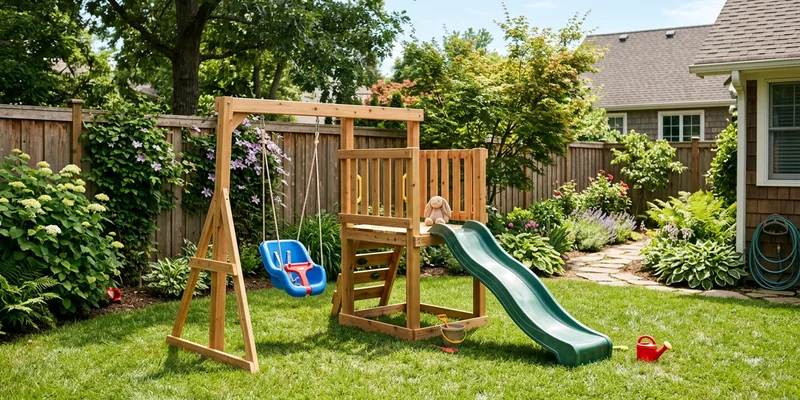
Last updated: August 18, 2026
Buying a playset for toddlers means buying for a user who cannot yet judge height, cannot catch themselves reliably, and will be a different size in eighteen months. That combination pushes the decision toward low decks, short slides and enclosed platforms, and away from the scaled down version of an older child’s fort.
This guide covers what to look for at toddler scale, how plastic climbers compare with small wooden towers, the openings and edges worth checking before you assemble, and how to buy something that does not become landfill the moment your child turns five. Everything here comes from published safety guidance and manufacturer specifications, not from testing of our own.
This article contains affiliate links. If you buy through them, we may earn a commission at no extra cost to you. Learn more.
Quick Answer
What kind of playset suits a toddler?
- A low, molded plastic climber with a short slide and an enclosed platform is the honest answer for most families with a child under three. It is the right scale, it needs no finishing, and it can be moved.
- Match the equipment to the age band rather than the child’s confidence. The CPSC Public Playground Safety Handbook makes separate recommendations for children aged 6 to 23 months, 2 to 5 years, and 5 to 12 years.
- Check openings before assembly. The handbook identifies openings between 3.5 inches (89 mm) and 9 inches (229 mm) as a head entrapment hazard, and railings and platform gaps are where that range shows up.
- Full bucket seats are the swing type the handbook recommends for children under 4 years of age, and it advises hanging them from a separate structure or at least a separate bay.
- Surfacing still applies at toddler height. CPSC guidance is that home playground equipment should not be installed over concrete, asphalt or other hard surfaces.
Toddler Playset Types Compared
Four formats dominate the toddler end of the market, and they differ more in longevity and siting than in play value. This table sums up how each behaves for a household with a child roughly one to four years old.
| Type | Suits | Space and siting | Watch out for |
|---|---|---|---|
| Molded plastic climber with slide | Early walkers through preschool | Small footprint, movable, works on a patio with soft surfacing | Outgrown fastest; check the stated age and weight range |
| Small wooden tower with short slide | Toddlers into early school age | Fixed position, needs level ground and anchoring | Needs sealing like any cedar set; deck height rises quickly by model |
| Toddler swing frame | Bucket seat age, roughly under 4 | Narrow frame but a long clear swing corridor | The corridor, not the frame, is what rules a small yard out |
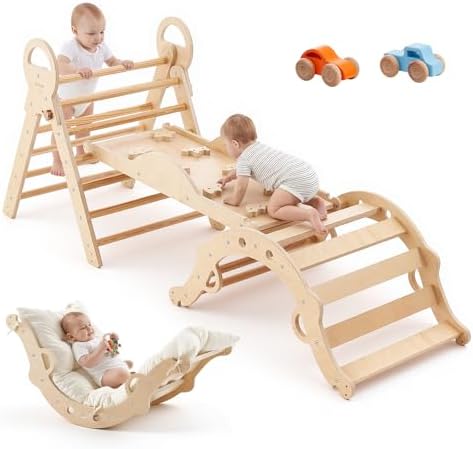
| Climbing arch or ramp set | Crawlers through preschool, indoors and out | Portable, stores flat, no fixed installation | Needs a soft surface under it and adult supervision at height |
Most families end up with two of these rather than one, because a climber and a swing seat cover different play at this age and neither replaces the other.
What to Check Before You Assemble
Three checks catch most of what goes wrong at toddler scale: the size of any opening a child could put their body through, the height of the highest standing surface, and whether the platform has a barrier rather than just a railing. All three are things you can verify with a tape measure once the box is open.
The opening check is the one people skip. The CPSC Public Playground Safety Handbook identifies openings between 3.5 inches (89 mm) and 9 inches (229 mm) as a head entrapment hazard, because a small child can pass their body through a gap in that range but not their head. On a toddler playset that range shows up in railing spacing, window cutouts and the gap under a raised deck.
Height and Barriers
Deck height matters more than total structure height, because the deck is where a toddler stands. A platform with an open side needs a barrier the child cannot climb through or over, not a decorative rail, and that is visible in the product photos if you look at the platform rather than the roof.
Fall height, the distance from the highest standing surface to the ground, is what the surfacing underneath has to handle. Note it down before you decide what goes under the set.
Our Top Picks for Toddlers
How we chose: we compared widely available toddler scale equipment on stated age and weight ranges, deck height, enclosure of the platform, and how consistently owners report stable footing on grass. Selections rest on manufacturer specifications and recurring review themes rather than any hands-on trial of our own.
🏆 Best Overall
A molded plastic toddler climber with a short slide and an enclosed platform, the format that fits the age band without needing finishing, anchoring or a permanent spot in the yard.

🛝 Best Slide Only
A freestanding toddler slide with wide steps and side rails, for families who want the slide without committing the space a full structure needs.

🧗 Best for Climbing
A wooden climbing arch and ramp set, which suits crawlers through preschoolers, moves indoors when the weather turns, and stays useful longer than most molded equipment.
Add a swing seat separately rather than buying a structure for it. Our guide to the outdoor toddler swing covers seat types and the fastenings to look for.
Picks by Situation: Two Ages and Small Spaces
Two situations come up constantly. The first is a household with a toddler and an older sibling, where a single structure has to work for both. The second is a small yard or a deck, where a fixed structure is not realistic and the equipment has to come and go.
👧 Best With an Older Sibling
A full bucket seat that hangs from an existing beam, so the toddler gets the seat type the handbook points to for children under 4 while the older child keeps the set they already use.

🏡 Best for a Deck or Small Yard
A compact activity gym with a slide and a low platform, light enough to move for mowing and small enough that the clear space around it is achievable.

Where to Put It, and What Goes Underneath
Site a toddler playset where an adult can see it from wherever they usually stand, because supervision is the real safety feature at this age. After that, the CPSC Outdoor Home Playground Safety Handbook advises locating equipment at least 6 feet (1.8 m) from any structure or obstacle such as a house, fence, shed, tree or pole, with more clearance to the front and rear of swings.
Surfacing is not a formality just because the deck is low. CPSC guidance is direct that home playground equipment should not be installed over concrete, asphalt or any other hard surface, and that grass by itself does not count as protective surfacing. Our surfacing depth guide explains how the required depth follows the fall height of the specific set.
Anchoring a Light Structure
Plastic climbers are light, which is exactly why they move. A toddler pulling on the edge of a platform can shift an unanchored unit, so use the anchor points the manufacturer provides. CPSC guidance advises anchoring equipment securely with anchoring devices installed below ground level, which also keeps hardware out of the area where children land.
Buying Something That Lasts Past Age Four
The most common regret at this end of the market is buying a structure that fits perfectly for one summer. Two things extend the useful life: equipment that spans age bands, such as a climbing arch, and structures whose accessories can be swapped as the child grows.
The alternative is to accept the short life and choose something that resells or hands down easily. A molded climber in good condition moves on quickly; a small wooden tower bolted to the ground does not.
Common Mistakes to Avoid
- Buying an older child’s set and assuming a toddler will grow into it. The age bands exist because the equipment is specified differently.
- Ignoring railing and platform gaps. The 3.5 to 9 inch range is a published entrapment hazard, and it is easy to check with a tape.
- Putting a climber on a patio because it is level. A hard surface under play equipment is exactly what the CPSC guidance rules out.
- Hanging a bucket seat next to a belt swing on the same bay. The handbook advises a separate structure or at least a separate bay.
- Skipping anchors on a plastic unit. Light structures are the ones that move under a toddler pulling themselves up.
Frequently Asked Questions
What age is a toddler playset for? Follow the manufacturer’s stated age range for the specific model, which is usually somewhere between one and five years. As a cross check, the CPSC Public Playground Safety Handbook makes separate recommendations for children aged 6 to 23 months, 2 to 5 years, and 5 to 12 years.
Is a plastic or wooden playset better for a toddler? Plastic suits the age better in most yards: it is the right scale, needs no sealing, and can be moved. Wood lasts longer and grows with the child, but it needs level ground, anchoring and an annual finish to stay sound.
Do toddler playsets need to be anchored? Yes, including the light ones. CPSC guidance advises anchoring equipment securely with anchoring devices installed below ground level, and a light structure is the one most likely to shift when a child pulls on the edge.
What swing seat should a toddler use? The CPSC Public Playground Safety Handbook describes full bucket seats as recommended for children under 4 years of age. For the lower limit, use the minimum age and weight the seat manufacturer states, since those figures vary between products.
Can a toddler playset go on a deck or patio? Not on the bare surface. CPSC guidance rules out installing home playground equipment over concrete, asphalt or other hard surfaces, so a patio needs a tested surfacing system rather than a mat pulled from the garage.
The Bottom Line
For most families with a child under three, a low molded climber with a short slide and an enclosed platform is the right buy, with a full bucket seat hung separately for swinging. Check the openings and the platform barrier with a tape before you assemble, anchor even the light units, and put real surfacing under the fall height rather than trusting the lawn or the patio.