Last updated: August 18, 2026
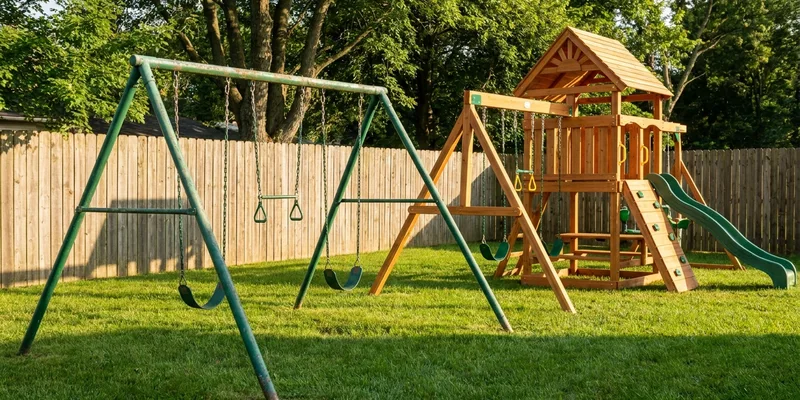
The metal vs wooden swing set question is usually framed as a looks question, and it is not. It is a question about how many Saturdays you are willing to spend on the thing after it is built, because the two materials fail in completely different ways and they ask for completely different upkeep.
This comparison works through service life, the maintenance each material requires to keep its warranty intact, what the manufacturers actually publish, and which household each one suits. Nothing here rests on a hands-on trial of our own; it rests on published warranty documents, CPSC guidance and what the two materials do outdoors.
This article contains affiliate links. If you buy through them, we may earn a commission at no extra cost to you. Learn more.
Quick Answer
Should you buy a metal or a wooden swing set?
- Buy metal if you want a swing frame that needs almost nothing from you. Powder coated steel sets are sold on the promise of no sanding, painting or staining, and the play value is swings plus a trapeze rather than a fort.
- Buy wood if you want a structure with a deck, a slide and a clubhouse that a child grows into, and you accept an annual seal or stain job as part of ownership.
- The wood warranties make that job non optional. Backyard Discovery and KidKraft both publish a five year wood term and both state that failure to maintain the product can void coverage.
- Both materials need the same two things underneath: level ground and anchors installed below ground level, which CPSC guidance calls for regardless of what the frame is made of.
Metal and Wood Compared on the Points That Decide It
Five things separate the two materials in practice: what wears out first, what you have to do each year, how much play the structure offers, how heavy it is to move, and what the manufacturer promises in writing. The table sums up how each material behaves on those points.
| Point | Metal frame | Wooden set | What it means for you |
|---|---|---|---|
| Annual upkeep | Marketed as no sanding, painting or staining; inspect coating and hardware | Seal or stain on the schedule in the manual, plus hardware checks | Wood costs a weekend a year, metal costs an inspection |
| What fails first | Coating at scratches and ground contact, then chains and seats | Soft parts: canopy, slide, seats and ropes weather before the timber | Neither material is what you replace first |
| Play value | Swings, trapeze, rings; no deck or clubhouse | Deck, slide, clubhouse, monkey bars, sandbox on larger models | Wood buys imaginative play, metal buys swinging |
| Published warranty | 5 years on the Backyard Discovery Big Brutus metal A-frame | 1 year on all parts plus a 5 year wood term at both cedar brands | Check whether the wood term is pro rated |
| Moving it later | Two adults can walk it a short distance once unanchored | Effectively permanent; disassembly stresses the joints | Renters and short stays lean metal |
Warranty terms above come from each manufacturer’s published documentation and can change, so read the current warranty for the specific model before you buy.
How Long Each One Actually Lasts
Neither material has a fixed lifespan, and the honest answer is that both outlast the children if the owner keeps up with them and neither does if the owner does not. Wood dies from rot at ground contact and from a finish that was never renewed. Metal dies from rust that starts at a scratch or at the point where a leg meets wet soil.
That is why the published wood warranties attach maintenance conditions rather than promising a service life, a point the warranty section below returns to.
Where Each Material Gives Up
On a wooden set, ground contact is the weak point. Posts that sit in a puddle after every storm rot from the bottom regardless of the species, which is why anchoring and drainage do more for service life than the timber grade does. On a metal frame, the weak point is the same place for a different reason: the leg sits in damp soil, the powder coat gives up, and rust works upward out of sight.
Cedar, the species most residential wooden sets are built from, resists rot, decay and insect damage better than untreated softwood. That is a head start, not immunity.
The Maintenance Each One Asks For
Metal asks for an inspection and a touch up. Wood asks for a cleaning, a dry day and a coat of exterior sealer or stain, on the schedule the manual states. That difference is the biggest practical gap between the two, and the one most buyers underestimate at the point of purchase.
Manufacturers of powder coated steel sets lean on this directly, selling the finish as weather and rust resistant and stating that no sanding, painting or staining is required. What metal still needs is a walk around: chains and S-hooks wear, seat straps crack, and a deep scratch in the coating is an invitation to rust.
The Wood Job, Realistically
Sealing a wooden set is a day’s work on a mid size model, most of it spent cutting in around brackets rather than on the open faces. Skip it for a few seasons and you get grey, splintering timber and a claim the manufacturer can decline. Our guide to staining and sealing a swing set covers the sequence and the finishes that suit cedar.
🪵 For the wooden set
An exterior sealer or stain suitable for cedar, applied on the schedule in your manual, is the condition both major brands attach to their wood coverage.

⚓ For either material
Ground anchors, which CPSC guidance says should be installed below ground level, are sold separately for almost every set of either type.

What the Warranties Tell You
Warranty documents are the most useful published comparison available, because they are the manufacturer committing in writing rather than a marketing page. Read three things in each one: the length, whether the wood term is pro rated, and what the owner has to do to keep it valid.
On the wooden side, Backyard Discovery publishes one year on all parts including wood, hardware and accessories, plus a five year pro rated wood warranty against rot and decay. KidKraft publishes one year on all parts and a five year wood warranty against rot, decay and insect damage. Both are tied to the original owner and both name maintenance as a condition.
The Metal Side Is Less Uniform
Metal swing sets do not share one industry pattern the way the cedar brands do. Backyard Discovery lists a five year warranty on its Big Brutus heavy duty metal A-frame and states that the set is built to meet or exceed ASTM F1148, the consumer home playground equipment standard. Other steel frames publish shorter terms, so read this per model rather than treating it as a material wide rule.
Space, Play Value and Who Each Suits
A metal A-frame is the more space efficient structure of the two, because it has no deck, no tower and no fixed slide competing for square footage. A wooden set trades that footprint for play value: a clubhouse, a slide exit, a sandbox under the deck, and features a child keeps discovering as they grow.
Neither escapes the use zone. The CPSC Outdoor Home Playground Safety Handbook advises extending surfacing at least 6 feet (1.8 m) from equipment in all directions, and further to the front and rear of swings: a distance equal to twice the height of the top bar from which the swing is suspended. In a tight yard that rule decides more than the material does, as our small yard swing set guide works through.
Choosing by Household, Not by Taste
Renters, short stays and families who want swinging and nothing else are better served by metal, which comes down and moves. Owners with a yard they intend to keep, siblings at different ages, and the patience for an annual coat are better served by wood, which is the only one of the two that grows into a clubhouse.
Whichever you pick, anchoring and surfacing are separate purchases. CPSC guidance is direct that home playground equipment should not be installed over concrete, asphalt or other hard surfaces, and our anchor kit guide covers the options for grass, slope and existing slabs.
Common Mistakes to Avoid
- Treating the material choice as the durability decision. Ground contact, drainage and annual upkeep decide service life on both.
- Buying wood without budgeting the annual job. Both major cedar brands make maintenance a condition of the wood warranty.
- Assuming metal means maintenance free. The finish is low maintenance; chains, seats and scratched coating are not.
- Comparing warranty headlines without reading whether the wood term is pro rated. A pro rated year five is not a replacement.
- Skipping anchors because the wooden set feels heavy enough. Mass is not anchoring, and the guidance does not distinguish by material.
Frequently Asked Questions
Which lasts longer, a metal or a wooden swing set? Both fail at ground contact first, and both outlast the children when the owner keeps up. Wood needs its finish renewed to resist rot, and metal needs its powder coat intact to resist rust. Maintenance separates them more reliably than material does.
Do wooden swing sets really need to be sealed every year? Follow the schedule in your own manual rather than a general rule. Backyard Discovery and KidKraft both state that failure to maintain the product according to the maintenance requirements may void the warranty, which makes the schedule in the manual the number that counts.
Are metal swing sets safe for older kids? Judge that on the manufacturer’s stated age range and weight rating for the specific model rather than the material. Heavy gauge steel A-frames are sold for older children, while lightweight frames are not, and the published rating is the only reliable guide.
Does a metal swing set need anchoring? Yes, and more urgently than a wooden set, because a light frame walks and lifts under a hard swing. CPSC guidance advises anchoring equipment securely with anchoring devices installed below ground level.
Can you put either type on grass? Grass alone is not protective surfacing. CPSC guidance is clear that home playground equipment should not be installed over hard surfaces, and packed earth under a swing arc becomes one within a season, so plan loose fill under the landing zones.
The Bottom Line
Choose metal if you want swinging with almost no upkeep and the option to move the frame later. Choose wood if you want a structure with a deck and a clubhouse and you will genuinely do the annual seal, because both major cedar brands make that maintenance a warranty condition. Then spend the same care on what goes underneath, since level ground, below grade anchors and real surfacing outlast the material argument entirely.